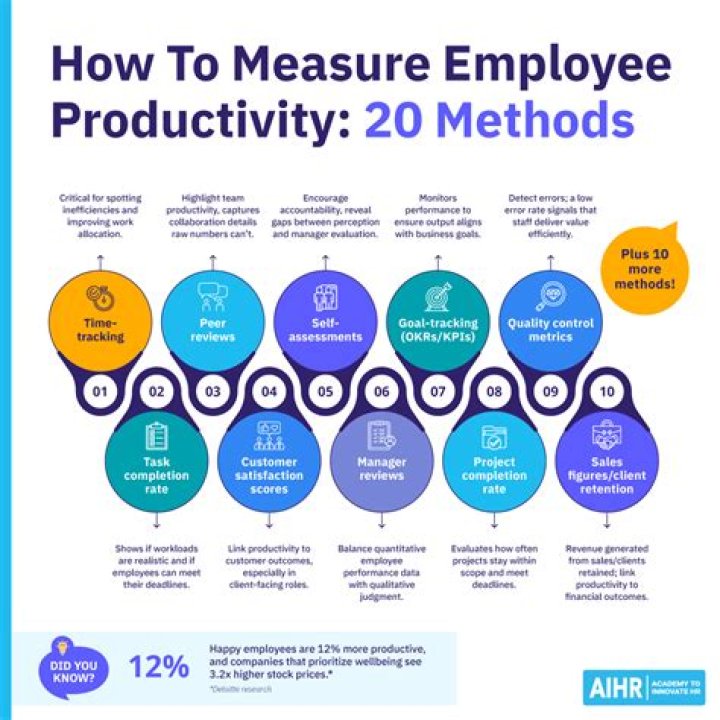
What is productivity? You have a team of limited resources and how they work to achieve the end product of your business can be called productivity. Now, with these limited resources you must find the best ways to measure your team productivity. Functions like tech, human resources, administration, sales, marketing, finance, and others are there to help you achieve your business goals. These functions need to be highly productive in order to help the business with its numbers at any given point in time.
Ideally speaking, productivity can be measured by taking the number of end products produced by all the functions and then divide it by the inputs. Multiply what you get by 100% and that’s the rate of productivity of your team. It does sound easy but with current workplaces, it’s very hard to find the best ways to measure your team productivity.
Productivity should be kept track of so your employees are on their toes. Keep them wanting to contribute more and work more efficiently. Working overtime and working on weekends is not needed at all if your team can work efficiently during a workweek. Find the best ways to measure your team productivity so all of you can benefit from it.
1. All round feedback
One of the best ways to measure your team productivity is for them to receive 360-degree feedback from time to time. Not receiving feedback is like your team functioning without fuel. Feedback shouldn’t wait to be given during annual appraisals. Once a month or quarterly feedback is a great timeline for your team to receive feedback.
This helps them understand where they might be going wrong. When you’re doing the same kind of work day in and day out, you may oversee a few things and it becomes hard to apply yourself. But with regular feedback, it gives you some perspective.
Feedback should also come from colleagues and not only from the reporting manager. Sometimes things like attitude and punctuality are what might set someone in the team a little back. Colleagues must be able to give one another written or verbal feedback so everyone is on the same page.
2. Measuring sales productivity accurately
It’s not just enough for the sales team to go out and sell your products and services. They need to be highly productive because they are the ones bringing in the revenue. Make detailed notes about the number of units sold by each team member in a specific timeline, total revenue brought in by each salesperson, number of new customers gained, number of old customers retained, and so on. These numbers are an absolute and for sales, one of the best ways to measure your team productivity.
With sales, you should keep in mind of the sales people’s expenses. So, if a salesperson makes a certain amount worth of sales but his or her expenses, it’s no good. A good sales person is one who spends the least amount of the company’s money and brings in more revenue.
3. Measuring productivity in services
Unlike sales of a product, measuring the ‘sales’ of a service is much more difficult and tricky. But with service, you can find some of the best ways to measure your team productivity and have them push the sales of your services. You can track the time taken by a team member to serve a customer. Then there is the retention of the customer.
Measure how many customers each team member has retained. Track customer complaints because those reflect on your team’s performance and productivity. Every few weeks give your team a refresher training session so they can be on top of their game. It’s easy to take one’s daily routine for granted and that’s when productivity takes a hit. Every now and then give your team a surprise visit and test their knowledge of service.
4. Measuring tasks and not time
While talking about the best ways to measure your team productivity, we often forget to take into consideration the task at hand and not the time taken to complete it. Certain tasks help increase productivity for the entire team and lies on a handful of people.
Let them complete the task without any errors without their managers breathing down their necks. It’s not to say that all work shouldn’t have deadlines, but there are tasks in the human resources function or finance function that may require time and not deadlines.
5. Setting expectations right
Your organization may strive to find the best ways to measure your team productivity. But if expectation settings aren’t done correctly from the top down, you will not get the desired results. Each manager is responsible for his or her team.
In such cases, it is on them to identify the talent levels of each team member and set their expectations from the team accordingly. Each individual has something different to contribute and as a manager, they must be able to recognize these talents and put the team to work to benefit the organization as a whole.
6. Using online tools to manage tasks
There are some jobs that require tedious tasks that take up time, effort, and resources that can be put to better use. The recruitment team, for instance, can use software or online tools that can help upload candidates’ resumes directly into the system so they can search them with just a keyword.
Imagine the time they would otherwise need to browse through hundreds of resumes. Similarly, the same kind of tools can be used for admin, human resources, finance, and other functions to make them more productive. This surely is one of the best ways to measure your team productivity.
No matter what the nature of a business or organization is, tracking performance and measuring productivity is very important. That is not only for the business owners or senior management members but also for employees so they become better at what they’re already doing. Their learning curve must become sharper so they can contribute in a more effective way to the organization.
Motivation is the driving force behind productivity. It’s what makes your employees get up in the morning, go to the office and start churning out products or serving your clients with a smile on their face.
And while the relationship between employee output and motivation is evident, knowing how to encourage staff to be more prolific is a difficult thing to do.
To help, here are a few ways you can motivate members of your team and drive their productivity forward.
1. Measure Current Performance
When setting your company on the path of increasing productivity, it is important to create a plan.
To do so successfully, you will need to measure and evaluate the current production rate. It will serve as a baseline to check if the strategies you implement are improving the rate at which work is completed.
One of the best ways to calculate employee output is based on speed and quality. Use a state-of-the-art project management tool to evaluate both elements. You will be able to time track work completion and see what it takes to produce quality products and services.
Additionally, you can measure productivity at both an individual and team level for greater insight into the current state of things.
After that, you have a starting point to begin implementing strategies to motivate your employees.
2. Focus on Company Culture When On-boarding
Cultural fit is among the most important things to look for in a new hire. If the employees fit the company culture better, they are much more proactive at the job and faster at connecting with their team and their work.
A strong cultural fit also contributes to a stronger company-employee bond. This can protect the company from expenses associated with turnover and regular and unforeseen recruitment costs.
3. Reward Employees
Rewarding workers is one of the best ways to show appreciation and improve job satisfaction.
It might be a good idea to think about giving your team extra incentives to increase loyalty and morale:
- A personalized Prepaid Visa card that lets employees get their own incentive
- Monthly gym membership subscription which supports their self-care
- An allowance or discounts at a bookstore chain
- Weekly cinema tickets or box office discounts for two
- An additional one or two days off from work to relax
One or more of these perks have the ability to enrich the lives of your staff and improve team dynamics. And it shouldn’t always be about money.
In fact, a survey shows that employees want this since every fourth worker out of five actually prefers perks over a pay raise. So it might be time to consider it.
4. Emphasize Personal Development
Improving the training process helps your employees reach the pinnacle of their professional aptitude.
After all, it is important to view workers not as a stationary resource, but a changing one which requires constant nurturing at an individual level.
Not only can training improve their current skill set, but it can also motivate them to take on new skills.
Without the need to pass on tasks they can do on their own, they speed up the business process and increase efficiency and productivity.
5. Stop Micromanaging
When it comes to increasing efficiency, you should avoid micromanaging at all costs.
Having to check with higher management for every task can seriously discourage employees by lowering their self-belief in what they are doing.
That business model is extremely time-consuming, which again decreases productivity.
Instead, you should consider delegating tasks across the board, not just to senior management.
Assigning a role to each employee motivates them to complete their projects in the most efficient way to demonstrate their worth to the company.
And in having a project in the first place, they are much more likely to further associate themselves with the company which increases their loyalty.
6. Allow Employees to Work Remotely
If you want to increase productivity, consider allowing your employees to do more work from home.
Research from Hubstaff suggests there is a strong connection between working remotely and productivity. Logging in more working hours, taking fewer sick leave absences, better performance, and even engaging at work is much higher and better with remote staff.
Without the need to pay for transport and office supplies, and with increased productivity, this also minimizes expenses.
If you’re unsure, split work hours into remote and in-house and evaluate performance for each day. You might be very pleasantly surprised.
Take Action
Employees are your greatest asset. How you treat them will determine the success and growth of your company.
It’s all up to you to find ways to appreciate them and support their efforts and development to increase motivation.
In doing so, you will undoubtedly increase productivity, too.
How Can Leaders Increase Employee Productivity?
If you have ideas you feel like sharing that might be helpful to readers, share them in the comments section below. Thanks!