| KaDeWe (Kaufhaus des Westens) | |
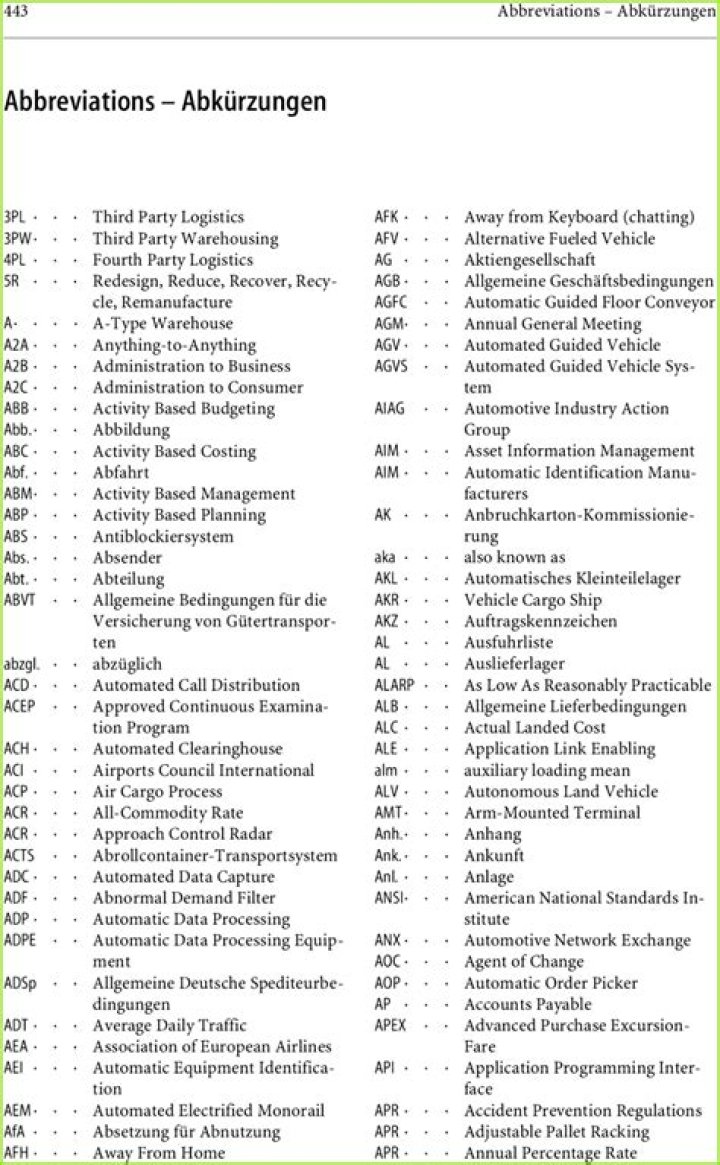
Abbreviations in German:1
Like English, German often shortens words or phrases for convenience, comic effect, or the production of other sorts of coinages. These abbreviations can vary in format.
Written Abbreviations
The most common is a simple selection of a few letters intended to reduce the amount of written space. When read aloud, they are pronounced just like the full word.
Here are just a few examples of standard abbreviations used in writing. With the exception of "usw." each abbreviated word in the phrase is marked with a period:
| Abbreviation | Full Expression | English Meaning |
| allg. | allgemein | in general |
| bzw. | beziehungsweise | respectively; or rather |
| bspw. | beispielsweise | for example |
| d.h. | das heißt | that is; i.e. |
| etc. | et cetera | and so forth |
| evtl. | eventuell | possibly; perhaps |
| geb. | geborene | née |
| ggf. | gegebenenfalls | if applicable; where necessary |
| m.E. | meines Erachtens | in my judgement |
| n.Chr. | nach Christus / nach Christi (Geburt) | AD; Anno Domini |
| od. | oder | or |
| S. | Seite | page |
| s. | siehe | see |
| s.a. | siehe auch | see also |
| s.o. | siehe oben | see above |
| s.u. | siehe unten | see below |
| u. | und | and |
| u.a. | und and[e]re, und and[e]res, unter ander[e]m, unter ander[e]n | for example |
| u.U. | unter Umständen | possibly |
| usw. [note the punctuation] | und so weiter | and so forth |
| v.a. | vor allem | above all; especially |
| v.Chr. | vor Christus; vor Christi (Geburt) | B.C.; before Christ |
| vgl. | vergleiche | cf.; compare |
| z.B. | zum Beispiel | for example; e.g. |
| z.T. | zum Teil | in part |
| z.Z. (z.Zt.) | zur Zeit | at present; for the time being |
Written Measurements:
Measurements are normally reduced to initials, written lowercase without periods. A few examples:
| 10 m | 10 meters |
| 100 g | 100 grams |
| 2 l | 2 liters |
| 175 cm | 175 centimeters |
| 30 km/h | 30 Stundenkilometer (kilometers per hour) |
| 250 km2 | 250 Quadratkilometer (square kilometers) |
Measurements of capacity in cooking can be uppercase:
| 3 TL | 3 Teelöffel (3 teaspoons) |
| 2 EL | 2 Esslöffel (2 tablespoons) |
Initialism:
Several categories of abbreviation use only the initials of the various words in the original. In some cases those are compounded words, treated as if they were written separately. These initialisms are written without periods and are pronounced just by their letters. They retain the grammatical gender of their primary noun. A few of many examples:
- Countries or International Federations: BRD (Bundesrepublik Deutschland); DDR (Deutsche Demokratische Republik); EU (Europäische Union); UdSSR (Union der Sozialistischen Sowjetrepubliken); USA (United States of America).
- Political Parties or Similar Organizational Entities:ADAC (Allgemeiner Deutscher Automobil-Club); AfD (Alternative für Deutschland); CDU (Christlich Demokratische Union); CSU (Christlich-Soziale Union); FC Nürnberg (Fußball-Club Nürnberg); USC Mainz (Universitäts-Sportclub Mainz); SED (Sozialistische Einheitspartei Deutschland [Socialist Unity Party of Germany]); ZK (Zentralkommittee [Central Committee]); ZV (Zentrale Verwaltung [Central Administration]).
- Universities:FU (Freie Universität [Berlin]); HU (Humboldt Universität [Berlin]); LMU (Ludwig-Maximilians-Universität [Munich]); TU (Technische Universität).
- Broadcasters, Newspapers, and Companies:ARD (Arbeitsgemeinschaft der öffentlich-rechtlichen Rundfunkanstalten der Bundesrepublik Deutschland [Consortium of Public Broadcasters in the Federal Republic of Germany]); BMW (Bayerische Motoren Werke); BR (Bayrischer Rundfunk [Bavarian Broadcasting]); FAZ (Frankfurter Allgemeine Zeitung); RBB (Rundfunk Berlin-Brandenburg); RTL (Radio Television Luxembourg); SWR (Südwestrundfunk [Southwest Broadcasting]); ZDF (Zweites Deutsches Fernsehen).
- Some Legal Categories:AG (Aktiengesellschaft [incorporated company]); BGB (Bürgerliches Gesetzbuch [Civil Law Code); e.V (eingetragener Verein [registered association]); GmbH (Gesellschaft mit beschränkter Haftung [company with limited liability]).
- Texting:While German texters often use English abbreviations like OMG ("Oh, my God!"), SRY ("sorry"), or LOL ("lots of laughs" or "laugh out loud"), there are also German ones, such as: BD ("bis dann"); BF ("beste Freunde"); HGW ("herzlichen Glückwunsch"); ILD ("ich liebe dich") = HDL ("[ich] hab dich lieb"); kA ("keine Ahnung") = kP ("kein Plan"); MfG ("mit freundlichen Grüßen"); VG ("viele Grüße"), LG ("liebe Grüße").
- Various other initialisms:KZ (Konzentrationslager [concentration camp]); LAG (der Lebensabschnittsgefährte / die Lebensabschnittsgefährtin [companion during a particular phase in life]); LKW (Lastkraftwagen [truck, lorry]); MfG (Mitfahrgelegenheit [a ride]); PKW (Personenkraftwagen [passenger car]); JWD ("janz weit draußen" [Berlin dialect: "way out in the boonies"]); WG (Wohngemeinschaft [communal living unit]).
| NDR (Norddeutscher Rundfunk) Info Know what moves the world. NDR Radio is the info-radio with news every quarter hour, interest news features, and a lot more. Get to know us! | |
Acronyms:
- Acronyms are made out of initials, pronounced as words:
DaF (Deutsch als Fremdsprache);
TÜV (Technischer Überwachungsverein [Association for Technical Inspection]);
DIN (Deutsches Institut für Normung [German Institute for for Standardization]).
A number of acronyms are imported from English: AIDS (Acquired Immune Deficiency Syndrome); Laser (Light Amplification by Stimulated Emission of Radiation) NATO (North Atlantic Treaty Organization); Radar (Radio Detection and Ranging); UNO (United Nations Organization).
Colloquial Shortenings:
- Shortened nouns:English-speakers, in a process that linguists call "apocope," often cut off the end of a longer word (e.g. "curio," "hippo").
In German, this term frequently describes just the colloquial dropping of a schwa, as in: "Ich geb' es dir," but here we are concerned
with deliberate shortenings, such
as Akku (storage battery) instead of Akkumulator, Deo rather than Deodorant,Prof for Professor.
A number of these shortenings end with -i, but that is not the suffix described in the following sections. It comes from the word itself. That being said, German-speakers are clearly comfortable with that -i. Some examples:Uni (Universität);Spasti ([crude slang:] Spastiker);Sozi (Sozialist);Nazi (Nationalsozialist).Shortened nouns + -i:In casual conversation, German-speakers might refer to their Kugelschreiber (ball-point pen) as a Kuli or their Pullover (sweater) as a Pulli. In these cases, the shorter version of the noun often receives an -i on the end, which now has the function of denoting a thing. The new word retains the grammatical gender of the original (here: der). The plural is formed by then adding an -s: Kulis, Pullis.
The hypocoristic -i. The -i suffix can also have a hypocoristic function, as do -y or -ie in English (compare "Andy," "Timmy," "doggy" or "doggie," "dearie," "sweetie"). Germans similarly use it to bestow nicknames like Andi, Hansi, Timmi, Ulli, and Uschi, and to create terms of endearment like Mausi (little mouse) or Spatzi (little sparrow).
An interesting case is the Trabant, the East German car that is almost universally referred to as der Trabi. It was was notorious for its poor quality and the subject of countless Trabiwitze (Trabi jokes), but at the same time it was - and still is - an object of some affection. The -i ending helps to express this ambivalence,
The personalizing -i or -o: An -i is also often added simply to indicate a person, without any hypocoristic implication. Hence: Ami (American); Profi (a professional); Ossi (a person from the former East Germany); Wessi (someone from the West). (Compare the English -y or -ie: "lefty," "commie," "alkie" [alcoholic], "bookie," "druggie," "preemie" [a baby born prematurely]).
An -o can serve the same purpose (Compare the English "weirdo" or "wino"). Thus the internecine struggle within the Green Party in the 1980s and early '90s was between the Fundis (fundamentalists) and the Realos (realists).
Clippings (Syllabic Abbreviations) [= Silbenkurzwörter (sometimes Silbenwörter)]:
- German is particularly given to clippings, words created out of fragments of longer words or phrases. These terms differ in the extreme.
Their registers vary from officialese to colloquialisms to obscene slang,
and they can designate organizations (or their members), geographical entities, commercial entities, occupations, procedures, stereotypes, or things.
Here are just a few examples:
Trainees wanted! Clipping Original Word Meaning Adidas Adolf "Adi" Dassler [company named after the founder] AStA der Allgemeine Studierendenausschuss General Students' Committee Azubi2 der/die Auszubildende trainee BAFöG- Bundesausbildungsförderungsgesetz Federal Training Assistance Act Düdo Düsseldorf Flak die Flugabwehrkanone aircraft defense gun Haribo Hans Riegel Bonn) [company named after founder and city] Hiwi Hilfswilliger non-German volunteer in the Bundeswehr Hiwi Hilfswissenschaftler research assistant KaDeWe Kaufhaus des Westens [Berlin department store] Kita Kindertagesstätte dead certain Kripo Kriminalpolizei Criminal Police Meck-Pomm Mecklenburg-Vorpommern [state in Northern Germany] Obmeßböker Objektiv meßbare ökonomische Erfolge [East German bureaucratese:] Objectively Measurable Economic Successes ReWe Revisionsverband der Westkauf-Genossenschaften [name of a supermarket chain] Schupo Schutzpolizei uniformed police Sefu Sesselfurzer "Easy-chair farter" [armchair administrator] Spusi Spurensicherung securing of evidence Stabi Staatsbibliothek State Library Stasi Staatssicherheit State Security [East German Secret Police] Stuffz Stabsunteroffizier Staff Sergeant TAZ Tageszeitung [Berlin] Daily Newspaper Vokuhila Vorne-kurz-hinten-lang-Frisur mullet WiWi Wirtschaftswissenschaft Economics Vopo Volkspolizist [East German] policeman Zabu Zahlenbumser number-fucker [someone with an inordinate love of numbers] 1With special thanks to Selina Foltinek and Petra McGillen.
back to text2Some might argue that Azubi is a shortened form, not a clipping.
back to text