Unsplash / Pixabay / CC By 0
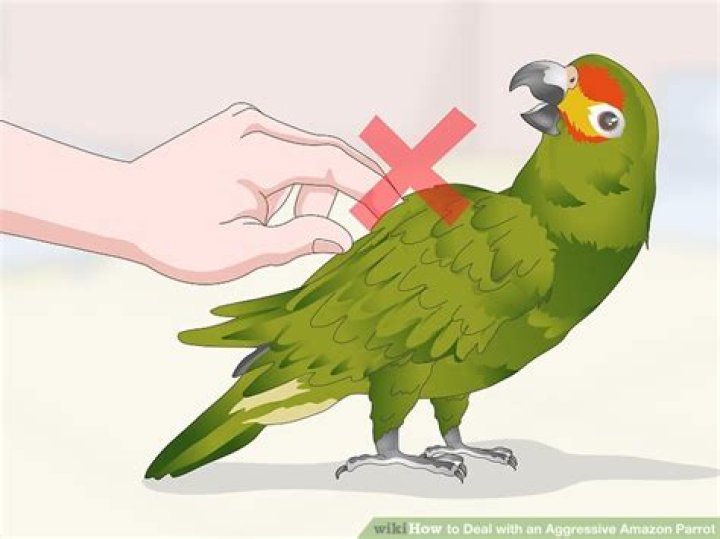
Biting parrots are far more common than you may think. All pet birds bite. While this is not to say that all birds are aggressive, it should serve as fair warning to anyone interested in owning a parrot or another type of pet bird. Sooner or later, you’re likely to get bitten and it will be painful.
Why Do Parrots Bite?
Just because a bird bites you doesn’t mean that the bird is mean, aggressive, or isn’t bonded to you. Parrots, as hookbills, use their beaks for a variety of functions: preening, eating, climbing, and playing. Parrots often use their beaks in the place of a hand to grab onto toys, food, perches, and sometimes their owners. If your bird is normally good-natured, you may need to evaluate whether or not your parrot is really biting you or is simply using its beak in a normal, healthy fashion.
Another possibility is that your bird could be biting you out of fear. Even parrots that were hand-fed as babies can develop a fear of humans if they are not properly socialized consistently. If your bird came into your life as an adult, there are any number of factors it may have come into contact with that can cause fear biting. Even well-socialized birds that are completely comfortable with humans can become frightened of something and bite their owner out of impulse. Learning how to earn your bird’s trust can help quell your bird’s fears and save you a few sore fingertips.
Aggression
If you can determine that your parrot is not playing, trying to climb, attempting to preen you, or isn’t simply afraid, then aggression may well be at the root of your bird’s biting. Aggression in parrots can be a serious problem, leading to unhappy birds and even unhappier owners. Causes of aggression in parrots include territoriality, hormonal fluxes during adolescence or breeding season, stress, lack of mental stimulation, and dominance issues, to name a few.
Take steps to eliminate any obvious factors that may contribute to your bird’s aggression.
- Check the bird’s environment for things that might cause discomfort. Is the cage near a drafty window?
- Do you need to adjust your cage cleaning schedule so that your bird’s home stays clean and comfortable?
- Are there other pets in the home that could be causing your bird stress?
Make adjustments as necessary and monitor your bird’s response. Causes of aggressive biting can sometimes be tricky to identify, so it’s always a good idea to schedule an appointment with an avian veterinarian to rule out any health issues that may contribute to your bird’s undesirable behavior.
How to Stop the Biting
Owning a parrot that bites out of fear or aggression is no fun. Not only are bites physically dangerous due to the power of a parrot’s beak, but they are a sign that the bird itself is unhappy with some aspect of its situation. Every pet bird owner wants to make sure their feathered friends are happy. When problem behaviors such as biting rear their head, it’s important to act quickly to remedy the problem before long-term patterns of these behaviors set in. You can help calm your biting parrot and establish a better bird/owner relationship by:
- Handling and taming aggressive parrots: Not every parrot owner is a natural-born bird trainer, but just about anybody can bribe a bird into being handleable with patience and effort. Move to a neutral location, avoid yelling, build trust, focus on repetition, and come with treats.
- Correcting bad behavior in birds: Birds are very sensitive creatures that interpret our actions differently than more traditional pets like cats and dogs. This can lead to frustration and miscommunication between the bird and owner, which often only exacerbates existing behavior problems. Successfully rehabilitating a bird with behavior problems requires some knowledge of avian psychology, as well a calm, expressive voice that provides consistent messaging.
Next Steps
If you want a pet bird that you can handle and interact with, you will eventually get bitten at some point. The key to dealing with bites is to monitor your bird’s behavior patterns and provide consistent training to pinpoint the cause of the undesirable behavior and fix it.
Even in temporary bouts of biting behavior such as the “bluffing” phenomenon, it’s important to stick to a set training schedule so that you can disrupt the potential onset of a pattern of behavioral issues. Failure to do so could cost you your relationship with your bird.
Take Caution
While you’re managing your biting bird, be cautious. Bites aren’t only painful, but they can also be severe. While rare, parrot owners have lost eyes, fingers, and toes to their pet birds, while others have sustained traumatic injuries to their lips, ears, and noses.
Large parrots have very powerful beaks, and owners must realize that even sweet, tame pets can cause these sorts of severe injuries in the blink of an eye if they get frightened or otherwise upset. These situations can be particularly tragic if kids are involved, so bird lovers with little ones at home should be particularly careful about choosing a parrot species that will make a good pet bird for children.
Weeter Sim/Getty Images
Most can agree that some parts of a bird’s anatomy can deliver quite painful attacks if our pets become angry with us. Indeed, the instincts and inherently wild nature of our avian companions can bring forth many behaviors that are undesirable in the home. Dealing with these issues can be especially trying for bird owners, given that their feathered friends are such highly sociable and emotionally sensitive creatures. Read on for tips that will help you gently but effectively convey your displeasure toward undesirable behavior in your pet bird.
Training Rules
Although at times your pet may behave in a way that annoys you or makes you downright mad, it’s important to remember these rules when responding to the transgression:
- Never hit a bird: Birds are extremely fragile creatures and even the slightest force can cause severe injury or death. Physically abusing a bird can also lead to irreversible psychological problems, and can promote aggression and viciousness.
- Don’t hold a grudge: Birds are extremely intelligent, but also very sensitive creatures. When you express displeasure with your bird’s behavior, make the lesson short and sweet. Prolonged negative attention can cause undue emotional stress for your pet.
- Never compromise your bird’s health: “Punishing” a bird by withholding food or neglecting cage cleaning is never a fit way to deal with a behavior problem. Such actions are not only cruel but can cause serious physical and emotional damage to the pet.
Responding to Unwanted Behavior
In order for your bird to understand you when you catch it acting up, it’s necessary that you remember the correct way to respond. While a normal “human” response to an unpleasant discovery would be to loudly declare your grievance, a bird can interpret this reaction and body language as excitement—meaning that it may actually think you are praising the behavior. Dealing with a bird’s behavior problem can be just as much about training yourself as it is about training your pet.
In order to respond properly to undesirable behavior, it’s helpful to keep the following steps in mind. With consistency and patience, you may find that it won’t take long for your bird to catch on.
- Ignore negative behavior: Simply ignoring the unwanted behavior doesn’t reinforce it by giving it any attention so the behavior is less likely to be repeated.
- Be very expressive: Don’t be afraid to frown at your bird. Birds are capable of picking up on facial expressions, and most get the idea if your body language expresses your distaste for his actions.
- Speak softly: Use a tone of voice that is low but not loud when you tell your bird that it has done wrong. Be as “matter of fact” as possible, but keep it short. You will be amazed at how effective it can be!
- Place your bird on his cage or perch: After you’ve conveyed your dissatisfaction, have your bird step off of your hand and onto its cage or perch. Allow it to stay there for a few minutes to reflect on what happened, and then go back and interact playfully with your pet—it should know that you are no longer upset and that it’s now being a good bird.
Consistency Is Key
All birds are individuals, and some may catch on quicker than others. Don’t get discouraged if your pet’s behavior doesn’t change overnight. As long as you stay consistent with your training methods, your bird will likely understand you sooner rather than later.
Remember that positively reinforcing good behavior is more important than pointing out and modifying bad behavior. If you notice your bird acting exceptionally well, don’t miss the chance to lavish praise on your pet. Birds respond much more readily to training techniques that focus on the positive rather than the negative, so don’t forget to incorporate lots of fun and praise into your training methods.
With a little work, patience, and love, your bird should be acting like an angel in no time. Your effort will be rewarded with a beautiful, intelligent, and well-behaved pet. Who could ask for anything more?
Question:
How do I tame my Quaker parrot
Hi. I have a 6 months old Quaker parrot. I got him home for a few days. He was a hand fed bird but he is not hand friendly. He would bite anyone who put their hands in the cage or fly around inside the cage while screaming. He spent his days sitting on his stainless steal food dish and he would also scream when he can see me. So far, he never played with any of the toys I left in his cage. I think it’s because he never had any toys in his old home. I tried stick training him but he would walk up the perch and try to bite me. Is he just being territorial? Please give me advice and step to train my Quaker parrot.
Answer:
Quaker parrots can be great pets, but they can also be bullies. They go through a phase where they will test their owners and if not addressed the right way, the bird can end up like your new pet. And yes, they can be extremely territorial around their cage. But don’t give up hope on this little guy. You have a long road ahead of you, but with patience and time, you can end up with a great pet.
I am going to provide you with a link to articles that will help you work with him. It is important to have a professional trim his wings or he will be very hard to work with. As far as the stick training goes. always slant the stick slight upwards – birds prefer to climb up and he is less likely to run to your hand if he has to climb down to do so. Once he learns to get on the stick and not try to bite you, have the training sessions in another room, out of sight from his cage.
Please read all of these articles and again, give him time to get to know you and show him a lot of patience. When you are not making progress, stop the training session and try another day. Good luck with him!
I need more information on this bird’s history.
Why the sudden change in behaviors/loyalty?!
Has he always been this aggressive?!
How much out time and handling does he get?
How many people handle him?
Caging the bird may be necessary, but additional behavior mods – discipline, socialization, bite pressure training, and training the bird not to bite or chase people around the room is obviously necessary. Sounds like the bird is doing as he bloody well pleases at the moment. Could be just a phase that he needs re-training and reinforcement to get his behavior where he should be.
__________________
Clover Baby
Tiki & Cleo, may you both rest in peace together now at the rainbow bridge.
First of all, any large parrot that chases me, quickly finds the tables turned on him.
My solution to large macaws who chase feet is to grab a sofa cushion, and back his little butt into a corner, and make him sit there for a minute and think about what he did. In the wild, the bird who backs down, tells the other bird he’s in charge. Their wild instincts often prevail in captivity. He doesn’t get off the floor until he steps up nice. Suddenly, this is no longer a fun game to play. Don’t run. Push back. The more you back down, the more he thinks he is in charge.
No biting has to be a rule, and it has to be enforced. If he has to be toweled, then so be it. Play nice, and it won’t happen.
Dominant macaws ARE NOT mild mannered. Mild mannered responses tend not to work with them.
Dominant macaws are not emotionally fragile either. They will get a cause and effect if you are consistent with it. Same response happens immediately every time.
This is how a macaw SHOULD be taught to behave:
The sooner you start behavior mods, the sooner you get this!
This isn’t the first time this has come up, nor will it be the last. Macaw training is a lifelong thing. Every once in awhile you have to go back to the beginning, start over, and correct mistakes. Both you and the bird are always learning.
My wife & I took in Three Macaws this past Monday night. Sad story, owner has cancer is soon expected to pass away. He was looking to find a good home for all three birds and wanted them to stay together. My wife and I have been looking for some time now for a Macaw.
The three Macs are a B&G, GW, and a Military. The B&G & GW are both 11 yrs old and just SUPER love bugs. The Military . well that’s another story and hence my problem. Sarge is his name and he acts just like a Marine Corp drill Sarge, too. It took me a day to figure out, but long story short . he’s cage aggressive. He (sex unknown) will tear you up trying to get him out, even just walking near his cage when he’s in it or on it. Once you get him on the floor it’s all over. His body language changes. Give him the command, “Step Up”, and he will lift his foot let you pick him up, bare armed, and hold him.
My wife and I have had birds for nearly 26 years now, ranging from Finches up to Cockatoos. This is our first time as Macaw owners. So although we are new to Macaws we’ve been around the block a few times with Conures, Parrots, & ‘Too’s.
So, the issue is . how to deal with this guy?
Sarge does need a new cage desperately. He’s just hammered his cage so hard with his beak that all the paint is worn off. and I’m not a big fan of rare steel like that around my birds. I half wonder if getting him a new cage would be a drastic change for him to help lose that aggression of his territory? Then again, it might at first, but then manifest weeks/months down the road once he gets use to it again??
I have LOTS of pets! I love animals, art, coffee, and video games.
I have always been a fan of the more “moody” parrots. Over the years, I have lived with and cared for a green-cheek conure, Moluccan cockatoo, African grey, blue-fronted Amazon, and several cockatiels and lovebirds. Some of these belonged to flat-mates, while others were my own. Of these species, I have come to appreciate those who have required more subtle forms of non-verbal communication and interaction. As challenging as they can be, I will always have a soft spot for Amazons and lovebirds, who I consider to be as testy as they are friendly.
With drastic mood swings during breeding seasons, it seems that interacting with your bird is impossibly difficult. I was once convinced that there was nothing I could do to help my lovebird Bonnie through these swings. I had resigned myself to owning an untouchable pet during these periods of intense aggression and territorial behavior.
You Can Adjust Your Bird’s Behavior
Little did I know, there was much I could do to minimize how much her hormones affected her mood and how often her body kicked into breeding mode. Here are 4 tips to try.
1. Consider Diet Changes
A high-protein diet of nuts, seeds, and protein-fortified pellets are what you’d feed your bird if you wanted to encourage breeding behavior.
Warm, soft foods can trigger hormone spikes. Re-evaluate what you usually feed your bird and how often she seems to go through mood swings.
- Introduce a staple pellet diet with a lower protein value. Roudybush, Zupreem, or Harrison’s Organic pellets are good choices.
- Provide them with a variety of fresh fruits and vegetables, and steer clear of commercial “conditioning” foods as these trigger breeding.
- Soft foods, such as cooked whole-wheat pasta, rice, and other lean dishes, can be shared with parrots without worry so long as they are allowed to cool. Remember, warm foods signal that conditions are right for breeding.
2. Make Sure Your Bird Gets Enough Sleep
Varying daylight hours can trigger seasonal changes in many plants and animals alike. It is consistent that a change in bedtime routine, or lack of routine for that matter, contributes to irregular hormonal spikes in your parrot. Just as poor sleep patterns causes irritability in humans, they are also the cause of general moodiness.
Because parrots are tropical and reside in regions near to the equator, they are most biologically accustomed to a 12-hour day, with 12 hours of darkness. Increasing the amount of daylight hours your bird gets, natural or artificial, will stimulate an increase in hormones. Parrots cannot operate on human hours.
- With my busy life, it’s sometimes difficult to remember to cover Bonnie’s cage at night. It helps immensely to have her in a separate room so she can be closed off with lights out at a consistent hour every day. If you are sometimes forgetful like I am, you can put some lamps in the room on a timer so that bedtime becomes worry-free.
- If a separate room is not an option, get a dark blanket to cover the cage for her 12-hour night period. Bonnie likes to shred hers through the cage, so I make a few trips to the thrift store for replacements every now and then.
3. Limit Handling
Too much “snuggle” time with your bird during these hormonal periods will increase courting behavior.
- Try to avoid too much physical interaction. This can not only save you from being bitten, but it can also keep their romantic mood at a quieter level.
- This does not mean you should isolate your parrot. By all means, bring her out to enjoy her flock, but keep her in a safe place where she won’t be “tempted” into snuggling or nesting behaviors. A parrot stand is ideal for moody times such as these.
- My Bonnie will dive towards any tight space nearby and fiercely defend it. When I have her out for social time, she must be kept on a table-top play stand on an empty surface. Much of keeping parrots out of trouble is in preventing the opportunity—as you are well aware, I’m sure. While she is perfectly sweet during non-breeding times, if I let her take to my shoulder with her hormones on the run, she is suddenly possessive of the area under my hair and will attack my cheek, ear, and neck to claim her new nest site. Given the fuss she throws over it, I am convinced she is happier not having to defend these kinds of cozy spaces, so she stays on the table.
4. Learn to Identify Your Bird’s Moods and Respect Them
Like people, parrot species communicate through both vocalizations and body language. Even without words, they can ask for things and tell you their state of mind if you are willing to listen. You’ll be surprised by how much you already know about your bird’s way of speaking to you.
Your access to this service has been temporarily limited. Please try again in a few minutes. (HTTP response code 503)
Reason: Access from your area has been temporarily limited for security reasons.
Important note for site admins: If you are the administrator of this website note that your access has been limited because you broke one of the Wordfence advanced blocking rules. The reason your access was limited is: “Access from your area has been temporarily limited for security reasons.”.
If this is a false positive, meaning that your access to your own site has been limited incorrectly, then you will need to regain access to your site, go to the Wordfence “options” page, go to the section for Rate Limiting Rules and disable the rule that caused you to be blocked. For example, if you were blocked because it was detected that you are a fake Google crawler, then disable the rule that blocks fake google crawlers. Or if you were blocked because you were accessing your site too quickly, then increase the number of accesses allowed per minute.
If you’re still having trouble, then simply disable the Wordfence advanced blocking and you will still benefit from the other security features that Wordfence provides.
If you are a site administrator and have been accidentally locked out, please enter your email in the box below and click “Send”. If the email address you enter belongs to a known site administrator or someone set to receive Wordfence alerts, we will send you an email to help you regain access. Please read this FAQ entry if this does not work.
Generated by Wordfence at Wed, 4 Nov 2020 18:17:15 GMT.
Your computer’s time: .
My little guy is the sweetest thing when out of his cage. In the cage he is very aggressive when we put our hands in, even when feeding him. He will bite if we let him.
How do we discourage this behavior?
Are you still having problems with this? This bird knows that when you put your hand in his cage when he strikes or bites you will retreat. Mission accomplished. He wants to be left alone.
This cage aggression with this bird has probably started when he was very young. Probably the original owner forced him from from the cage to get him out so he has learned to bite to keep hands away. You have only had him for a few months & IMO you are still building trust with him. This could take time & a lot of hard work. But not impossible.
If you are able to attatch a perch to the door, you can target train him to come to that perch for a treat, once he is on that perch & the door is open ask him to step up. You can then put him on a play stand while you service his cage.
When a parrot is apprehensive to step up & come from the cage, to calm them & i guess build trust with them I first touch their feet only if they let me. If they try to bite i will stop but still leave my hand there if they are serious & look like biting i will still talk gently to them & retreat. We do this a number of times everyday. Once i am able to stroke their foot without any reaction i will slowly move my hand up to the chest. I also use a lot of verble praise. Talk gently & maintain eye contact. No sudden movements. Once the bird trusts the hand isn’t going to hurt them, they will usually step up when asked.
This you can work with Melbourned, I am feeling that maybe you haven’t made an accurate assessment of the cage aggressive behavior. Reluctance to leave his cage maybe that he just isn’t ready to come out or he is fearful of something. Eclectus are like that. It doesn’t mean he is aggressive or uncontrollable & i really don’t see that he requires any behavior modification. I would say he is exhibiting survival techniques in which he is assessing any possible dangers in his environment before leaving the safe confines of his cage.
In many situations, some carers will perceive their bird is behaving aggressive when actually they are exhibiting fear or irritability in the only way it knows how, by it’s distinct & classic, avian body language. Although there are many common signs of fear, or warning behavior in parrots, people need to be aware of those that are specific to the species of their own parrots. Those signals should be respected in the domestic environment as well. Behavior modification techniques will not be effective if implemented for the wrong reasons.
So you have to ask yourself why is my bird biting. Parrots bite for 2 reasons that i am aware of survival or control. I personally don’t think you have really got to know your Eclectus yet. Once you work out what he really likes & doesn’t like everything will fall into place.
You must also remember he is an adult parrot & you really don’t know his full history. I wouldn’t worry to much about the cage aggression at this point in time. It comes down to trust & from what i am reading in your threads your boy is a lovely bird. So rather that stress him out, I would wait until he was out of the cage before i did any cleaning or feeding. The best place to train a parrot & especially if they are attached to their cage is to work with them in a neutral territory out of sight of their cage.
The most important is to read his body language and get to know your bird. It takes many months or even years to truly appreciate a parrot.
- 1.1K shares
- Tumblr
The sexual instinct
The very first thing to know about this ( unchanging ) sexual instinct of the parrot is that it is a monogamous animal, and this, all year long, not only during the breeding season. The parrot will have during its life only one sexual partner ( unless the disappearance of said partner ).
Couples are very attentive and considerate of each other and create very powerful emotional bonds ( read: fusional ) for their entire life as parrots or until the death of the companion.
Parrots choose each other, mate in an erotic way, take care of their nest together, and evolve in harmony within a social group – what a real family!
How to deal with that Hormonal Bird
What a HORMONAL BIRD Looks Like!!
The Parrot “lovers” choices
The parrot is also one of the few advanced animals that choose their “loving” partner. This is partly the reason why, despite the fact that you are completely crazy about your bird, the latter will not necessarily choose you as “lover of the heart” on the simple pretext that you are the one who takes care of him. It is up to you, but this detail is of no particular interest in the choice of the life companion.
From the moment we make our choices and in addition, there are many choices at our disposal, we are free to choose who we want … a human, dog, cat, a companion bird of sex opposite or same-sex. I have often seen, at the shelter I operated, parrots of the same sex forming a couple despite the great availability of partners of the opposite sex and I have often seen, too, birds of the same species and of the opposite sex. having no hooked atom and systematically refusing all forms of intimate contact, even if there were no other birds available around them. It’s part of making your choices … we say that love is stronger than the police!
Parrots are not exclusive and like to live in a group.
Parrot Friendships
Despite all this, normally, the parrot is a gregarious animal that needs to live as a couple within a group. On the other hand, this characteristic in no way prevents him from creating other forms of links, at different levels within his society. It would be wrong to claim that a parrot is an exclusive animal that loves or accepts only one person and rejects or assaults in a natural way all the other members of the social group to which it belongs ( the family ). No parrot would allow itself to do so in its natural habitat.
This kind of behavior, directly related to life in captivity, is more a matter of socialization and the eternal rivalry of the parrot compared to a given group, whether human or with other parrots. The lack of socialization generates great insecurity vis-a-vis its environment or the bonds which connect it to the darling human.
The parrot can choose you as a life companion, you will then become a darling human.
Sex and hormones
In the wild, the breeding season depends on several external stimuli, such as temperature, humidity, photoperiod, and the moment of the parade generally arrives ( at the right time) when there is a great availability of food. to feed the flock of chicks.
When the sexual instinct awakens, strong hormonal surges encourage the birds to reproduce. The search for the companion becomes a priority activity ( if the business is not already concluded). Then, when the choice of companion is finally fixed, and intense court ritual takes hold. These birds can spend hours petting and grooming each other. There follows a very tender and demonstrative display: the male slowly approaches the female with all feathers swollen to give herself the more imposing air (macho birdy), then he tilts his head and his body as a sign of appeasement. The female, if willing, responds positively by also tilting her head and her body and becomes receptive by adopting juvenile attitudes towards her companion. This court can last and last. They stay side by side, walk around while caressing and shouting, and then hop …! I thank you for the XXX details…
From this moment, the behaviors of birds change: they become more territorial and protective, which does not necessarily mean aggressive! You have to learn to make sense of things …
The sexual instinct in a context of captivity Parrot
Our parrot remains a monogamous animal even in a relationship with its darling human. This need for a companion is as pressing for the free parrot as for the pet parrot. If the bird cannot be housed with a companion of its own species, it will do so most naturally in the world with its favorite human and the latter would benefit from being receptive and available. Indeed, the parrot does not perceive its human as a parent ( mom or dad ), the relationship it establishes is one of a life partner, of “spouse”. The parrot had to trust his “beloved”, you must, therefore, be a stable, reassuring, and above all reliable “husband”.
Coco Jeckill and Coco Hyde?
The parrot that has benefited from good socialization will not reveal itself overnight as a monster simply because its hormones work it! On the other hand, I must admit that it is true that these hormones exert a very strong influence on his behavior. The search for the nest, the sexual seduction, the regurgitation, the masturbation, and the laying of eggs are innate behaviors ( unchanging ) and which must be regarded as normal.
Never reprimand your bird for exhibiting such behavior and if it engages its feelings with you, do not repel it either. Do not provoke envy in your parrot by lavishing it with sexual caresses: on its beak, under the wings or the region of the tail, nor play with its tongue or girdle its body. In the case of masturbation, if the “thing” is already in motion, just let him go after his pleasure from time to time. Modesty does not take place in the world of parrots … So what the hell! … stop seeing bad things!
Parrot Hormonal period = Galley?
No, I don’t think so, in fact, personally, I never had any trouble getting through the seasonal affection periods of my birds. Even though it has often been easier for me to tame a fierce bird during these periods, simply because the hormonal surges are so intense that, in most cases, a fearful-tempered parrot will accept ( willingly ) to be caressed and manipulated during this cycle. The beauty of the thing is, that he learns at the same time that the human is not so formidable and that he can even be a pleasant company. Often this fragile newly acquired confidence continues after the hormonal episodes.
I have never had the right to aggression or other problems so often denounced and which many consider inherent in this condition.
I believe that good socialization ( including satisfactory communication ), respect for the bird’s sensitivity during this period, patience, and a little bit of empathy makes all the difference in the world in what is so often described as being a time of crisis with our pet parrots.
Helping People Keep Happy Healthy Parrots Since 1997
- Home
- About
- Copyright & Reprint Information
- Contact Us
- Inca the Amazon Parrot
- Site Map
- Max the Senegal Parrot
- Health
- Basic Care
- Disease & Health Risks
- Recipes that Birds Love
- Cautionary Tales
- Upside-Down Food Pyramid
- Avian Vets
- Alerts & Toxins
- Owning a Parrot
- How to Buy a Parrot
- Why Buy Weaned Birds?
- Checklist for Buying a Bird
- DoDo Awards
- Lovebirds
- Tutorial on Trimming Wings
- Lovebird Colors & Mutations
- Dutch Blue & Blue Pied Peachfaced Lovebirds
- Green Violet
- Violet Factor & Whitefaced Violet
- American Cinnamon
- Australian Cinnamon & Orange-Faced Lovebirds
- “Cobalt” – Slate, Double Dark Factors
- Fischer’s Mutations: Albino, Lutino, Yellow, White
- Breeding Lovebirds
- Handfeeding & Socializing
- Fixing Splay Legs
- Nestboxes
- Abyssinian Lovebirds
- Lovebird Baby Gallery
- Parrot Training
- Why Did My Bird Bite Me?
- Parrot Training Videos
- Teaching Parrots to Talk
- Books
- Species Guides
- Bird Photo Gallery
- English Budgies & Parakeets
- Amazon Parrots
- Blue-Fronted Amazon
- Mealy Amazons
- Double Yellow Head Amazon
- Spectacled Amazon
- African Grey Parrots
- Congo African Greys
- Timneh African Grey
- Cockatiels
- Eclectus Parrots
- Senegal Parrots
- Parrotlets
- Lovebirds
- Peachfaced Lovebirds
- Black Masked Lovebird
- Fischer’s Lovebirds
- Madagascar Lovebird
- Abyssinian Lovebirds
- Canaries
- Rose-Breasted Cockatoo
- Zebra Finches
- Greater Vasa Parrot
- Hahn’s or Noble Macaw
Get The Lovebird Handbook
Parrot Blog
- Behavior & Training
- Health & Safety
- Toxin Alert Stories
- Diet & Nutrition
- Species Articles
- Thinking of Getting a Bird
- Breeding
- Special Needs Birds
- Fun & Play
- Humor
- Furry Friends
- Parrots in the News
Species Guides
- African Grey Parrots
- Amazon Parrots
- Canaries
- Cockatiels
- Eclectus Parrots
- English Budgies & Parakeets
- Zebra Finches
- Greater Vasa Parrot
- Hahn’s or Noble Macaw
- Lovebirds
- Parrotlets
- Rose-Breasted Cockatoo
- Senegal Parrots
Before you run out to your local pet store and yell, “Gimme that African grey,” it is important to understand that parrots are one of the most challenging pets to own. Do your research before you buy a parrot to avoid future health and behavioral problems, and to be sure you get the parrot that best fits your lifestyle and personality. You should realize that some of the larger parrots can easily outlive their owners, with life expectancies of 50 to 80 years. Many will live with you through various moves and changes in lifestyle. The better prepared you are to deal with this long-time companion, the less likely you are to be disappointed and the less likely your pet is to end up on the bird adoption merry-go-round. If a bird’s potential to mimic human speech is your primary criteria when picking a parrot, you might want to think twice about getting one. There is no guarantee that even an African grey parrot, the most skilled talker in the parrot kingdom, will ever say a word. If this is your only reason for having the bird, you may end up disappointed. It is important that you accept the possibility that your bird might never learn to mimic human speech before you decide to buy it. Cost is another consideration. Most of the larger parrots cost hundreds, even thousands, of dollars. This only begins your financial commitment. The cage must be large enough for a bird to flap its wings freely. You will need bird toys, and you will have to replace them regularly. You will be feeding your bird a good pellet mix, seed mix, and a variety of fresh vegetables and fruits. You will have veterinarian visits and grooming costs. Be prepared for emergencies because many birds are prone to accidents and respiratory infections.
And don’t forget noise. Certain species have the potential to scream loudly. The screech of many large parrots is designed to enable flock members to call to each other across miles of jungle. The truth is, you cannot prevent a parrot from ever screaming. Good dominance training and positive reinforcement can reduce most screaming to an acceptable level, but every once and a while the call of the wild will burst forth from your parrot. If you live in an apartment with paper-thin walls, we suggest you get a parrot that cannot drown out your neighbor’s television set. Cockatiels, lovebirds, senegals, red bellies, and African greys, as well as pionus parrots, generally have a reputation for being quieter parrots, the term “quieter” being relative of course. Cockatoos have one of the worst reputations for screaming, largely because they require quite a bit of attention and amusement or they clamor for it loudly. Many of the conures can stun you with their loud screech. Sun, jenday, nanday, and Patagonian conures reportedly are the loudest. Green cheeks, maroon bellies, and painted conures are considered “quiet” conures. Macaws vary greatly in the amount of noise they make.
All parrots require a varied diet with plenty of fresh vegetables and fruits. These will end up on the floor, on the cage bars, and sometimes halfway across the room on the wall. Birds are messy creatures. You will sweep, vacuum, mop, and pick up after them in order to keep their area clean. Frankly, the amount of clean up necessary has been the biggest complaint I have heard from bird owners who are having second thoughts about their pets. If you require your home to be utterly spotless at all times you probably will be driven mad by a pet bird. Parrots also require 10 to 12 hours of sleep each night. This means they need a quiet, dark place during those hours. If the cage is next to a television set that you watch until the wee hours of the morning, you will have a grumpy bird during the day, and eventually the bird will develop some severe behavioral problems. One of the first questions I ask bird owners whose pets have become aggressive is, “How much true sleep time is your bird getting?” Most of these owners have found that behavioral problems decrease dramatically once they make sure their parrot gets a full 10 to 12 hours of undisturbed sleep each night. Finally, you need to have time to properly train your parrot to avoid aggressive behavior and painful bites.
If you are not daunted by any of this information, you might be ready for the responsibility of owning a parrot. They make wonderful pets and their intelligence and humor will delight you for many years to come. Finally, we suggest you read a good book on the particular species you would like to buy before bringing your bird home.
Here’s what happened during my shift at a Falls Church shop for bird fanatics.
One Saturday while out for a family drive, we passed a small Tudor-style house that looked out of place amid the fast-food chains and used-car lots that dot Lee Highway in Falls Church. A sign read PARROTS, PARROTS, PARROTS, JUST PARROTS. “Hmm, I wonder if they sell parrots,” I said.
“I always wanted to know what went on in there,” said my husband, Karl, who grew up in Annandale and passed this place countless times.
What goes on is a lot of noise. My son, Leo, covered his ears as we sidestepped a huge bird screaming as if it were on fire. All around us, birds of various sizes and colors went berserk.
“Can you imagine working there?” I asked Karl once we were back in the car.
“Can you imagine my mother yelling in your ear for eight hours?” he answered.
Still, I kept thinking about that place and those birds (not to mention the kind of people who’d willingly invite one into their home). A few weeks later, I phoned and asked if I could spend a day working in the store. Despite the fact that I didn’t know the difference between a parakeet and a cockatoo—and had a profound fear that one or both would get caught in my hair—owner Ed Willis hired me on the spot.
On the morning of my shift, I’m worrying about the usual things: Will I like my coworkers? Will there be coffee? How long before a bird poops on my head? I dress in a hoodie and rubber rain boots.
When I show up, Henery, a sherbet-colored cockatoo, greets me. “Hey, baby,” he says over and over (and over), with all the charm of a construction worker.
The first human I meet is 18-year-old Jack Walton. A white cockatoo named Snowball is perched on his shoulder, pirate-fashion. Walton rings up a five-pound bag of fruit-flavored pellets for customer Marc Cottrell, a clinical psychologist who lives in Falls Church with three birds.
Cottrell admits he can’t explain his avian affinity: “They’re like toddlers with a can opener attached to their face. They are messy and throw their food everywhere.” But, also like toddlers, he says they can be adorable and sweet. He clearly has a soft spot for them. Cottrell got Rudy, an African grey parrot, when a relative moved and left the bird behind. Penny Leo, another African grey, and Lemon, a type of parrot called an eclectus, were both longtime refugees of Willis’s shop—Cottrell says Penny Leo was so ugly no one wanted her; Lemon had been waiting two years for an owner.
According to the National Pet Owners Survey, 7.9 million US households keep birds, compared with the 60.2 million households that have dogs. But the bird people seem just as devoted. In an article for the International Association of Animal Behavior Consultants, anthropology professor Patricia Anderson writes: “The bond between people and their parrots can be quite profound . . . . [I]t may be due to the capacity for parrots to imitate human speech and speak cognitively.” People, she writes, tend to relate to their birds as family.
“Give her a bucket and sponge and let her clean some cages!” jokes Willis, who has descended from the second floor, where he lives with his 17-year-old daughter, Kency.
The store was once the Wishing Well Tourist Home, in which hostess Mrs. H.C. Tubbs rented rooms to transients. It became a place for birds in 1988 when, says Willis, there were tons of these stores around. “Parrots,” he adds a bit sadly, “were forecasted to be the pet of the millennium.” Today, his is the only Washington-area business exclusively selling birds. A former Parrots Parrots Parrots customer, Willis took over the operation four years ago after management stints at stores including Petland. Despite the huge sign out front, he corrects me repeatedly that the proper name of the store is American Bird Company.
A lilac-crowned amazon parrot. Photograph by April Greer.
His arms and legs are a battlefield of bird-related scabs and puncture wounds. “This is Kiwi here,” he says, pointing to one on his hand. “This one’s Coral.”
During slow times, six to eight birds board here. Over Thanksgiving, there will be 30 to 50. Along with the boarders, Willis thinks he currently has between 50 and 80 birds for sale but says, “I don’t really know.” He gets his stock from breeders in Florida, Texas, and Virginia.
When Willis goes off to help a customer in the back room, I approach a sweet-faced girl who has come to collect a cockatiel she plans on naming Lenny. Nia, ten, and her mothers, Ilyse Zable and Rachel Kyte, have been making weekly trips from Bethesda to visit Lenny until she was weaned. “We are complete bird virgins,” says Zable.
Nia, Zable notes, did a lot of research: “She was serious about this.” Before she sets Lenny in her cardboard carrying case, the girl kisses her on the head. Meanwhile, Kyte pays for so many accessories it’s unclear if Lenny will fit in her own cage.
Another indication that bird people aren’t so different from dog fanatics, says Willis: They spare no expense. Take Sarah Carpenter, who recently returned from San Diego. There, she and her husband attended a seminar offered by Avian Behavior International because they’re training their umbrella cockatoo, Mohawk, to be nicer.
I also meet Mary Lynn Snowman, who works in budgeting for Montgomery County. She rattles off the names of her birds, keeping track on her fingers. There are her two eclectus parrots, Ricky and Lucy, and her four macaws: Murphy, Sammy, Rhemo—she takes a moment to remember—and Jeannie. “I’ve had up to 13 before,” she says.
Willis had to limit Snowman’s purchases to one bird a month. She cheats on him, however, often rescuing unwanted birds off Craigslist. She never had birds growing up—her parents thought they were filthy. She’s making up for lost time. The 60-year-old estimates she spends $150 a month on food and toys. “More like $500 to $600 a month,” says Willis, ribbing her.
So far, I’m having a hard time pinpointing why birds matter so much. They’re not cute or cuddly. Their faces are impossible to read. And they’re expensive. Cockatiels start at $149, macaws at about $3,000. Henery, who hasn’t stopped saying, “Hey, baby” since I arrived, is $4,400.
All day, I watch a stream of people stick their fingers into cages. Sasha Weiss, nine, comes in every week to play with Snowball. Today she stands mesmerized as Willis’s daughter, Kency, washes the cockatoo in the bathroom sink. Soaking wet, Snowball’s feathers reveal pink skin and knobby bones.
It’s nearly closing time and I’ve avoided being pooped on (although someone’s iPhone wasn’t as lucky), but I have yet to let a bird come close to any part of my body. Which makes me feel like a chicken.
I decide I can trust Snowball. I mean, I’ve already seen him at his most vulnerable, so we do share some history. First, he strolls up my left arm and settles on my shoulder. He trills in my ear, and I reach around to scratch his neck. He’s a lot lighter than I imagined. Must be all the feathers. It’s not so bad, really, having a bird nuzzle your neck. In fact, it’s a pretty good way to earn a living. Just don’t call me baby.
This article appeared in the May 2018 issue of Washingtonian.