More Articles
- Sample of a Balanced Diet
- How to Calculate Kcal
- How to Count Calories to Gain Weight
- How to Measure Palm Portion Sizes
- List of the Worst Foods for a Bodybuilder
- Calorie Control Guide for Men
- Calorie Control Guide for Women
- Your Personalized Measuring Device
- Build a Flexible Meal Plan
This author has been verfied for credibility and expertise
Portion sizes can be tricky. But understanding how to measure them is essential to reaching and maintaining a healthy weight. Apps like LIVESTRONG.COM’s MyPlate Calorie Tracker use technology to help make the process easier.
But how can you be sure you’re eating the right amount without having to weigh and measure your food all the time? Measure food portions with your hand!
If you’ve been frustrated with calorie counting, you’re not alone. Instead of counting grams and weighing your intake, give this portion control guide a try. All you need is the ability to count to two and your own hand. Here’s how it works:
- Your palm determines your protein portions.
- Your fist determines your vegetable portions.
- Your cupped hand determines your carbohydrate portions.
- Your thumb determines your fat portions.
Calorie Control Guide for Men
To see what this looks like in action, check out this calorie control guide for men:
Calorie Control Guide for Women
Sample of a Balanced Diet
Here’s what the calorie control guide for women looks like:
Measuring Protein: For protein-dense foods like meat, fish, eggs, dairy or beans, use a palm-sized serving.
- For men: two palm-sized portions with each meal
- For women: one palm-sized portion with each meal
Note: A palm-sized portion should be the same thickness and diameter as your palm.
Measuring Vegetables: For veggies like broccoli, spinach and carrots, use a fist-sized serving.
- For men: two fist-sized portions of vegetables with each meal
- For women: one fist-sized portion of vegetables with each meal
Measuring Carbohydrates: If you’re including extra carbohydrates in a meal — like grains, starches or fruits — use a cupped hand to determine your serving size.
- For men: two cupped-hand sized portions of other carbohydrates
- For women: one cupped-hand sized portion of other carbohydrates
Measuring Fat: If you’re including extra fats in a meal — like oils, butters, nut butters, nuts/seeds — use your thumb to determine your serving size.
- For men: two thumb-sized portions of extra fats
- For women: one thumb-sized portion of extra fats
- Here’s what the calorie control guide for women looks like: Measuring Protein: For protein-dense foods like meat, fish, eggs, dairy or beans, use a palm-sized serving.
- For men: two cupped-hand sized portions of other carbohydrates
* For women: one cupped-hand sized portion of other carbohydrates
Measuring Fat: If you’re including extra fats in a meal — like oils, butters, nut butters, nuts/seeds — use your thumb to determine your serving size.
- For men: two cupped-hand sized portions of other carbohydrates
Your Personalized Measuring Device
Of course, if you’re a bigger person, you probably have a bigger hand and if you’re smaller, you probably have a smaller hand. This means your own hand can be a personalized (and portable) measuring device for your food intake.
True, some people do have larger or smaller hands for their body size. Still, our hand size correlates pretty closely with general body size, including muscle, bone — the whole package.
- Of course, if you’re a bigger person, you probably have a bigger hand and if you’re smaller, you probably have a smaller hand.
- True, some people do have larger or smaller hands for their body size.
Build a Flexible Meal Plan
How to Calculate Kcal
Based on the guidelines above, which assume you’ll be eating about three or four times a day, you now have a simple and flexible guide for meal planning.
- 2 palms of protein-dense foods with each meal
- 2 fists of vegetables with each meal
- 2 cupped hands of carb-dense foods (optional)
- 2 thumb-sized portions of fat-dense foods (optional)
- 1 palm of protein-dense foods with each meal
- 1 fist of vegetables with each meal
- 1 cupped hand of carb-dense foods (optional)
- 1 thumb-sized portion of fat-dense foods (optional)
Just like any other form of nutrition planning — including calorie counting — this serves as a starting point. So stay flexible and adjust your portions based on your hunger, fullness and other important goals.
For example: If you’re having trouble gaining weight, you might add another cupped palm of carbohydrates or another thumb of fats. Likewise, if you’re trying to lose weight but seem to have stalled out, you might eliminate a cupped palm of carbohydrates or a thumb of fats at particular meals.
Want help finding the best exercise, eating and lifestyle advice for you? Download these free starter kits for men and women:
More Articles
- Sample of a Balanced Diet
- How to Calculate Kcal
- How to Count Calories to Gain Weight
- How to Measure Palm Portion Sizes
- List of the Worst Foods for a Bodybuilder
- Calorie Control Guide for Men
- Calorie Control Guide for Women
- Your Personalized Measuring Device
- Build a Flexible Meal Plan
This author has been verfied for credibility and expertise
Portion sizes can be tricky. But understanding how to measure them is essential to reaching and maintaining a healthy weight. Apps like LIVESTRONG.COM’s MyPlate Calorie Tracker use technology to help make the process easier.
But how can you be sure you’re eating the right amount without having to weigh and measure your food all the time? Measure food portions with your hand!
If you’ve been frustrated with calorie counting, you’re not alone. Instead of counting grams and weighing your intake, give this portion control guide a try. All you need is the ability to count to two and your own hand. Here’s how it works:
- Your palm determines your protein portions.
- Your fist determines your vegetable portions.
- Your cupped hand determines your carbohydrate portions.
- Your thumb determines your fat portions.
Calorie Control Guide for Men
To see what this looks like in action, check out this calorie control guide for men:
Calorie Control Guide for Women
Sample of a Balanced Diet
Here’s what the calorie control guide for women looks like:
Measuring Protein: For protein-dense foods like meat, fish, eggs, dairy or beans, use a palm-sized serving.
- For men: two palm-sized portions with each meal
- For women: one palm-sized portion with each meal
Note: A palm-sized portion should be the same thickness and diameter as your palm.
Measuring Vegetables: For veggies like broccoli, spinach and carrots, use a fist-sized serving.
- For men: two fist-sized portions of vegetables with each meal
- For women: one fist-sized portion of vegetables with each meal
Measuring Carbohydrates: If you’re including extra carbohydrates in a meal — like grains, starches or fruits — use a cupped hand to determine your serving size.
- For men: two cupped-hand sized portions of other carbohydrates
- For women: one cupped-hand sized portion of other carbohydrates
Measuring Fat: If you’re including extra fats in a meal — like oils, butters, nut butters, nuts/seeds — use your thumb to determine your serving size.
- For men: two thumb-sized portions of extra fats
- For women: one thumb-sized portion of extra fats
- Here’s what the calorie control guide for women looks like: Measuring Protein: For protein-dense foods like meat, fish, eggs, dairy or beans, use a palm-sized serving.
- For men: two cupped-hand sized portions of other carbohydrates
* For women: one cupped-hand sized portion of other carbohydrates
Measuring Fat: If you’re including extra fats in a meal — like oils, butters, nut butters, nuts/seeds — use your thumb to determine your serving size.
- For men: two cupped-hand sized portions of other carbohydrates
Your Personalized Measuring Device
Of course, if you’re a bigger person, you probably have a bigger hand and if you’re smaller, you probably have a smaller hand. This means your own hand can be a personalized (and portable) measuring device for your food intake.
True, some people do have larger or smaller hands for their body size. Still, our hand size correlates pretty closely with general body size, including muscle, bone — the whole package.
- Of course, if you’re a bigger person, you probably have a bigger hand and if you’re smaller, you probably have a smaller hand.
- True, some people do have larger or smaller hands for their body size.
Build a Flexible Meal Plan
How to Calculate Kcal
Based on the guidelines above, which assume you’ll be eating about three or four times a day, you now have a simple and flexible guide for meal planning.
- 2 palms of protein-dense foods with each meal
- 2 fists of vegetables with each meal
- 2 cupped hands of carb-dense foods (optional)
- 2 thumb-sized portions of fat-dense foods (optional)
- 1 palm of protein-dense foods with each meal
- 1 fist of vegetables with each meal
- 1 cupped hand of carb-dense foods (optional)
- 1 thumb-sized portion of fat-dense foods (optional)
Just like any other form of nutrition planning — including calorie counting — this serves as a starting point. So stay flexible and adjust your portions based on your hunger, fullness and other important goals.
For example: If you’re having trouble gaining weight, you might add another cupped palm of carbohydrates or another thumb of fats. Likewise, if you’re trying to lose weight but seem to have stalled out, you might eliminate a cupped palm of carbohydrates or a thumb of fats at particular meals.
Want help finding the best exercise, eating and lifestyle advice for you? Download these free starter kits for men and women:
When you’re tracking calories, estimating portion size can be tricky, especially when eating out. While some restaurants have their nutritional information online, most don’t. Here’s how to make sure that your food journal doesn’t miss a beat.
First off, don’t fret. It’s common for dieters to think that their plan is ruined just because they don’t know the exact contents of what they’re eating. When it comes to tracking calories, some information is better than none, and it’s fine to eyeball things so long as you don’t do it all the time. Perfect is the enemy of good here, and it’s much better to be consistent than occasionally flawless.
The Perfect Is the Enemy of the Good
Nothing is perfect and waiting for the perfect moment or killing yourself trying to ensure that…
Second, you can use the sizes of known items in order to approximate what you’re eating.
McKinley Health Center has a great guide with lots of examples—it’s somewhat old, but the information is still good. Here’s an example for meat:
| THE MEAT, POULTRY, FISH, DRY BEANS, EGGS and NUTS GROUP | |
| 2 tablespoons peanut butter-equal to 1 oz. of meat | is the size of a Ping-Pong ball |
| 1 tablespoon peanut butter | is the size of a thumb tip * |
| 3 ounces cooked meat, fish, poultry | is the size of a palm, a deck of cards or a cassette tape |
| 3 ounces grilled/baked fish | is the size of a checkbook |
| 3 ounces cooked chicken | is the size of a chicken leg and thigh or breast |
It helps to choose dishes where each food group can be “compartmentalized.” For example, steak and potatoes will be much easier to estimate than spaghetti and meatballs. Once you have a general idea of your meal contents, you can plug it into your favorite nutrition tracker , such as MyFitnessPal . For the full chart (which includes much more than the sample above), see the link below.
Share This Story
Get our newsletter
17 Soothing Videos to Watch If You’re Feeling Panicky for Some Reason
10 Podcasts to Listen to If You Need to Laugh (to Keep From Crying)
Pace Yourself, It’s Gonna Be a Long Week
The Best Things to Eat and Drink for Better Tasting Bodily Fluids
DISCUSSION
I got this book years ago and I refer to it often: The Portion Teller. I recommend it often enough that the author should pay me royalties!
I find it most helpful when What’s-His-Name is in training (he’s a triathlete), and is eating everything in sight. I already use smaller plates than he does (psychology!), but being able to eyeball a portion of pasta that is right for me while he eats a bowl of it the size of his head is immensely helpful.
Join the Community
The best way to estimate the correct portion size is usually to start with a firm knowledge of what, exactly, an appropriate portion looks like. There are a couple of ways to get this information. Most governments and medical offices publish guidelines for healthy eating that break down how much of things like proteins, grains, and fruits healthy people should try to consume in a day. These guidelines aren’t rules, though, and part of the problem often comes in the way modern foods are prepared. Unless you’re cooking everything yourself, it can be hard to know exactly what’s in a given dish, and different food groups are often blended together. In most cases, the “correct” portion is a lot smaller than what restaurants serve, and many packaged foods actually contain numerous servings per container. Talking to a qualified medical provider, particularly one trained as a dietician, can also be very helpful. One-on-one help is often the most useful when it comes to discussing individual portion concerns and eating challenges.
A portion size of pasta is about 1 cup (140 grams).
The Modern Portion Challenge
In general, “portion size” is thought of as the amount of food an individual should eat at a given meal in order to both feel sated and remain properly nourished. The exact measurements for this are usually somewhat fluid, and have also changed over time as research dictates. Not all dieticians always agree on strict numbers, but they do usually all say that, at least in the West, people often eat far more than they should of certain types of food. This is particularly true of most restaurants; served food often contains more than one portion per serving, which can encourage over-eating. Incorrect portioning can, over time, lead to a number of different health concerns, but in most cases it’s pretty easy to fix.
Research the Rubrics
The correct portion for meat, fish, and other proteins is approximately three ounces, which is about the size of a person’s three middle fingers when the hand is fully extended. An appropriate amount of fruit is one-half cup for most fruits. A single portion of pasta typically amounts to one dry cup (about 227g). Many restaurants serve as much as four times this much pasta for one entrée.
Estimating the right size doesn’t usually require you to actually measure the food, but if you know how much you should eat, it’s often much easier to divide up portions that roughly match that size. One common trick when eating out is to immediately divide the plate in half, eating one portion but packaging the other to go. Many companies sell special containers or plates that can be useful in determining the proper sizes, whether at home or out and about.
Consider Special Containers or Plates
There are also a variety of products on the market available to help consumers estimate portion sizes better. Plastic containers with lids and built-in measuring devices can be helpful if, for instance, you need to take lunch on the go but don’t want to give in to the caloric temptations usually related to fast food. Lunch-sized plates that are portioned off to indicate the correct proportion of grains to protein, vegetables, and fruits may also be helpful to people trying make more balanced meals.
Consult a Dietician
Getting an expert consultation can also be helpful, both as a matter of basic training as a means of more personalized advice. General physicians can usually give this sort of counseling, as can registered dieticians. Registered dieticians are clinicians trained to help people recognize their eating patterns and relearn how to eat healthfully. This includes learning about correct portion sizes to lose weight, regain weight, or to address certain medical conditions. These types of professionals can also help you establish a diet plan or steer you toward resources that can help support you in your weight-management goals.
Professional help is particularly important if you suffer from medical conditions that are exacerbated by diet, or if you have now or have ever had an eating disorder. Individuals with eating disorders, such as anorexia nervosa and compulsive eating, may have an imbalanced sense of body size and may also suffer from something known as “portion distortion.” Portion distortion is a term that refers to a disconnect between the amount an individual should be eating and the amount he or she thinks he or she should be eating. Professional help and counseling is usually recommended for people with this sort of issue.
Want to lose weight? Step one is to eat sensible portions. But it can be really easy to load up your plate and eat too much during a meal. Here are five ways to calculate the right portion size. See More: 10 Top Secrets of Portion Control
You May Like
Other Meredith Sites
- 4 Your Health this link opens in a new tab
- Allrecipes this link opens in a new tab
- All People Quilt this link opens in a new tab
- Better Homes & Gardens this link opens in a new tab
- Bizrate Insights this link opens in a new tab
- Bizrate Surveys this link opens in a new tab
- Coastal Living this link opens in a new tab
- Daily Paws this link opens in a new tab
- Diabetic Living this link opens in a new tab
- EatingWell this link opens in a new tab
- Eat This, Not That this link opens in a new tab
- Entertainment Weekly this link opens in a new tab
- Extra Crispy this link opens in a new tab
- Family Circle this link opens in a new tab
- Fitness Magazine this link opens in a new tab
- Fit Pregnancy this link opens in a new tab
- Food & Wine this link opens in a new tab
- Health this link opens in a new tab
- Hello Giggles this link opens in a new tab
- Instyle this link opens in a new tab
- Martha Stewart this link opens in a new tab
- Martha Stewart Weddings this link opens in a new tab
- Midwest Living this link opens in a new tab
- More this link opens in a new tab
- MyRecipes this link opens in a new tab
- MyWedding this link opens in a new tab
- My Food and Family this link opens in a new tab
- MyLife this link opens in a new tab
- Parenting this link opens in a new tab
- Parents this link opens in a new tab
- People this link opens in a new tab
- People en Español this link opens in a new tab
- Rachael Ray Magazine this link opens in a new tab
- Real Simple this link opens in a new tab
- Ser Padres this link opens in a new tab
- Shape this link opens in a new tab
- Siempre Mujer this link opens in a new tab
- Southern Living this link opens in a new tab
- SwearBy this link opens in a new tab
- Traditional Home this link opens in a new tab
- Travel & Leisure this link opens in a new tab
Cooking Light is part of the Allrecipes Food Group. © Copyright 2020 Meredith Corporation. All Rights Reserved. Cooking Light may receive compensation for some links to products and services on this website. Offers may be subject to change without notice. Privacy Policy this link opens in a new tab Terms of Service this link opens in a new tab Ad Choices this link opens in a new tab California Do Not Sell this link opens a modal window Web Accessibility this link opens in a new tab
Published December 18, 2018
Reviewed February 2020
wmaster890/iStock/Getty Images Plus/Getty Images
A key part of healthful eating means choosing appropriate amounts of different foods. When it comes to deciding how much to eat, the terms serving size and portion size are often used interchangeably. However, they don’t mean the same thing.
Serving size is a standardized amount of food. It may be used to quantify recommended amounts, as is the case with the MyPlate food groups, or represent quantities that people typically consume on a Nutrition Facts label.
Portion size is the amount of a food you choose to eat — which may be more or less than a serving.
For example, the Nutrition Facts label may indicate ½ cup cereal for one serving but if you eat ¾ cup, that is your portion size.
Estimating Portion Sizes
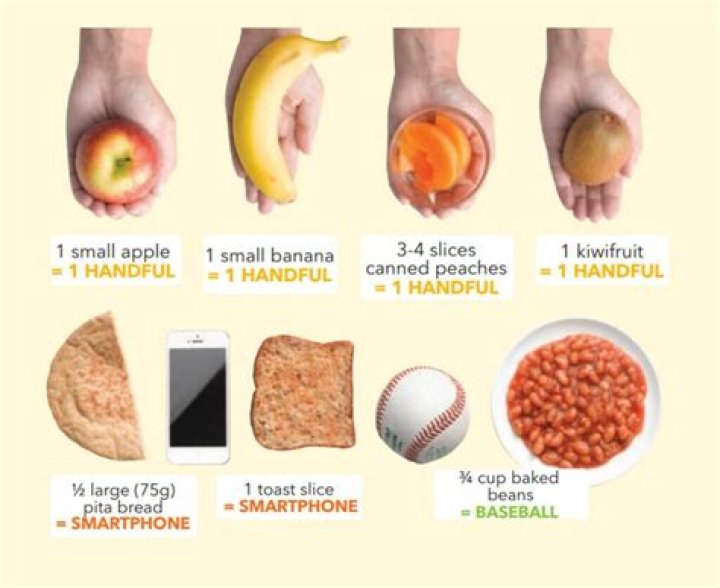
Measuring cups and spoons are great tools for making sure your portion is the same as the serving size, however, these tools aren’t always available when you’re getting ready to eat. Another way to estimate your portion is by comparing it to something else.
- A baseball or an average-sized fist
- Measures about 1 cup
- An appropriate portion size for raw or cooked vegetables, whole fruit or 100% fruit juice
- A tennis ball or small, scooped handful
- Measures about ½ cup
- Equal to 1-ounce equivalent for grains, such as pasta, rice and oatmeal
- A deck of cards or the palm of the hand
- Measures about 3 ounce-equivalents
- An appropriate portion size for fish, chicken, beef and other meats
- The size of the thumb
- Measures about 1 tablespoon
- An appropriate portion size for peanut butter or other nut spreads such as almond butter
- A postage stamp or the tip of the pointer finger to the first joint
- Measures about 1 teaspoon
- An appropriate portion size for oils or other fats
Measure foods regularly to get an idea of what the serving sizes look like. It becomes easier to pick the appropriate amount as you grow more accustomed to it. While serving sizes are a valuable tool, it’s important to listen to your body while eating. If you are still hungry after eating one serving, that likely means you need more food. And if you’re full on less than one serving, that’s OK too.
Overcoming Portion Distortion
It’s easy to mistake a larger portion as a better value. To overcome portion distortion and downsize your helpings, try the following:
- Read the label. The Nutrition Facts label can help you to identify the appropriate serving size. Have you noticed any changes to the Nutrition Facts labels? Many manufacturers already have started to adapt the new Nutrition Facts label on their products, and the new Nutrition Facts label will appear on all food items by January 1, 2021. Learn more about the new labels by visiting the FDA website
- Eat from a plate, not a package. It’s easy to eat more than one serving when eating straight from the box or bag. Portion out your food first and put the container away before you start munching to keep your portion size in check.
- Use the right tools. Try portioning out foods with measuring cups and spoons to give yourself an idea of what the serving size looks like. Small plates and bowls can also make the portion sizes appear larger and leave you feeling more satisfied.
- Skip the upgrade. When dining out, it can seem like a better value to pay 50 cents extra for a larger size. If you can safely transport the food home to eat later, that might be a good deal. Otherwise just stick to the serving size you know you can eat at one sitting without feeling too full.
The portion size that’s right for you depends on what you’re eating and how much you need to feel satisfied while staying within your SmartPoints® Budget. Using tools like measuring cups and food scales makes it easy to dole out right-for-you portions when you’re at home. But toting those tools around when you’re out to dinner or at a party? That isn’t going to cut it.
Luckily, no matter where you are, you’ve got a great portion estimator at hand—literally. Use this guide the next time you need to track a portion.
How to use your hands as a portion guide
- Your fist is about the same size as one cup of fruit or pasta.
- Your thumb (tip to base) is the size of one ounce of meat or cheese.
- Your palm (minus fingers) equals three ounces of meat, fish, or poultry.
- Your cupped hand equals one to two ounces of nuts or pretzels.
Fruit portion guide
Although most fruit is a ZeroPoint food and they provide a lot of health benefits, they aren’t calorie-free. So, what should you aim for? The general rule is two servings of fruit a day.
What does a serving of fruit look like?
- 1 medium apple, banana, orange, or pear
- 2 small apricots, kiwi fruits, or plums
- 1 cup fresh fruit salad
What about fruits that have SmartPoints?
Some fruit is more energy-dense (meaning, higher in calories) and easier to overeat than others. They’re still nutritious, but you’ll want to track them.
- Avocado: 1/4 medium
- Coconut: 1/4 cup
Vegetables
Most vegetables are ZeroPoint foods—they’re a great way to bulk out your meals and help you feel fuller, longer. The USDA recommends 1 to 3 servings a day. A serving is about:
- Cooked non-starchy vegetables like broccoli, spinach, or carrots: 1 cup
- Leafy or raw vegetables: 2 cupts
- Potatoes or other starchy vegetables, like corn: 1 medium (or 1 cup mashed)
And what about vegetables that have SmartPoints?
You’ll want to take that into consideration when it comes to tracking.
Unsure if a veggie has SmartPoints or not? We’ve got you.
ZeroPoint list: Blue
Meat
A serving of meat should take up about a quarter of your plate. Still unsure?
- Red meat: Aim for a portion about the size of your palm
- Poultry: Go for the size of a computer mouse
- Pork: A deck of cards
Carbs
At least half the grains you eat in a day should be whole grain, according to the USDA.
*Unless you’re on Purple and eating whole grains or whole-wheat pasta, you’ll want to track the SmartPoints.
- Rice: 1/2 cup, cooked
- Pasta: 1/2 cup, cooked
- Bread: 1 slice
- Cereal: 1 cup
10 tips for measuring and portioning
6. Whether you’re using a tablespoon or cup, it should be leveled off
The best-measuring spoons and cups are ones that can be squared off for easy leveling.
7. Take your portion and then move away
You can always go back for seconds if you’re still hungry.
8. Eat on smaller plates
Or bring your lunch in a bento box. (Stylish!)
9. Go for built-in portion control
Buy individual servings of items. It may cost you a bit more, but consider it a health savings.
It can be hard to measure out every portion of food you eat. Yet there are some simple ways to know that you are eating the right serving sizes. These tips will help you choose adjust portion sizes to help with weight loss.
A recommended serving size is the amount of each food that you are supposed to eat during a meal or snack. A portion is the amount of food that you actually eat. If you eat more or less than the recommended serving size, you may get either too much or too little of the nutrients you need.
People with diabetes who use the exchange list for carb counting, should keep in mind that a “serving” on the exchange list will not always be the same as the recommended serving size.
For foods like cereal and pasta, it may be helpful to use measuring cups to measure out an exact serving for a couple of days until you get more practiced at eyeballing the appropriate portion.
Use your hand and other everyday objects to measure portion sizes:
- One serving of meat or poultry is the palm of your hand or a deck of cards
- One 3-ounce (84 grams) serving of fish is a checkbook
- One-half cup (40 grams) of ice cream is a tennis ball
- One serving of cheese is six dice
- One-half cup (80 grams) of cooked rice, pasta, or snacks such as chips or pretzels is a rounded handful, or a tennis ball
- One serving of a pancake or waffle is a compact disc
- Two tablespoons (36 grams) of peanut butter is a ping-pong ball
You should eat five or more servings of fruits and vegetables each day to help reduce your risk of cancer and other diseases. Fruits and vegetables are low in fat and high in fiber. They will also help you fill up so that you are satisfied at the end of your meals. They do contain calories, so you should not eat an unlimited amount, especially of fruits.
How to measure out the correct serving sizes of fruits and vegetables:
- One cup (90 grams) of chopped raw fruits or vegetables is a woman’s fist or a baseball
- One medium apple or orange is a tennis ball
- One-quarter cup (35 grams) of dried fruit or nuts is a golf ball or small handful
- One cup (30 grams) of lettuce is four leaves (Romaine lettuce)
- One medium baked potato is a computer mouse
To control your portion sizes when you are eating at home, try the following tips:
- DO NOT eat from the bag. You could be tempted to eat too much. Use the serving size on the package to portion out the snack into small bags or bowls. You can also buy single-serving portions of your favorite snack foods. If you buy in bulk, you can divide snacks up into single-serving portions when you get home from the store.
- Serve food on smaller plates. Eat from a salad plate instead of a dinner plate. Keep serving dishes on the kitchen counter so you will have to get up for seconds. Putting your food out of easy reach and out of sight will make it harder for you to overeat.
- Half of your plate should contain green vegetables. Divide the other half between lean protein and whole grains. Filling half of your plate with green vegetables before you serve the rest of your entrГ©e is one of the easiest methods of portion control.
- Substitute lower-fat varieties of food. Instead of whole-fat cream cheese, sour cream, and milk, buy low-fat or skim instead. Use half the amount you would normally use of to save even more calories. You can try replacing half of the cream cheese with hummus or mix the sour cream with plain yogurt to make this easier.
- DO NOT eat mindlessly. When you snack in front of the television or while doing other activities, you will be distracted enough that you may eat too much. Eat at the table. Focus your attention on your food so you will know when you have had enough to eat.
- Snack between meals if desired. If you are hungry between meals, eat a healthy, high-fiber snack such as a piece of fruit, small salad, or bowl of broth-based soup. The snack will fill you up so that you do not eat too much at your next meal. Snacks that pair protein and carbohydrates with fiber will leave you more satisfied. Some examples are having an apple with string cheese, whole-wheat crackers with peanut butter, or baby carrots with hummus.
To control your portion sizes when eating out, try these tips:
- Order the small size. Instead of a medium or large, ask for the smallest size. By eating a small hamburger instead of a large, you will save about 150 calories. A small order of fries will save you about 300 calories, and a small soda will save 150 calories. Don’t super-size your order.
- Order the “lunch size” of a food, rather than the dinner size.
- Order appetizers rather than entrees.
- Share your meal. Split an entree with a friend, or cut your meal in half when it arrives. Put one half in a to-go box before you start eating. You can have the rest of your meal for lunch the next day.
- Fill up with lower calorie foods. Order a small salad, fruit cup, or cup of broth-based soup before your entree. It will fill you up so that you eat less of your meal.
Eating a variety of foods from each food group will help you get the nutrients you need.
The Dietary Guidelines describe three USDA Food Patterns, each of which includes slight variations in amounts recommended from different food groups. For example, people 50 or older following the Healthy U.S.-Style Eating Pattern choose foods every day from the following:
- Vegetables — 2 to 3 cups
- Fruits — 1½ to 2 cups
- Grains — 5 to 8 ounces
- Dairy — 3 cups (fat-free or low-fat)
- Protein foods — 5 to 6½ ounces
- Oils — 5 to 7 teaspoons
Does this mean you have to measure or weigh everything you eat? Not really. Some people find it helps to measure things carefully at first, but once you get used to your new eating plan, strict measuring probably won’t be necessary. But, what exactly is a serving? And is that different from a portion?
A “serving size” is a standard amount of a food, such as a cup or an ounce. Serving sizes can help you when choosing foods and when comparing like items while shopping, but they are not recommendations for how much of a certain food to eat.
Read and share this infographic to learn about making smart food choices for healthy aging.
The term “portion” means how much of a food you are served or how much you eat. A portion size can vary from meal to meal. For example, at home you may serve yourself two small pancakes in one portion, but at a restaurant, you may get a large stack of pancakes as one portion. A portion size may also be bigger than a serving size. For example, the serving size on the Nutrition Facts label for your favorite cereal may be 1 cup, but you may pour yourself 1½ cups in a bowl.
Portion size can be a problem when eating out. To keep your portion sizes under control, try ordering one or two small appetizers instead of a large entrée. Or, you could share an entrée with a friend, or eat just half and ask for a take-out container for the rest. Put the leftovers in the fridge as soon as possible. Then enjoy them the next day for lunch or dinner.
Snacks are okay, as long as they are smart food choices. If you want an afternoon pick-me-up or after-dinner snack, have a piece of fruit, or spread peanut butter or low-fat cream cheese on whole wheat toast. Don’t forget to include snacks in your daily food count. For example, 1 tablespoon of peanut butter spread on a slice of whole wheat toast counts toward the protein foods group and the grains group. Some ideas for healthy snacking include:
- Have an ounce of cheese with some whole grain crackers, a container of low-fat or fat-free yogurt, or a 1-ounce portion of unsalted nuts.
- Put fruit instead of candy in the bowl on your coffee table.
- Keep a container of washed, raw vegetables in the fridge along with hummus or other healthy dips.
- To limit your portion sizes, don’t eat from the bag. Count out a serving, and put the bag away.
- When you are out and need a snack, don’t be tempted by a candy bar. Instead, take along homemade trail mix in a plastic bag when you go out. If you need to buy a snack while you are on the go, pick up an apple or banana—most convenience stores carry them.
For More Information About Serving and Portion Sizes
USDA Food and Nutrition Information Center
National Agricultural Library
301-504-5755
[email protected]
This content is provided by the National Institute on Aging (NIA), part of the National Institutes of Health. NIA scientists and other experts review this content to ensure that it is accurate, authoritative, and up to date.
Content reviewed: April 29, 2019
Articles
Latest News
Related Articles
What Do We Know About Diet and Prevention of Alzheimer’s Disease?
Carbohydrate counting is an important element of diabetes care, but while it may sound like a difficult task, it doesn’t have to be. Two skills make carb counting easier: Memorizing the carb counts in certain foods and estimating portion sizes.
Portion know-how can tell you that, for instance, 1/3 cup of cooked brown rice has 15 grams of carb. This doesn’t mean that you can eat only 1/3 cup of rice, says Alison Evert, MS, RD, CDE, coordinator of diabetes education programs at the University of Washington Medical Center and dietitian and a diabetes educator at the Endocrine and Diabetes Care Center there, but it makes it easier for you to measure and count the carbs. So, a cup of rice would have 45 grams of carbs.
This is what Evert calls “carbohydrate awareness.” There are food lists available, such as the National Heart Lung and Blood Institute’s list, the The CalorieKing Calorie, Fat, and Carbohydrate Counter book, and the American Diabetes Association’s Choose your Foods: Food Lists for Diabetes, which give carbohydrate grams for certain portions of food.
1. Measure your food
Using measuring cups and/or a food scale, measure your food once or twice a month at home, says Evert. This can help you visualize what the proper portion of food—say, that 1/3 cup of rice—looks like on your plate. This is also true of beverages. Pour 8 ounces of your smoothie, soda, or milk into a liquid measuring cup to see what a recommended serving looks like.
2. Estimate serving sizes
Your fist can be an excellent tool for approximating portion sizes, says Hope Warshaw, MMSc, RD, CDE, author of Eat Out Eat Well: The Guide to Eating Healthy in Any Restaurant . When you’re unable to measure your food (while dining out, for instance), you can place your fist next to your plate to try to quantify the food you are eating. This is also true for other parts of the hand, which makes measuring your recommended 3 ounces of lean meat or tablespoon of dressing a cinch:
- Fist = 1 cup
- Palm of hand = 3 ounces
- Entire thumb = 1 tablespoon
- Tip of the thumb (to the first knuckle) = about 1 teaspoon
3. Read food labels
Probably the easiest way to understand portion sizes is to read a nutrition label. Though they won’t help you when dining out, food labels are invaluable tools when cooking at home or eating packaged food. But keep serving size in mind: If you’re eating an entire can of soup, but the serving size is half of a can, you’ll need to double the total carbohydrate grams.
4. Try portion control dishes
If visualizing your food on a plate helps you to understand appropriate portion sizes, consider investing in a set of dishware that removes the guesswork. You can purchase plates and cups that indicate how much of each food group should be on represented in your meal. (We love this gadget.) If you aren’t in the market for new plates, visualize your plate divided into quadrants. Each food group—protein, grains, veggies, and fruit—should take up one quadrant.
5. Limit your snacks
Sometimes it can be hard to stop snacking once you’ve started, particularly if your snack comes in a larger bag. Try portioning out appropriate snack portions into baggies or containers so you don’t get carried away when hunger strikes.
Planning a party has enough challenges as is, but one of the areas you want to make sure you have covered is the food. Hungry guests are difficult to keep happy especially if food is promised in advance through an invitation or by word of mouth. How much food is really enough is a question you should ask yourself at the start of your party planning. If your throwing a get together here are some tips on how much food you should really be buying.
For many people, one of the toughest challenges when planning a party is trying to decide how much food they will need to serve. I’d love to say that there is a fool-proof formula to solve this dilemma but, in the end, the answer to this question involves more art than science.
Many factors come into play when you make your plans including the length of your party, the type of food you’ll be serving, the composition of men, women, and children in your group, as well as the richness of the food you plan to serve. The time of your party is also very important. An after-dinner cocktail party requires much less food than an all-afternoon barbecue. Not all gatherings feed equally and you shouldn’t feel pressure to overfeed if it’s unnecessary. Make sure to research what type of food is appropriate for each setting when entertaining.
General Tips and Guidelines
Fortunately, there are a number of general principles you can follow when planning your menu and recipes. Begin by following these “rules of thumb” and write down your initial thoughts. Then look at the big picture several times over a period of a few days to make adjustments to your plan.
- Always round up your estimates, don’t round them down.
- Anticipate which food selections will be most popular and serve more of them than the general portion guidelines suggest. For example, shellfish appetizers are always popular, so serve as much as your budget allows.
- The more choices you offer, the smaller your calculation of individual portion size should be.
- That said, you can assume your guests will taste everything on a buffet, but the tastes will be small. However, overall consumption per individual will be greater than if there were fewer choices.
- Add “bulk” items to your menu. For a sit-down dinner have plenty of bread to fill in any hungry spots. When hosting a cocktail party, nuts, olives, pretzels, etc. provide a little extra security that you’ll have enough for all but requires no extra work.
Here are basic guidelines for individual serving sizes of various foods. Multiply these estimates by your number of guests and, once again, always round up your estimates.