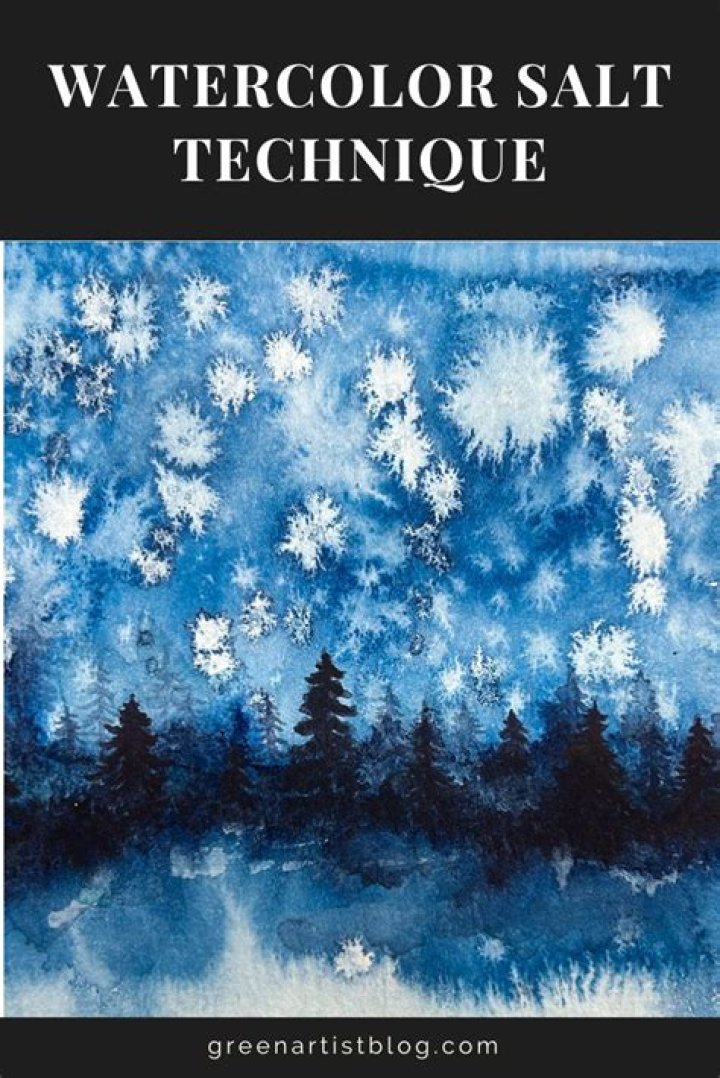
Materials and Objective
MATERIALS: Arches 140lb cold press watercolor paper, iodized table salt, Grumbacher 1″ flat red sable. A small square of dry cellulose sponge.
COLORS (various manufacturers): Alizarin Crimson, Cobalt Blue, Sap Green.
Start With a Painting
Using a 1″ flat red sable, I use washes of Cobalt Blue to paint a sky area. I graded the sky using lighter bands of Cobalt Blue closer to the horizon.
Using straight Sap Green, I blocked in the hill in the bottom right corner.
The Hills Ran Crimson
I washed in the Alizarin Crimson hill on the left and pulled a stroke up the top edge of the Sap Green hill a bit.
I let the Sap Green and Alizarin Crimson battle it out where they met in the middle.
When it Rains…
Holding my new tool, a canister of salt, I slipped open the metal spout and tried a few light dustings of salt and watched.
Hmmm… there’s salt sitting in puddles of paint. Looking like…salt sitting in puddles of paint.
As the minutes passed, I decided to add a bit more salt to the heavier areas of wash on the bottom.
Wow, I’m Impressed!
There’s not much happening at this stage. So now I watch the drying to see what happens.
There were a few areas I’d left to drop the salt on when almost dry. I dropped a bit of salt in those areas.
I set it aside to dry thoroughly.
Pass the Salt, Please
As the painting dried, the salt’s effect on the watercolor washes became visible.
But there was salt stuck all over my painting!
Using a clean dry hand, I gently started brushing away the salt from the sky area.
As I got to the hill sections heaviest with salt it felt like I was sanding my skin off! There was more available binder (gum arabic) in the more intense washes which held the salt tight.
Change of plans.
The Proper Tool for the Job
I cut a dry cellulose sponge into a small square to uses as a surrogate for my skin.
This enabled me to quickly and gently rub away the remaining salt. When removing any abrasive from your paint (salt, sand, etc.), take care not to scratch the painting’s surface. Brush lightly.
The Salt Watercolor Texture Effect
Click image to enlarge.
As the washes dry the salt crystals suck up pigment gradually, creating a myriad of light star-like shapes. This is most noticeable in the sky areas and was less effective, and different, in the darker areas.
Experiment with various types of salt: table salt (iodized and non-iodized), sea salt, rock salt, kosher salt, etc. Larger-grained salt will produce a larger, more pronounced starring effect.
I have no idea how salt affects the longevity of your art. Considering salt’s corrosive nature, I would think over time it may interact with pigments and natural paper fibers in an unintended way.
For more on how to use this cool salt technique in real watercolor paintings, check out these examples:
Creating a Watercolor Card Using the Salt Technique Step-by-Step Nebula & Stars in a Galaxy
Salt painting is a really fun activity to do with the kiddos without a ton of supplies or expense. This activity is super easy but provides a ton of fun for children.
Salt Painting
I’m always trying to come up with new ideas and crafts to do with the kids and we recently tried salt painting. We love to do activities that are fun but do not require a ton of supplies or expense.
We learned how to make puffy paint and today it’s all about Salt Painting. It’s a really fun activity and it’s always a big hit.
You will probably have most of the supplies on hand so it’s all very easy to put together. This is an inexpensive activity but will keep the kiddos attention for quite some time.
What is raised salt painting?
Kid’s get to make a design out of glue and then salt is sprinkled over the design. Watercolors complete the design for a gorgeous craft project.
I use Crayola water colors but you can use the brand you prefer. It’s such a simple project and so cheap to make that you will love doing this!
Don’t forget to use card stock because you need something that will hold up to the salt and paint. Regular paper will be too thin.
Can you add salt to paint?
Yes you can. The salt absorbs liquid and makes a super cool design.
It is always fun to see how the design turns out. Everyone can show off their creativity.
Materials:
- white glue
- table salt
- watercolor paints
- card stock
Check out this video on how to do this Easy Salt Painting for Kids!
How do you do salt painting?
1. Use white glue to draw a design or picture onto a piece of card stock. I like to cut small pieces that fit onto a paper plate.
2. Once you are finished with your glue drawing, liberally sprinkle salt onto the glue.
3. Gently shake off onto the paper plate and set the plate aside.
4. Place your salt covered card stock onto a flat surface covered with newspaper or wax paper.
5. Use watercolor paints to gently paint onto the salt. This is so neat to see the picture come together with lots of gorgeous colors.
6. You won’t need a lot of water, but the more pigment color you have on your brush the better. Once finished, set aside to dry completely.
Salt painting is such a fun and inexpensive craft to do with the kids!
We love art projects and this one is so simple and easy. Raised salt painting is a great boredom buster for children and fun process art.
The entire painting process is neat. Salt and glue combine for a really neat project. The kids are always amazed at how each picture turns out and how much fun it all is!
Everyone’s creativity really shines and it is fun to see. This is great for children of all ages and a simple but cost effective art project to try!
We love projects that are frugal but fun. That is a must around here as we always try to stay on budget and implement activities that are inexpensive.
This is a great reminder that it does not have to be complicated or expensive to be fun!
Make Salt Art today and see all the different creations you can make!
Kid’s of all ages enjoy doing this activity! Gather the kids and start crafting!
This is also a fun activity for a group of kids or even a party! Everyone can make the design they prefer.
Just remember to use card stock because regular copier paper will not hold up! Have fun with this cool Glue Painting!
Gather the kids and have a blast! Everyone will love painting with salt and water. It is a blast to use water colors to see the design come alive.
We have so much fun with DIY projects!
If your kids love to do fun DIY activities, they will love to learn how to make floam! Your kids will be amazed and have a blast making this.
Learn how to make Homemade Playdough Recipes that your kids will go crazy over. It so easy to make homemade playdough and you can easily make scented, edible, glitter and more varieties of playdough at home!
If your kids love playdough, they are going to go crazy over this Color Changing Homemade Playdough Recipe.
It is so easy and frugal to make homemade bubbles and your kids will have a blast.
Learn how to make glue and save a ton of money on your craft projects.
We love trying new activities and have tried so many different DIY fun activities. There are lots of cool ideas to try.
Get started today and let us know what you try. These are perfect for rainy day activities or when it is simply too hot to play outside.
The kids will be entertained for hours! Yeah!
No need to spend tons of money with inexpensive projects like these to try that are so fun! Choose one or several ideas and be prepared for a ton of fun with the family!
Learn how to make a tornado in a bottle for a really fun activity with your kids.
Perler bead crafts are so much fun and we have over 15 easy perler bead ideas.
Have you been wondering how to hydro dip? We have a very simple but fun tutorial so you can learn all about hydro dipping.
We are going to show you how to make puffy paint and it is super easy for a really fun activity at home.
Available on Amazon
This easy watercolor painting is primarily an exercise I created for my students on how to use salt to create believable textures.
Rather than just experimenting with salt and watercolor I felt it was just as easy to end up with a nice little painting. This painting is part of my series of simple watercolor paintings for relatively new watercolor artists.
The first step was to do a variegated watercolor wash.
Watercolor materials used
- Winsor and Newton artist’s quality watercolor paints: cobalt blue, cadmium orange, permanent alizarin crimson, French ultramarine, and burnt sienna.
- Quarter sheet ( approx. 37cm x 27cm or 14.5” x 10.5”)of Arches 300 gsm (140 lb) cold pressed paper.
- The paper is taped onto a piece of Gator Board or another waterproof board.
- Common table salt. You can try some rock salt for a different effect.
- Round watercolor brushes. Sizes 24, 16, and 8.
Finished simple watercolour painting with salt demonstration.
Easy watercolor painting steps
The trick to creating a nice clean watercolor wash is to use a fully loaded brush with lots of water and pigment. A fully loaded brush is one which will drip if head vertically with the point down.
For this painting, because I wanted a noticeable transition between the colors, I only had my board at about a 10° angle. I started at the top with my cobalt blue and a touch of permanent alizarin crimson mixture. Into the bottom of this cobalt blue and alizarin stage I then went in with my cadmium orange mix. This was followed with the alizarin crimson and then burnt sienna.
I cleaned my brush between the cobalt blue and cadmium orange stages, but not between the two other transitions.
You can see the result of this initial under painting in the photograph below. You can see how wet the watercolor wash was from the shine on the surface of the paper and the amount of pigment beading at the bottom.
I find that the best time to sprinkle salt is just as the shine is beginning to leave the surface watercolor paper. It should still be quite wet however. This is something that you learn with a little testing.
If you have not used this technique before I suggest you try it on some scrap watercolor paper first. Try sprinkling salt when the test paper is very wet, then when it is just losing its shine, and finally when it is barely damp.
If you sprinkle the salt when the paper still has a lot of shine on it and you move your painting the moving water and paint on the surface will remove much of the effect of the salt crystals.
However if you wait too long very little salt effect will occur.
I sprinkled the salt around the alizarin Crimson and burnt sienna, transition area. Do not sprinkle from too great a height or some of the salt crystals will bounce and end up all over the place. I sprinkled from about 2 inches above the painting surface. You can see from the image below that I varied the amount of salt I sprinkled to create a more interesting patent than just sprinkling a uniform straight line of evenly distributed salt.
You can see from the close-up image below how the salt crystals absorbed watercolor pigment and moisture from the painting surface.
You need to leave the salt crystals on your watercolor paper for quite a while to let them absorb significant quantities of pigment and water. This is what I refer to as the salt effect.
You can see, in the image below, the initial stage of salt crystals working. I leave my paper untouched until it achieves the effect I am after.
Once the salt has created the effect I was aiming for I dry the painting using a hairdryer. Make sure you do not use the hairdryer so close to your painting that it roughs up the wet surface. Otherwise you can lose some of watercolor painting’s beautiful translucency.
You can see from the image below the stage at which I dried my painting.
After the painting had totally dried I rubbed off the remaining salt crystals with a tissue.
You can see more detail of the final result from using salt on the watercolor surface in the close-up image of a section of my painting below.
These salt shapes suggested to me flowers blowing in the wind or seed heads of flowers such as dandelions. So in the next step I placed various colored watercolor dots in a number of the flowers’ centers.
While these dots representing the centers of flowers were still wet I dribbled water from my spray bottle over the area of flowers. This made some of the colors run. I also used my size 8 round watercolor brush to add some additional colors to the various flower heads.
Using some of the burnt sienna mix that was still in my palette I added some French ultramarine and use this to create the stems of flowers. Notice how I varied the spacing between these flower stems and their shapes and colors to add interest. You can see this watercolor painting step below.
This easy watercolor painting was nearly finished. All that was required now was to place an image representing the moon the top left-hand quadrant of my painting.
This was achieved by first lightly drawing a circle using a coin as a template ( I used an Australian 10 cent coin). I then used white gouache to create the impression of the moon within the circle. The gouache was painted on about one third of the area along one side of the circle. I then used a wet brush to soften this edge which spread a very small amount of gouache to the non-sun lit part of the moon. Once the moon shape was totally dry I erased any remaining pencil marks.
I finished this simple watercolor painting by signing it on the right hand side to balance the work.
Here is another version of this same painting.
One of my students ended up with some pretty harsh cauliflowers because of some excess pooling of water. However when I looked at her painting it suggested to me a series of mountains in the distance. So with her permission I quickly painted a wash of French ultramarine and some alizarin over the cauliflowers shapes. This was the result:
This technique can be used for both easy watercolor paintings and more complex ones.
A common question asked by students is does the salt damage the painting. I honestly do not know however I know of artists that have used salt in paintings 20 years ago with no noticeable damage to their work. Also as salt is often used as a preservative I suspect it will not cause any lasting damage to the work. However I leave it to you to make your own decisions on the matter, I am a watercolor artist not a chemist!
Share this:
Author: Joe
Owner and adminstration of the Painting With Watercolors website and forum. I am a professional watercolor artist, though I also use other mediums including pen and ink. I also enjoy playing with computers and the internet so this website is a bit of a hobby of mine. View all posts by Joe
3 thoughts on “Easy watercolor painting using salt”
Thanks for the demo. I now know why I failed the first time I tried this!! Love the mountains!!
Hi Joe. I’ve been painting on and off for most of my life but as I grow older my interest especially in watercolor painting is really growing. Am hoping to take it up on a full time basis eventually but for now I know I have a lot of learning to do. Thanks for the tips. I love your work.
Leave a Reply Cancel reply
This site uses Akismet to reduce spam. Learn how your comment data is processed.
All activities should be supervised by an adult. By using this site, you agree to our Terms of Use. This post may contain affiliate links. Read our disclosure policy here.
Now that winter is here and there is plenty of snow on the ground we’re sharing some fun winter activities to keep your kids busy when the weather is cold. Salt painting is a fun process art activity to do with kids. It’s easy to set up and the results can be so beautiful! It’s also really fun to watch the watercolors run along the salt as you paint!
Salt Painting
We made salt painted snowflakes, but this activity can be adapted for any art image you’d like! And you can grab our free printable to trace at the bottom of this post, or you can hand draw your own snowflakes!
Watch the full tutorial video here before you get started!
We love how vibrant and crystallized these salt painted snowflakes look. Adding the watercolors to this salt art makes these snowflakes just pop! And what better image to create with salt than a snowflake since it almost makes it look like a large snowflake on your paper!
Supplies Needed for Raised Salt Painting
– Liquid watercolors – we like this brand
– Salt (any kind will do)
– White glue – this bottle size is the best for tracing our template as the nozzle is small. When you add the salt on top of your glue tracing it will keep the snowflakes a good size.
– A little bit of water
– Snowflake template – get the free printable template by subscribing to our newsletter on the form with the preview of the template
Watercolor Salt Painting
1. First, print off our template on cardstock paper (you can grab the template by subscribing to our newsletter on the form with the preview of the template). Alternatively, you can print off any image to trace or free hand the snowflakes yourself!
2. Begin by tracing the snowflakes with your glue. We like to use this bottle of glue since the nozzle at the top is smaller. The larger bottles have larger nozzles and will let out more glue when you use them making the snowflakes too large.
Finish tracing every line and dot on your page, or make your own snowflakes!
3. Now is the first fun part – sprinkle on your salt! We like to keep a separate stash of salt for art activities. So when you’re done you can scoop off the remainder and store again for another salt craft.
Pour A LOT of salt over your image to ensure you coat every small piece of it. If you miss a piece then the color won’t run over that part.
4. Now shake off your excess salt from your page and you should have something that looks like this:
5. Now you can begin to paint with your watercolors! We like to use liquid watercolors as they are easy to use and more vibrant than food coloring, but food coloring would also work. If you’re looking for a low cost brand of liquid watercolors we like these ones.
TIPS FOR SALT PAINTING:
- Use a highly concentrated solution of your liquid watercolors. Only add a small amount of water to your solution to keep the color vibrant.
- Dip your paintbrush gently into your liquid watercolors to get only a little bit of watercolor at a time. If you have too much water when you’re painting the water will spill over and get your paper very wet. This is fine if you’re doing this art activity for fun but if you want to keep your art or are doing this with older kids we found it works best with just a little bit of paint.
- You can paint after the glue dries or right away – it shouldn’t make a difference!
- Use some cardboard underneath your cardstock to avoid getting your counter or table wet as the liquid watercolor will seep through a bit.
Now watch the magic! As you gently tap your salt with the paintbrush, the salt will soak up the watercolor from your brush and spread like magic!
Keep painting until you’ve painted all of your snowflakes!
6. Once you’re done, let your painting dry. Be careful not to touch the salt or it may come off. If you do accidentally knock off some salt, if you scrape it all off you’ll be left with a beautiful watercolor painting underneath.
Sign up for our Newsletter and get this Snowflake Template as a thank you!
If you are having trouble getting the email confirmation, make sure you check all folders as it can sometimes land in the promotion and junk folders.
Want more Winter activities?
We’ll show you how to make fake snow 3 ways – these are all really fun Winter sensory activities!
These popsicle stick snowflakes are so fun to make!
This snow globe sensory bottle is fun to put together too! Get the details on how to make it here.
Join Us! Follow The Best Ideas for Kids on Facebook, Pinterest or Instagram
posted by The Best Ideas for Kids on December 17, 2017
About the Author
Kim is the author of the kids craft book, Fun & Easy Crafting with Recycled Materials. She is a mom of two that loves to share easy crafts, activities and recipes for kids.
Subscribe
Fun & Easy Craft Challenge
Take our FREE 5-day craft challenge with boredom busting activity ideas for kids!
Success! Now check your email to confirm your subscription.
By signing up you’ll also receive our free weekly newsletter.
Salt is a fun, experimental tool to use when watercolor painting. Salt painting, or what is also commonly called salt technique, is very easy to do, and the results can be surprisingly wonderful.
Of course, the results can also be surprisingly not wonderful. When using salt with watercolor, you’re never going to be completely in control, but there are a few things you can do to gain the best results possible.
There are infinite watercolor effects that are possible when using salt with watercolor, but this simple tutorial on basic salt techniques should help you get started and make the most of this common ingredient in your watercolor paintings.
Video Tutorial: Salt Technique with Watercolor
Before we dive into the various factors involved in salt painting, I thought it might be helpful to share a simple video tutorial on how to use salt with watercolor. After watching the video, the information below should give you more ideas on how you can experiment with this technique.
A quick watercolor tutorial on painting a snowy winter sky using a salt technique.
“>,”hSize”:null,”floatDir”:null,”customThumb”:”597a5e963a0411960d55834b”,”html”:” n “,”url”:” data-block-type=”32″ >
P.S. Big “thanks” to my very generous & techie young son who put together my video. We have a lot to learn, but I’m thankful he is so willing to help his very non-techie, not young mama.
P.S.S. That initial, weird blue stuff is masking fluid applied with a Molotow masking pen— the best masking vehicle ever! I’ll never go back to toothpicks, Q-tips, or junkie brushes for application.
Instructions & Tips for Using Salt with Watercolor
Listed are the steps for the process I used in the video above:
1) Paint underlying watercolor colors.
2) I allowed the page to dry until the moisture sheen on the surface of the paper was just beginning to disappear, but you can vary this to get different effects. (More on this below.)
3) Sprinkle salt in desired areas.
4) Allow paper and paint to completely dry. (Very important!)
5) Lightly brush away salt. Be careful! When removing the salt, it’s all to easy to sand or scratch the surface of the paper.
6) Continue painting the rest of the scene.
Salt Painting with Various Salts
My subtitle sounds kind of redundant, but it makes sense! There’s a huge array of salts available, and each type will react differently on a page.
One of the most common table salts is the brand name Morton or a generic similar. Because of the additives and fillers in this salt (just read the label), I don’t keep this salt around the house. Though it will work in a painting without harm, I’ve only used it when traveling (hey, those salt packets are free!) and with lackluster results.
Above are some examples of salts that I’ve tried, from finely ground to grated to course Kosher. I actually love the grinder because it simultaneously releases various sizes of salt granules, so I find it a great advantage with watercolor.
By the way, if you decide to try that one, go ahead and buy two so your housemates (like mine) won’t constantly have to search for the salt on your studio table.
(So sorry, sweet family! I needed the salt shaker. Again.)
Salt Painting with Various Papers
I mainly use cold-pressed watercolor papers when painting, or as my friends across the pond say, “not hot pressed.” Except for the samples below, every other example in this post is painted on cold-pressed.
No matter your personal choice, salt painting works fine on most watercolor papers— hot, cold, and rough. And except for Yupo (which is always a hot movin’ mess and never seems to dry in my humid, southeastern climate), I really can’t tell much difference.
In the examples above, I tried to make sure that I sprinkled the same amount of salt on a similar wash at the exact same stage of drying, but there’s no way to perform a lab experiment with this. at least not in my house. But you may can do better than me!
This is one of the many reasons that you never know what you’ll get when doing a salt technique. Have fun experimenting!
Saturation Level of the Paper
When using a salt technique, I think the greatest variable depends on the saturation level of the paper. The general rule is that the drier the paper, the less effect the salt will have. Placing salt on a very wet wash or pigment load will result in a lot of movement, while sprinkling salt on a nearly dry wash will result in a very limited effect.
The saturation level of paper is a great way to control the final look that you want to achieve. However, it’s not a hard and fast rule because humidity, the type of salt and paint used, the paper’s characteristics, and many other variables can affect pigment movement and control, but the paper’s wet/dry ratio is the best gauge.
Other Variables Using Salt Technique
I just mentioned this above, but when using a salt technique, I’ve noticed that certain pigments or paints will move more than others on a page. Staining pigments may not react as strongly as nonstaining pigments, and granulating pigments may sometimes go a little crazy or not react at all. Weird.
Humidity in the air and in the paper can also affect the process. Also, the same pigment but in a different watercolor brand may also react differently to salt.
If you are interested in having more control, it’s going to take practice. It’s a good idea to do some test swatches like the ones above but with the paints in your palette. Once you discover a few colors and techniques that work best for you with the products you use, you’ll be able to more accurately predict the results. most of the time.
I love making our own art materials. I can spend a fortune in an art/craft store in the blink of an eye so it is such a relief to make our own materials with inexpensive ingredients at home. Colored salt is a very easy material to make with ingredients I bet you have lying around the house at this very moment. And this project is great for little hands. My daughter couldn’t wait to start mixing!
Materials
- Salt
- Food Coloring or Liquid Watercolors
- Ziploc Bags
Instructions
- Step One Add the desired amount of salt to a Ziploc bag.
- Step Two Add food coloring to the bag. The more food coloring, the more saturated your colors.
- Step ThreeThe most important step! Press out all the air from the bag and securely close it. The last thing you want is a bag of exploded food coloring and salt all over your house!
- Step Four Knead the salt and coloring until it is all mixed together. I found that waiting to mix everything a minute or so after adding the food coloring made for less coloring clumps and an easier mixing process.
You’re done! If you’ve added a lot of food coloring you may want to let your salt dry out a little by leaving it exposed to fresh air. Otherwise, you can either store it in the Ziploc bag or another airtight container.
So now that you’ve made colored salt what do you do with it?
- Water Color Painting with Salt Salt adds a great texture to water color paintings. If you haven’t tried it, have your kids sprinkle some salt on the page the next time they do a watercolor paining.
- Salt and Glue Paintings Have your child “paint” a picture using glue, sprinkle salt over the glue to create the color, then shake off the excess salt.
- Salt Layering Give your child a clear glass bottle, a spoon, and several colors of salt, then ask them to layer the various colors.
- Ice Sculptures We made these last year at my children’s preschool and they were a hit! Sprinkle colored salt over large chunks of ice; the colored salt both helps to melt the ice and create colorful patterns.
- Salt PendulumThis batch of salt was made specifically for this science/art project. Check out the tutorial here.
For more fun projects using colored salt check out the web. Unless the project involves water or a living plant, colored salt can easily be substituted for colored sand in many an art project.
Fill your child’s life with more art, design, and science!
Subscribe to our free newsletter and check out our FB page where I share tons more creative ideas and resources from around the web.
One of the endearing qualities of watercolor paint is that you can use a number of deceptively easy tricks to create some unexpected textures in your watercolor paintings. Not knowing the secrets, your audience will marvel at how difficult it was to complete your painting and how long it must have taken!
Sprinkling salt
A little table salt sprinkled on damp watercolor paint creates a delicate flower-like spot. Each crystal of salt chases away the pigment to make a lighter area beneath it. You can use this texture to create a field of flowers, snow, or leaves on a tree. It also creates interest in a background or foreground where not much else is going on.
Salt doesn’t always work the way you hope it will. It involves the right pigment at the correct dampness and speed that the paper and air dry. Sometimes you just can’t predict what will happen, and that’s half the fun. But if you use the following steps, you should get an interesting result from using salt:
1. Wet a piece of 5-x-7-inch watercolor paper with clear water.
2. Place the paper on a flat surface and paint the area where you want to use the salt.
3. Wait for the magic time when the paint is damp and shiny. If the paint is dry, this technique won’t work. If the paper has puddles, pour them off or absorb the excess water with the corner of a paper towel.
4. Add the salt. Less is more. Take a pinch of salt in your fingers and sprinkle a few grains rather than dumping a whole shaker on your painting.
5. Let the painting dry without disturbing the salt.
6. Brush away the salt after the paint dries.
If you apply the salt too thickly or add it when the paint is too wet, it tends to stick and not brush off when dry. The salt won’t hurt the painting, but it will give it some real texture and a little crystal sparkle.
Reusing plastic grocery bags
Here’s a great way to recycle all those plastic bags: dry cleaning bags, kitchen food wrap, newspaper sleeves, grocery bags, and so on. Basically, you crumple the plastic and push it into wet paint. After the paint dries, you remove the plastic, and it leaves behind lighter areas and a textural pattern. This technique makes great texture for rocks and mountains.
To use plastic in your painting:
1. Tear or cut the plastic into a manageable piece and wad it up. About 6 inches square is a good size.
2. Wet your watercolor paper and paint some colors onto it with a half-inch flat brush.
3. Set the wadded plastic in damp paint on your paper. Remember that the paint must be damp to make this work. If the plastic won’t stay in contact with the paper, set something like a can or bottle on it to weight it down.
4. Leave the plastic on the paper until the paint dries, then lift it off. The plastic leaves a shape behind wherever it touched the paper.
Explore the gorgeous process art technique of salt, glue and watercolor painting to make beautiful snowflake art.
Salt and glue snowflakes
This snowflake art project combines watercolour paint with salt and glue. Watch the colour ‘jump’ along your snowflakes!
:: snowflake guide from the Ice and Snow Unit or white card and pencil or marker pen to draw your own
:: PVA white craft glue in a squeezy bottle
:: paint brush or pipette
Begin with simple drawings of snowflakes on card.
You can use the snowflake printable from the Ice and Snow Unit or you might like to draw your own.
Carefully trace over the snowflake outline using a squeezy bottle of white glue.
Then sprinkle a layer of salt over the top of your glue snowflake
Completely cover the snowflake with salt, then gently shake off the excess salt that isn’t stuck to the glue to reveal a salt snowflake.
Apply watercolour paints on top of your salt snowflake.
Use a concentrated / strong watercolour, with a good amount of paint and just a little amount of water.
Use a paint brush or a pipette to gently drop a little paint on to the salt of your snowflake. Watch how the salt absorbs the paint and it seems to jump along the line of your snowflake.
Keep carefully applying paint, little by little, until you have coloured your whole snowflake.
You can vary the colour paint you use and make more snowflakes of different designs.
How to download this printable
The snowflake guide sheets are included in our Ice and Snow Unit.
Everything you need for a winter unit, all in one place.
:: over 80 pages of lessons, activities, and printables
:: a complete unit of Ice, Snow, Arctic, Antarctic, Polar Bear and Penguin-themed science, math, literacy, arts and crafts, sensory, food and play
:: materials lists and bonus printables make it so easy!
:: everything planned for you, so you can enjoy it as much as your children do
:: created with children aged 4 to 8 in mind
Save time and teach better with NurtureStore’s resources!
Comments
Heather says
If I put wax paper between the glue and the paper cut out could I remove them? Not sure if you tried just asking so my students can hang them up?
Cathy James says
Hi Heather. I’ve made them using just glue (no salt) on plastic sheets, and they pulled off and could be used as a window cling. I wonder if the added salt might make them heavy, and I don’t think they’d be rigid enough to hang on their own – from a sting – but they might work as window clings. Let me know how they turn out, if you try it!
Erin says
All of my snowflakes are falling apart after they dry. Did you have this problem?
Cathy James says
Hi Erin. No, we did not have this problem. We kept the paper flat/horizontal and enjoyed the process of making the snowflakes. Are you perhaps trying to hang the printables vertically on a wall? To do that, maybe you need to use more glue and less salt, so you don’t have gravity working against you too much?
Melissa Pallotto says
Has anyone tried putting the snowflake pattern on a paperplate and then proceed with the glue and salt? Would they hang then?
Leave a Reply Cancel reply
This site uses Akismet to reduce spam. Learn how your comment data is processed.
Hold it right there: Before you start adding fancy details and textures to your work, you need to know a few of the most basic watercolor painting techniques. Use these to get started, then build on them however you like.
1. Watercolor Washes
There’s more than one way to approach laying a watercolor wash — you can either do it on a wet surface or a dry one.
One tip for any watercolor wash: If you notice a mistake in a previous stroke, don’t try to fix it. Once the wash has started to dry, a new stroke will almost definitely be more noticeable than any small mistake. It’s best to leave these happy little accidents as they are.
Dry Wash
Use a large flat or round brush and an angled surface like a drafting table or easel (this way gravity does some work for you.) On your palette, mix a generous amount of water with your chosen pigment. Remember that watercolors dry lighter than they look when they’re wet. You might want to practice on a scrap of watercolor paper first.
Load your brush with as much paint as it’ll hold. Then, working quickly, make a steady, controlled horizontal stroke along the top of the paper. You’ll notice the water in the first stroke starts to pool along the bottom edge — don’t let this dry! Reload your brush with pigment and paint another stroke just below the first one, overlapping with the bottom edge.
When you reach the bottom, blot your brush on a paper towel, then use the dry tip to carefully pull up the excess paint along the bottom of the final stroke to avoid a darker bottom. Let your paper dry completely at an angle before setting it down flat again.
Wet Wash
A wet surface watercolor wash is about the same as a dry wash, with one main difference: First you’ll dip your brush in water and brush it over the whole surface. Be generous with the water here — you want the paper glistening with moisture.
Once you’ve wet the area, dip the brush in paint and apply lines of color within the wet area, just like you would with a dry wash. The paint will blend together into one luminous wash of color.
2. Wet-In-Wet Watercolor Painting
Wet-in-wet painting is one of the most basic techniques — so basic you might have already done it before without realizing it!
Start by brushing water (and only water) onto your paper. Then dip your brush in paint and spread it over the water wash. The paint will feather and diffuse like magic.
The reaction of water and salt is a visible phenomenon if you use watercolor paints, which is why this simple, kid-friendly art project might be the perfect creative experiment for you and your family. Design creative patterns, explore blending colors with ease and create artwork that you won’t be shy to show off on the fridge.
How to Use Watercolors for Salt Painting
Help your kids make colorful works of art using salt, glue, and watercolor paints.
Photo by: Emily Fazio
Related To:
What You’ll Need
- glue
- kosher salt
- table salt
- large mixing bowl
- paintbrushes
- watercolor paints
- watercolor paper or heavier cardstock
Drizzle Your Glue Lines
If your child has been clamoring at the idea of squeezing that glue bottle ’til it’s empty, here’s a good time to let loose. Atop the watercolor paper (or any heavy-duty cardstock) allow them to create patterns, swirls, letters or blobs of white glue. Seriously, let them have some fun with this step.
How to Use Watercolors for Salt Painting: Drizzle Glue Lines
Help your kids make colorful works of art using salt, glue, and watercolor paints.
Photo by: Emily Fazio
Top With Assorted Salts
Have your child sprinkle a blend of coarse kosher salt and ordinary table salt on top of the wet glue using their fingers.
How to Use Watercolors for Salt Painting: Top Glue With Salt
Help your kids make colorful works of art using salt, glue, and watercolor paints.
Photo by: Emily Fazio
Once it’s pretty coated, help them shake the salt around the paper to achieve excellent coverage over the glue. Position the mixing bowl in a convenient spot, and use it to capture the excess salt. Tap-tap-tap on the paper to ensure that the loose granules make it into the bowl.
How to Use Watercolors for Salt Painting: Coat Glue With Salt
Help your kids make colorful works of art using salt, glue, and watercolor paints.
Allow the Glue to Dry
Waiting is the hardest part for little kids, but allow a few hours for the thick, salt-coated glue to dry completely before you start painting for the best effect.
Paint the Rainbow
Applying paint onto the dried salt lines is neat to witness, regardless of age. Watercolor paints are the ideal medium for this craft because the water used is quick to absorb and flow through the salt crystals. You won’t need lots of water in the paint, and remember to apply the color gently. Just a drop of paint onto the salt will diffuse in all directions, though note how it flows only throughout the salt lines and leaves the paper relatively unaffected.
How to Use Watercolors for Salt Painting
Help your kids make colorful works of art using salt, glue, and watercolor paints.
Have you ever tried salt paint? It’s a super easy way to get that thick, crackled look of things aged by the wear of salt water and time to look like they came straight out of an old beach cottage. Besides being absolutely gorgeous, it’s easy to do with any type of paint by adding just a couple of things you might already have (or can pick up at the craft store for super cheap!) Since I love a good, unique paint finish (like my Shabby Farmhouse Style), I thought I’d share this easy technique you can do, too!
How to Make Your Own Salt Paint Recipe
I’ve been surprisingly into creating videos lately, and this one is no exception – so there’s a complete video to show you how I did it step by step. But I did want to give you a few quick tips.
- Mix your salt paint in a non-reactive dish (I use old glass bowls)
- Don’t mix more than you need. While you can put it in an air-tight container to keep for a few days, it won’t be as good as freshly mixed paint.
- Use cheap chip brushes to apply the salt paint. All those brush strokes along with the rough texture it creates only enhances the overall finish. You WANT to be messy – gloopy – and very thick. As it dries, this is what makes the texture amazing after sanding.
Salt Paint Recipe
*this post contains affiliate links to my Amazon shop – which means if you make a purchase then I may earn a commission*
- 3 tablespoons plaster of Paris
- 2 tablespoons water
- 2 tablespoons paint (I used acrylic)
- 1 tablespoon kosher salt (you need kosher for the texture – plain table salt will not give you the same result.)
Now that I’ve told you how to make it – here’s a step by step video to show you exactly how I made it, paint it and also finish it.
Want to see more of that yummy beach cottage paint finish.
Soon I’ll share how to make this sign – but that’s for another day 🙂
About Gina Luker
Gina Luker is a writer, photographer and lover of all things quirky. She’s usually found with a drill in one hand and a cocktail in the other while blogging along the way. She’s addicted to coffee, polka dots, rock stars, Instagram, and everything aqua.
Comments
This turned out BEAUTIFUL. Thank you so much! I’m not sure if you answered this already, but how long should I let it dry before I use it?
Gina Luker says
Thanks so much Michelle! Just let it dry until it is completely dry…just give it a touch and you’ll know 🙂
Hi can I use this on my wooden floor? Will it be non slip and do I have to finish with a wax too make it water tight? X
Gina Luker says
I am not sure that would work Shona, I have only used this technique for DIY projects and don’t know how well…if at all it would hold up to foot traffic.
I have mixed SAND with acrylic paint and painted a front porch and steps–it held up very well to weather and foot traffic!
Gina Luker says
Wow, thanks so much for sharing Gigi, I bet it’s beautiful!!
I’ve also used sand mixed with paint.
We painted this mix on Pool steps to prevent anyone from slipping on the painted steps.
The sand made a huge difference!
That was in 2008, and it’s still working!
Gina Luker says
That is a great idea Nancy, thanks so much for sharing 🙂
Did you mix just paint and sand or all the other ingredients as well?
Melanie L Partridge says
I thought of that but since I WANTED it for a beach on souvenir paintings, and needed it to be a little more durable, I mixed my sand with plain old Elmer’s glue, then put paint in to get the right color. Let me tell you, that stuff will NEVER come off!
Gina Luker says
Wow, thanks for sharing Melanie!
Did you use the plaster of Paris or just the sand and paint?
Gina Luker says
Just sand and paint Deb 🙂
Did you really mean: 2 tablespoons of paint, in you list of ingredients?
Gina Luker says
Yes I did 🙂 Give it a try, I bet you’ll love it!
Cynthia Edmondson Ballard says
I’M SO EXCITED TO TRY THIS! I love Aqua too! So does my sister. I’ve shared this with her & saved you to my board. Reading 3 to see where I can sign up with my email to your blog here hopefully I’ll find it I’m not very goid at blogging! but that’s okay I’m learning and it’s fun and I absolutely love this idea thank you so very very much look forward to reading all of your ideas.
Thank you, Cynthia.
Gina Luker says
Thanks so much Cynthia! Good luck 🙂
Claudia Tull says
two tablespoons of paint won’t go very far. Can you mix larger quantities?
Gina Luker says
Sure Claudia, I just didn’t need much for this project 🙂
Is there another ingredient you can use other than Plaster of Paris, or can you make it with products you may have at home?
Gina Luker says
I don’t know Kelly, this is the only way I’ve tried it. Let me know if you find another way!!
This is genius! And I love this color 🙂 Gotta question though. Does it have to be acrylic paint or would work with the chalk paint(or any other paint) as well? Thanks for sharing Gina!
Gina Luker says
Hey Kasia,
Thanks!! Any paint works – but you may have to tweak the amount of paint to get the right consistency 🙂 Have fun!
Thanks for the tip Gina!
Wow that turned out really beautiful…love the look of it! thank you for sharing!
Gina Luker says
Thanks so much Sherry 🙂
I’m going to give this a try! I’ve bought the salt wash brand mix and got absolutely no result
Gina Luker says
Go for it Leah, I hope you like it and have fun!!
Thanks for sharing! Does it only need one coat? How long does it take to dry?
Gina Luker says
My pleasure Vanessa 🙂 Usually only one coat, you’ll know if you are happy with the results or if you prefer more. It takes about the same amount of time to dry as regular paint.
How to Paint a Reflection of a Sunset
Things You’ll Need
- Paints
- Brushes
- Palette
- Palette knives
- Thinner
- Canvas
- Easel
Oil paints are the medium of choice for many artists as they produce bold and stunning color. With a little practice, you will find oil paints easy to use and an especially forgiving medium, as you can easily remove and paint over most mistakes. Regardless of whether your style is impressionistic like Van Gogh’s or as realistic as Rembrandt’s, there are several tips that can help you capture the appearance of water in your oil paintings.
Educate yourself on understanding the appearance of water. Observing a body of water, river or stream will allow you to note the subtleties in color and texture produced by water. Look at other paintings of water to see how other artists tackle the task of painting water. Keep a picture of water near your easel to use as a reference.
Practice mixing colors after laying out a range of paints on the palette. While most people associate it with the color blue, water is actually colorless and is hued by what lies below it or what is reflected on its surface. Because of this, water holds a variety of colors and tones. Embrace the range of colors by using shades other than just blue or white.
Cover the area of the canvas that will be the water with a thin coat of color, such as a blue or brownish hue. From here, you can layer on more colors and textures. Don’t be afraid to experiment with the variety of colors you created earlier, as well as different lines and textures. It is very easy to paint over oil paints, so any mistakes can easily be covered.
Paint in the subtleties of the water, such as rocks in a stream, ripples in a pond or ocean waves. Create a reflection of the surroundings in the water. These final touches will make the painting seem realistic.
Sharing is caring!
Maybe you’ve heard of Jean from The Artful Parent? Hmmm? Yes?
I hope so, because she has been blogging for 10 years on her kid’s art blog, and she has been a major inspiration for every one who has anything to do with blogging about art for kids.
In fact, her first book, The Artful Parent, has gotten a fresh makeover both inside and out and it is virtually kid art perfection between 2 covers now.
I love it so much I’m giving a copy away. (This is so exciting and old-school blogging-style to hold a giveaway.) Read until the end to find out how to score a copy. (Giveaway has ended!)
I wanted to choose an activity from the book that would 1. Appeal to me 2. Hopefully lure Beckett (9) into having a go. He is typically resistant to make art with me, so I knew I would have to find just the right art project.
After sticky noting the bejesus out of the book, I kept coming back to salt painting, so we just rolled up our nonexistent shirtsleeves and got to it.
This art technique is simple, colorful, and quick, which perfectly appeals to my lack of patience and Beckett’s lack of love for anything overly arty-crafty.
Salt, liquid watercolor, glue in a squeeze bottle, and paper are all you need for this ridiculously fun project. Lots of paper. We used white card stock, because just don’t use flimsy paper.
- Draw with the glue
- Load on the salt
- Tip the paper and tap it to rid it of excessive salt
- Touch some liquid watercolor to areas of the salt
- Gasp and shriek as you watch the color travel down the salt lines
P.S. I couldn’t help myself from experimenting with liquid acrylics and inks along with the watercolors. They work too if you water them down. The salt needs all that liquid to absorb and push the paint around.
I think the reason this book is such a classic is that it is the perfect mix of doable, fun art projects for kids, including classics and newer techniques. Each project is laid out simply and clearly, and you can riff on her ideas to create more art activities as your kids grow older.
Are you ready to own your own copy? Comment below and I’ll pick a winner at random on June 26. Since that is a week away and you might be jonesing for a copy right now, get thee to Amazon and buy a copy.
This post was last updated on April 30, 2019
Hello Practically Functional readers! I’m Linda from Night Owl Corner! and I’m excited to be back this month to share a magical kids craft with you that has a surprise ending…epsom salt painting!
This art project will start out looking like regular watercolors but as it dries the salt will crystalize and form ice-like crystals over the whole painting!
Epsom Salt Painting
All you need is water, heavyweight watercolor paper, paintbrushes, food coloring and of course epsom salt. You can find epsom salt in the drug store near the alcohol and witch hazel. Start by heating up the water in the microwave until it boils. I used 1/2 cup of water to make 4 different paint colors. Then pour in an equal amount of epsom salt and stir until it is completely dissolved. Next, evenly distribute the water / salt solution into small containers to mix your paint. Add a few drops of food coloring in each container. We made red, yellow, blue and green paint.
Now let your child paint on the heavyweight paper. You definitely want to use heavyweight paper for this project. Thinner paper tears easily when saturated with water and will curl up when dry. And if your child is like mine, he or she will paint, paint, paint until that paper is soaking wet! My daughter Sophie covered every inch of it!
The paint will just look like regular watercolors when it first goes on the paper, but as it dries magic happens! The salt will crystalize and make a shiny, sparkly film over the painting that looks like ice. Don’t let your kids wander too far away if they want to see the action. It happens fairly quickly…this first picture was taken just a few minutes into the drying process and you can already see the crystals starting to form.
Sophie was so excited to watch the “ice” crystals form! Being a huge Frozen fan, as is every other girl on the planet right now, she instantly said, “Elsa froze my painting!”
Another totally mess free version of this craft is to dissolve the salt in the water but don’t add any food coloring. Then you can paint the salted water on black or purple paper and watch white “ice” crystals form. This is just as much fun for the kids and what mom doesn’t love a mess free art project?!
I’ll be back again next month to share another fun kids craft but in the meantime I’d love for you to keep in touch through my blog Night Owl Corner and the social media links below!
Want to share this project idea with your friends? Just click any of the share buttons off to the left to share to Facebook, Pinterest, Twitter, etc.!
Hi I’m Linda from Night Owl Corner! On my blog you will find lots sewing, crochet, arts and crafts, and DIY projects that I’m often working on late into the night! I also love to share recipes, especially desserts. I’m married to my best friend Robbie and mom to 2 beautiful girls Sophie (age 4) and Audrey (age 1). We live in coastal South Carolina so I love to fit in trips to the beach in between all my craft projects! Hope you’ll stop by and see what I’m making this week!
Are you are looking for an awesome art project to do with your kids? You have found it! This Firework Salt Painting Project is a favorite with kids and it looks AMAZING when it is done! As a work at home mom, I’m always looking for fun (and easy) art projects to do with my kids and this one was a huge hit.
Bonus: This one is also super simple. This firework salt painting project is one of our favorite projects to do with kids and it looks so cool when it’s done. Combine it with our 4th of July Flag Magnet Craft and you’ve got some great kid-made holiday decor ready to go!
Want 10 more of our favorite art projects for kids? Click here and we will send them.
Laying on the grass, watching the fireworks is such a magical time. You can recreate it with this cool salt painting project. This is the perfect art activity to do with your kids this summer or any other time of the year!
I knew I wanted to do some kind of firework art project, and remembered doing salt paintings in elementary school when I was a kid, so this was kind of nostalgic for me.
We only had art once a week but it was always my absolute favorite class. Katherine is an artist today but there is something about kids art projects that is such a great way to spend time with your kids.
I chose to do fireworks for the Fourth of July but let your kids be creative with it! I can see an outer space or under the sea scene being really awesome as well!
Art is great for kids but moms screw it up all the time (me included).
I’m a mom of six and a former teacher. I’ve seen art done really well with kids and I’ve seen art turn kids (and moms) into a crying mess. I want to make sure you and your kids have a great experience with this. Here’s what I recommend:
- Turn off the perfection. There’s a time and a place for perfection. Doing art with your kids is definitely not one of them. Take a step back, relax, and be ready to just go with it.
- Focus on the process. Art should be fun, especially when kids are involved. Keep things light. Focus on kids art projects that let them be creative. Don’t worry so much about what the end product looks like, just have fun making it. Art is about the experience for kids. They are spending time with you, learning to express themselves, exploring materials. The final product pales in comparison to those things.
- Don’t worry about the mess. Art can get messy. Sure, take some precautions. Lay a cheap plastic tablecloth down on the table and the floor. Have your kids wear old clothes or an art apron. Then just let go. Have fun. The mess can be cleaned up later.
Ready for the salt painting? First we need some materials.
Materials Needed
- Table Salt
- Paper (black really makes the colors pop)
- watercolors (We love this set. It has some great color choices)
- paint brushes
- White Glue (save yourself some hassle and buy it in bulk here)
- Cookie Sheet
Optional: You could also use food coloring and an eye dropper instead of watercolors if you’d like.
Recommended Products
Salt Painting Instructions
Start by laying your paper on a cookie sheet so the salt doesn’t get all over the place.
Draw out your design with the glue. It works better if you do it thick. If you aren’t comfortable free handing a design, draw it out with a white crayon or colored pencil first.
Next, sprinkle salt over the glue before it dries. Apply generously! You want to get everything covered. Shake off excess salt onto your tray.
Get your watercolors really wet, and lightly paint onto the salt. You can use food coloring and an eye dropper here if you’d prefer. You don’t want to drag it too much or it will mess up the salt. I tried to get my brush extra drippy so I barely had to tap the design. Have fun with colors! It looks great when they bleed together.
Let the project dry completely and you are done! Your kids will love how the salt sparkles when its all dry.
*Over time this project will flake off and won’t last forever, so make sure to take pictures of your kiddos creating!
UPDATE: A reader shared this awesome tip with us. Spray your project with hairspray when you are done to make it last longer.
Don’t have time to plan summer projects?
I totally get it. We have those moments around here more often than I’d like to admit. We have gathered together some of our favorite outdoor toys for summer here.
If you want to craft with your kids, one of my favorite summer boredom busters is Kiwi Crate (and their partner crates for different age groups). They come with everything you need to have some fun with your kids and the projects are always amazing!
My 13-year old LOVED their Chemistry Crate and my tween gets so excited when his Tinker Crate comes every month.
Want more craft ideas for kids? Check out our Kids Art Projects Pinterest Board
You may also like:
Related Posts
Art can be created using materials found around the house. This open-ended art activity can…
Paper weaving crafts are a great way for kids to practice fine motor skills and…
My favorite part of being a mom is all the fun and silly activities you…
Are you looking for a fun craft to do with your kids? This Rainbow Cloud…
Comments
I have a question. Do you let the glue and salt dry and then paint the salt? Will the colors bleed on the salt or are they pretty static once applied? Thanks…this would be great over a cityscape.
I had the same question, and just noticed that there are actually three pages. The third page answers our question. Here is the address:
I’d love it if you shared!
Are you looking for a simple art project AND science experiment? This Salt Painting Science Experiment is a creative way to teach children all about absorption.
Getting The Salt Painting Science Experiment Ready:
- Card Stock or Mix Media Paper
- Pencil
- Bottle of White Glue
- Table Salt
- Liquid Watercolors, Food Coloring, or Watercolor Paints
- Pipettes or Droppers
- Small Plastic Cups
- Tray, Baking Dish, or Box
Preparing for this simple art and science experiment is part of the fun! Fill plastic cups up with about a half a cup of water. Then, add one color of food coloring to each cup. We use about 10 drops. The more food coloring you use, the darker the color will be.
If you are using watercolor paints, take the paint out of the plastic holder and place each color into a cup. Then, add about a half a cup of warm water. Watch as the water begins to turn colors. You may need to stir the colored water mixture until the paint is dissolved.
Next, write your name, letters, or numbers on a piece of card stock or other heavy paper such as mix media paper. You can also draw shapes, lines, or even a picture. Then, trace over your writing or drawing with white glue.
Finally, place your paper in a tray (with edges), baking dish, or box and sprinkle salt over the glue. After the glue is well coated, remove the paper from the box and gently shake the paper to remove any extra salt.
Doing the Salt Painting Science Experiment:
After the glue dries, fill your pipette or dropper with the colored water or paint. Next, drop the colored water or paint onto your writing or drawing, one drop at a time. Then, observe as the colors spread as they are absorbed by the grains of salt.
The Science Behind The Salt Painting Science Experiment:
The salt absorbs or soaks up the water through a chemical action. Salt is hygroscopic which means that it can absorb both liquid water and water vapor in the air.
This Salt Painting Science Experiment is a fun way to combine art and science together. It is also a visual and hands-on way for children to learn about absorption as they transform their white glue drawings into colorful designs.
Need more science activities?
Download Your Salt Painting Record Sheet Below:
Click the picture below to download. You will immediately be redirected to the freebie.
Last updated on May 30, 2019
A fun and fascinating salt, glue and watercolour experiment that helps teach preschoolers how to spell their name!
This was our first time doing salt, glue and watercolour art, and the hooligans and I had so much fun with the process! This is a terrific art technique for toddlers and preschoolers to learn letter and name recognition while getting creative, but it can be used as a simple science activity as well.
If you’re looking for an activity that’s fun, engaging, and that covers a lot of educational ground, this one is great. The supply list is really basic too, so you can pull it all together in minutes using items you have around the house.
Skill-building and learning:
This activity is jam-packed with teaching and learning opportunities!
- Science: absorption
- Art: colour recognition and colour blending
- Fine motor: squeezing pipettes and droppers
- Co-ordination: pouring salt, shaking tray
- Concentration: applying colour to a specific area on the paper
- Literacy: letter recognition and formation, name recognition
Easy set-up with common, house-hold materials:
Supplies needed for salt, glue and watercolour art:
For your convenience I’ve included Amazon affiliate links.
- white glue
- liquid watercolours (or Food Color and water)
- ice cube tray
- pencil
- table salt
- Pipettes /droppers (or a paint brush)
- card stock or thin cardboard
- A tray or baking pan
Salt, glue and watercolour experiment – the process:
I started by printing each child’s name on a piece of white card stock. Then I gathered the children around, and they identified their own names, and watched as I traced all of the letters with white glue.
Describe the formation of each letter while you’re tracing:
Our glue bottles are really hard to squeeze so it took quite a while to trace the letters. That was great because the kids were mesmerized by the tracing process, and I could really draw their attention to how each letter was formed. As I traced, I would announce the letter, and also describe the way we form the letter when we’re printing it: “A – dowwwwn, dowwwwn and acroooooss”, or “N – dowwwwn, and uuuuup and ooooover”. That looks silly when I write it out, but by drawing out my speech, and tracing the letters very slowly, we were able to give each letter a good amount of attention.
Once I’d traced their names, I turned the activity over to the hooligans. They started by placing their name card in a baking pan. The pan contains any mess, and makes it easy to save any leftover salt for a future project.
I slightly opened the tab on the salt (so the flow would be reduced), and the kids took turns covering their white glue entirely with salt.
Then they shook the tray back and forth a few times to make sure all of the glue was well coated. Tip your tracing sideways and tap away any loose salt.
And now for the real fun – using liquid watercolours or food colouring:
I presented the hooligans with a handful of pipettes and medicine droppers, and an ice cube tray filled with coloured water. Some sections had liquid watercolours in them, and in other sections, I’d mixed a drop or two of food colouring with a few drops of water.
They dripped the food colouring on to their salt tracings, and WOW! Well, I’m not going to go into detail here, because the photos speak for themselves, AND, I want you to experience the same wow-factor with your own kids.
You don’t have to do a name project on white paper like we did. Let your imagination guide you!
Second time ’round we simply got creative on black card stock, and the results were equally thrilling!
It should be noted that you won’t be able to display your art upright as the salt will crumble and fall away from the paper.
For an art-science activity with permanent results that you can keep and display, try our 3 ingredient puffy paint! It’s fantastic!
Unicorn crafts for kids to make (and unicorn food to eat!) are all the rage right now. Try this watercolor salt painting unicorn craft for kids. It was a dark and stormy night afternoon so please forgive the bad lighting. Just goes to show that this salt painting kids craft is a great rainy day activity for kids.
Watercolor Salt Painting Unicorn Craft for Kids
For this salt painting kids craft you will need:
- School glue
- Table salt
- Food coloring
- Paintbrushes
- White or colored cardstock (construction paper won’t work as it’s too flimsy for the weight and moisture in this project)
- Printable unicorn template
Salt Painting Kids Craft Directions
Step 1 – Print template onto cardstock and apply a thick layer of glue over the template as shown below. Use your finger or a paintbrush to spread it evenly
Step 2 – Sprinkle salt over glue and shake off gently.
Step 3 – Mix your colors! Note that there’s waaay too much water in each of these cups. I had to pour half of it out and add more food coloring for it to be bold enough. Also, don’t even bother with trying to mix purple. It turns brown just like with purple Kool-Aid Easter eggs.
Step 4 – Time to paint! Dip a brush into the water then touch it to the salt and watch it spread.
Sweet T made a rainbow unicorn (of course) and didn’t like the red looking orange and the purple looking brown so we glossed over the surface of those two colors with a water color set to add some vibrance.
This salt painting kids craft turned out pretty well and they both had fun with it.
If you like this watercolor salt painting unicorn craft for kids, check out this fun and simple kid activity too! It would keep Sweet T busy for at least 30 minutes with minimal supervision when she was a toddler.
I’d love it if you shared!
Are you looking for a simple art project AND science experiment? This Salt Painting Science Experiment is a creative way to teach children all about absorption.
Getting The Salt Painting Science Experiment Ready:
- Card Stock or Mix Media Paper
- Pencil
- Bottle of White Glue
- Table Salt
- Liquid Watercolors, Food Coloring, or Watercolor Paints
- Pipettes or Droppers
- Small Plastic Cups
- Tray, Baking Dish, or Box
Preparing for this simple art and science experiment is part of the fun! Fill plastic cups up with about a half a cup of water. Then, add one color of food coloring to each cup. We use about 10 drops. The more food coloring you use, the darker the color will be.
If you are using watercolor paints, take the paint out of the plastic holder and place each color into a cup. Then, add about a half a cup of warm water. Watch as the water begins to turn colors. You may need to stir the colored water mixture until the paint is dissolved.
Next, write your name, letters, or numbers on a piece of card stock or other heavy paper such as mix media paper. You can also draw shapes, lines, or even a picture. Then, trace over your writing or drawing with white glue.
Finally, place your paper in a tray (with edges), baking dish, or box and sprinkle salt over the glue. After the glue is well coated, remove the paper from the box and gently shake the paper to remove any extra salt.
Doing the Salt Painting Science Experiment:
After the glue dries, fill your pipette or dropper with the colored water or paint. Next, drop the colored water or paint onto your writing or drawing, one drop at a time. Then, observe as the colors spread as they are absorbed by the grains of salt.
The Science Behind The Salt Painting Science Experiment:
The salt absorbs or soaks up the water through a chemical action. Salt is hygroscopic which means that it can absorb both liquid water and water vapor in the air.
This Salt Painting Science Experiment is a fun way to combine art and science together. It is also a visual and hands-on way for children to learn about absorption as they transform their white glue drawings into colorful designs.
Need more science activities?
Download Your Salt Painting Record Sheet Below:
Click the picture below to download. You will immediately be redirected to the freebie.
Try this amazingly easy DIY for artists of all ages.
Related To:
You guys! Homemade paints are where it’s at. If you’ve already tried DIY puffy paint and DIY fingerpaint, find time to add these watercolors to your collection. Made with ingredients that you likely already have, and customized into a palette that’s saturated, smooth, and a total joy to put on paper, DIY watercolors are really going to change the way you stock your art supplies.
How to Make Your Own Watercolor Paints
An easy recipe for making your own watercolor paints.
Photo by: Emily Fazio
Here’s what you’ll need
- 4 tablespoons baking soda
- 4 tablespoons cornstarch
- 4 tablespoons white vinegar
- 1/2 teaspoon corn syrup
- small mixing bowls
- food coloring
- spoons or spatulas for stirring
- paint palette with deep wells or ice cube trays
How to Make Your Own Watercolor Paints
An easy recipe for making your own watercolor paints.
Photo by: Emily Fazio
Begin by stirring the baking soda and cornstarch together in a bowl. Add the vinegar right on top and immediately mix as it interacts with the baking soda. Add the corn syrup last, stirring it slowly until all lumps and clumps are removed from the mixture.
How to Make Your Own Watercolor Paints
An easy recipe for making your own watercolor paints.
Photo by: Emily Fazio
Pour the mixture into small bowls – one for each color you intend to create.
How to Make Your Own Watercolor Paints
An easy recipe for making your own watercolor paints.
Photo by: Emily Fazio
Add food coloring to each bowl. Perfect opportunity to teach the kids about the magic of mixing custom colors.
How to Make Your Own Watercolor Paints
An easy recipe for making your own watercolor paints.
Photo by: Emily Fazio
At this point, stir together each paint color, and transfer it directly into your palette – ice cube trays work great, but you can also find reusable palettes with small wells at the craft store. I left our center well empty as a vessel for the water.
How to Make Your Own Watercolor Paints
An easy recipe for making your own watercolor paints.
Photo by: Emily Fazio
Notice how all of my reds look poorly mixed? I don’t have a good answer for this! Perhaps it was my own dye, or maybe red dye breaks down a little differently, but I can assure you that it didn’t affect the end product at all.
How to Make Your Own Watercolor Paints
An easy recipe for making your own watercolor paints.
Photo by: Emily Fazio
Now it’s waiting time – leave the watercolors alone for several days and allow the mixture to harden. When it does, it’s good to use. Use your watercolors as you would any store-bought product, and revel in the ability to make something so, so crafty by yourself at home.
These aren’t archival quality watercolors and they’re bound to fade with time (but the same can be said of most of the watercolor paints we buy for our kids at the craft store). They’re also apt to dye fabrics since food coloring is an ingredient. Use with care, but have lots and lots of fun playing with these DIY paints.
Adobe Fresco has Live brushes that behave as if you had real paint on your brush. See how Yellena James paints with watercolor while keeping her creative space dry.
Yellena James is a graphic designer and painter who explores the intricate and delicate forms of an imaginary ecosystem and twists and floats them together into alluring environments. To learn more about her, watch a video profile.
Take a one-minute look at James’s technique; the steps are written out below.
Before You Start
James exported part of her art as a Photoshop document (PSD) from Adobe Fresco. If you’d like to use it for practice, save her PSD to Creative Cloud Files, or your preferred cloud service that you can access from your tablet. Then, open Adobe Fresco and choose Import and open to open the PSD file.
Step 1: Discover Live Brushes
James sampled the available watercolor Live brushes before she started painting the second jellyfish in her composition. She thought the Watercolor Wash Soft brush could get her the look she wanted, so she chose that one.
Step 2: Start to Paint
Next, James tapped the + icon to add a new layer, tapped the color circle, and used the color stops to choose the color. Then she set her brush size to 180 and started painting the head of the jellyfish. She pinched, expanded, and dragged with two fingers to zoom in and out and pan the image as she worked.
Step 3: Blend and Dry
James chose a second color to blend with the blue she just painted. She wanted the colors to spread as she mixed them, so she increased the Water Flow to 60. The colors blended as if she had more water on her brush. When she was finished, she tapped the Layer Options icon and chose Dry Layer to stop any further blending of the watercolors.
Step 4: Brush with Texture
As she experimented with the available watercolor brushes and their settings, James discovered that she could add a wide range of textures to her art. As you practice, select the tentacles layer for the second jellyfish and choose a brush to enhance with additional detail. For the finer lines, the Blotty Ink brush under the Ink brushes worked well for James – Size: 150; Hardness: 100%; Blend Mode: Normal; All other settings: default.
Step 5: Erase and Show
James had drawn the head and body of the jellyfish in a previous session. Once she was ready to finish her work, she tapped the layer thumbnail with the head and clicked the eye icon to display it. She did this for each of the hidden layers. She then selected the blue and pink layer and used the Eraser to clean up the paint that flowed outside of the lines. Finally, she tapped and held the head layer and dragged it above the pink and blue layer.
Create New Worlds
Combine texture and color to blend elements from the world you know and create colorful, imaginary ecosystems.
Note: Project files included with this tutorial are for practice purposes only.
You may also like
Use Type to Create Letter-Based Art in Adobe Illustrator
Free Photoshop Brushes: Impressionist Set by Creators Couture
Moving Pictures: Rebecca Mock Has Turned GIFs Into an Art Form
Create is Adobe’s online magazine for creative people everywhere. Visit us for inspiration and tutorials on graphic design, photography, illustration, UX design, video, and more. Formerly Adobe Inspire Magazine.
We have made art in some pretty unorthodox ways in the past, such as painting with rolling pins and making soap foam prints. One of our favorite unique ways to make art is by salt painting. If you have never tried salt painting before, it is a technique that uses something found in most households to create beautiful, textured art.
If you plan on trying salt painting with your kids, you’ll need some basic supplies like glue, eye droppers, and liquid watercolors .
Salt Painting
Have you ever painted with black glue before? Check out how easy it is to make and how it just makes salt painting come alive.
2. Raised Salt Painting from One Perfect Day
Doing this activity on black paper really makes it pop!
3. Salt Painting from Housing a Forest
I love the various designs made and the focus on the process.
Even little ones can enjoy salt painting with this fun giraffe craft.
5. Sticky Salt Painting from I Can Teach My Child
If you don’t have a lot of time, this is the activity for you. Just two minutes of prep time needed!
With this activity, kids get to move and turn the paper to create art.
7. How to Do Salt Painting from Powerful Mothering
Kids paint using an eyedropper which helps to strengthen fine motor skills.
8. Colored Salt Painting for Kids from A Little Pinch of Perfect
Kids will love this textured art experience.
9. Painting on Salt and Glue from Simple Fun for Kids
Kids learn about absorption in this salt painting activity.
Download the templates to make a pretty butterfly and dragonfly using salt.
11. Ocean Art Project for Kids Using Watercolor and Salt from Buggy and Buddy
Combines salt art with a ocean theme.
Expand upon salt painting by making art prints.
13. Erupting Salt Art from Paging Fun Mums
Love the fizzy elements to this art project.
If you are looking more fun ways to engage your kids, I highly recommend KiwiCo . As a former teacher, I was really impressed with the quality of materials found in KiwiCo. Some moms have told me that they want to do activities like I do on Mess For Less with their kids, but they just don’t have to the time to go buy all the supplies and prepare them for the activity. KiwiCo is the perfect solution.
Every month your KiwiCo will focus on a particular theme like Colors, Dinosaurs or Gardening. KiwiCo offer a variety of projects ranging from crafts, imaginative play, science experiments and more.
Who’s up for some kids’ science? With the kids out of school for the break and many of you snowed in, here’s a fun activity to bring crystals inside–but not the cold. Wow your kids with Epsom Salt Painting. In the beginning the colors look like watercolors, but as the paint dries the kiddos get a fun crystal surprise!
It doesn’t take many materials to make this fun project, but it may get a little messy. Ready to try it? Let’s get started.
Epsom Salt Painting
Materials:
- Heavy paper (lightweight paper will curl up as the paint dries)
- Epsom Salt
- Water
- Food coloring (optional)
- Paint brushes of various sizes (the solution will wash out of the brushes, but I still wouldn’t use your best brushes)
- Small jars or plastic cups
Directions for white paint:
Pour one cup of boiling water into your jar or plastic cup.
Add 1 cup of epsom salt, and stir until it completely dissolves.
Paint your designs onto dark-colored heavy paper.
Directions for colored paint:
Pour one cup of boiling water into each of your containers.
Add a few drops of food coloring to each container. (Keep adding color until you like the result.)
Add 1 cup of epsom salt to each container and stir until dissolved.
Paint your designs on white or colored paper. Experiment!
We originally planned this activity to go with our Frozen party, so we definitely had snowflakes on the brain! The more we painted, the more we tried new things. As we painted, we discovered some cool things. We won’t tell you about all of them, though, because it’s fun to discover them for yourself. Here are some things to think about and try as you paint and experiment:
- Why do you think the clear paint turns white when it dries?
- What will happen if you paint on paper that has a texture?
- Can you make paint bubbles that sit on top of the paper? (See the image above.)
- Why do you think the colored paint dries shiny and sparkly, while the white paint does not?
- Why do you think the thin paper curls as the paint dries?
- Why do you think the paint gets thicker as the water cools down?
- Why do you think the paintbrush gets clogged up the longer you paint?
I hope you and your kiddos have a lot of fun! Above is my favorite effect. The paint got shiny and puffy as it dried on this colored printer paper. (So cool!)
This was a pretty fun project to do with the kids. I had a great time joining the girls and doing some paining, too! It’s definitely nice to let the dishes stay in the sink, forget about folding laundry, and sit down and enjoy some creative time with the kids. Try it!
This post originally appeared on Juggling Act Mama.
Thanks for stopping by. Stick around and browse some other fun projects while you’re here. Click on the images below to visit the posts.
Have you tried painting with salt and watercolors? It adds an interesting texture to art and is fun for kids to try out! We also added glue to add even more interest to our canvases. This is a simple and colorful art project for kids with beautiful and unique results every time. No canvas is the same!
Watercolor Salt and Glue Painting – Materials:
– Large canvases
– Watercolors (we used both liquid watercolors with pipettes and watercolor palettes)
– Glue (we tried both a glue gun and regular clear glue)
– Salt
– Glitter spray (optional, we sprayed this on at the end to give our final canvases a sparkly but subtle sheen)
Step 1. Add glue to your canvas. We tried it both ways by using a glue gun as well as regular clear glue. With the glue gun we peeled off the glue once all the watercolors were dried on the canvas. With the clear glue we let the glue stay (first allowing it to dry completely before painting) to add dimensional texture. You can see an example of each method method below. The pastel canvas is with a glue gun and the darker colored canvas is with dried clear glue.
Step 2. Once your glue is on and dried, paint! If using liquid watercolors, set up a tray with small disposable cups and liquid watercolors in each cup, along with pipettes. Ask your child to add drops of watercolors on the canvas. Brush with a paint brush if needed. You can also add more colors by using a watercolor palette. We did both.
Step 3. Add salt over the colors (wet) for texture. When it dries, it will created interesting textures. Brush off excess salt when dried.
Step 4. With our glue gun canvas (pastel canvas) we peeled the glue off the canvas when it was fully dried. For the darker canvas, we used clear glue and left it on.
Step 5. Optional, spray a glitter shimmer spray for more texture and a touch of sparkle (optional). Make sure to do this outdoors or in a well ventilated area.
When you’re done, admire your beautiful, textured canvases. The kids were so proud of these and we hung them up to remind them of their gorgeous art.
Have you tried watercolor salt and glue painting before? We highly recommend this fun art project! With a large canvas, you can turn it into a collaborative art project the whole family can enjoy!
Disclosure: Some of the links in the post above are “affiliate links.” This means if you click on the link and purchase the item, we will receive a small affiliate commission. Regardless, we give our promise that we only recommend products or services we would use personally and believe will add values to our readers.
Watercolour paintings are a hugely popular art style that can be incorporated into your design projects, but you don’t need to be a master artist to create such imagery when Adobe Photoshop can produce realistic watercolour effects with a cocktail of built-in filters. In today’s tutorial I take you through a range of settings that will convert any photograph into a hand-made watercolour style painting.
Unlimited Downloads: 1,200,000+ Photoshop Actions, Brushes, Mockups, Stock Photos & Design Assets Ad
Watercolor
Artistic FX
Perfectum
The effect we’ll be producing in this tutorial mimics the aesthetics of a hand painted picture using watercolour paints. A range of Photoshop filters will produce the foundations of the effect, then the addition of a paper texture and deformation with watercolour Photoshop brushes add an extra level of realism to produce a convincing effect.
Open your chosen image in Adobe Photoshop. I’m using this photograph of the Golden Gate Bridge by Patrick Tomasso from Unsplash.com. Right click on the background image layer and select Convert to Smart Object.
Head to the Filter menu and select Filter Gallery. Navigate to the Artistic category and select Dry Brush, then change the settings to 10 Brush Size, 10 Brush Detail and 1 Texture. Click OK to apply the effect.
Select the Filter Gallery menu option again, making sure not to choose the option at the top, which would reapply the same effect. This time select the Cutout filter and configure the settings to 5 Number of Levels, 4 Edge Simplicity and 1 Edge Fidelity.
In the Layers panel, double click the tiny settings icon next to the top Filter Gallery entry. Change the blending mode to Pin Light.
Click the Filter menu again, this time go to Blur > Smart Blur. Enter the settings of 5 Radius, 100 Threshold and change the Quality to High.
Double click the settings icon and change the blending mode of the Smart Blur effect to Screen and reduce the opacity to 50%.
Head to Filter > Stylize > Find Edges. Edit the Blending Options and change the blending mode to Multiply to render this layer’s background transparent, this will leave just the details of the find edges effect to represent pencil sketch lines.
Find a free paper texture, such as this Ivory Off White Paper Texture. Copy and Paste the texture into the Photoshop document and scale it to size to fit over the canvas. Change the blending mode to Multiply.
Download and install this free set of Watercolor Photoshop Brushes. Add a Layer Mask to the Background layer, then use the ALT+Backspace shortcut to fill the mask with black, which will effectively erase the entire photograph. Select the Brush tool and choose one of the watercolour brushes.
Switch the foreground colour to white in the toolbar, then use the square bracket keys to adjust the size of the brush. Click around the canvas to restore the photograph with watercolour style bleeding around the edges.
After a few clicks, change the brush to an alternative watercolour option and continue restoring the image with a range of watercolour tones to avoid repetition.
Since all the effects have been set up as part of a Smart Object, then watercolour painting effect can be applied to an alternative photograph by editing the contents of the Smart Object layer. Double click the Smart Object layer’s thumbnail to open the .PSB file. Paste in a different image then save and close the file. Return to the main document to find all the effects have been instantly applied to the new picture.