Secondary navigation
- Eating a balanced diet
- 8 tips for healthy eating
- The Eatwell Guide
- Food labels
- Food labelling terms
- Reference intakes on food labels
- Starchy foods and carbohydrates
- Dairy and alternatives
- Meat in your diet
- Fish and shellfish
- The healthy way to eat eggs
- Beans and pulses
- Water, drinks and your health
- Eating processed foods
- Why 5 A Day?
- What counts?
- 5 A Day portion sizes
- 5 A Day recipes
- 5 A Day tips
- 5 A Day FAQs
- Fat: the facts
- Salt: the facts
- Sugar: the facts
- Top sources of added sugar
- What does 100 calories look like?
- Red meat and the risk of bowel cancer
- What is a Mediterranean diet?
- How to prepare and cook food safely
- How to store food and leftovers
- 10 ways to prevent food poisoning
- Why you should never wash raw chicken
- Cooking turkey
- How to wash fruit and vegetables
- The truth about sweeteners
- Sprouted seeds safety advice
- The vegetarian diet
- The vegan diet
- Vegetarian and vegan mums-to-be
- Vegetarian and vegan diets Q&A
- Healthy breakfasts
- Surprising 100-calorie snacks
- 8 healthy eating tips
- How to eat more fibre
- Healthy food swaps
- Healthy breakfast cereals
- How to eat less saturated fat
- Tips for a lower salt diet
- How to cut down on sugar
- Healthier takeaways
- Food and drinks for sport
- Healthy eating for teens
Martin Lee / Alamy Stock Photo
Choosing healthier foods is easier than you may think. By changing just a few eating habits you can make a big difference to your diet.
Making small changes to your diet is the healthiest and most achievable way to lose weight.
Your first step is to eat fewer foods high in calories, fat, salt and sugars and swap them for something healthier, including more fruit and vegetables.
Remember, small changes can add up to make a big overall difference to your diet.
Find out more from the Eatwell Guide about which foods you should be eating – and in what amounts – to achieve a balanced diet.
Food and drink swaps
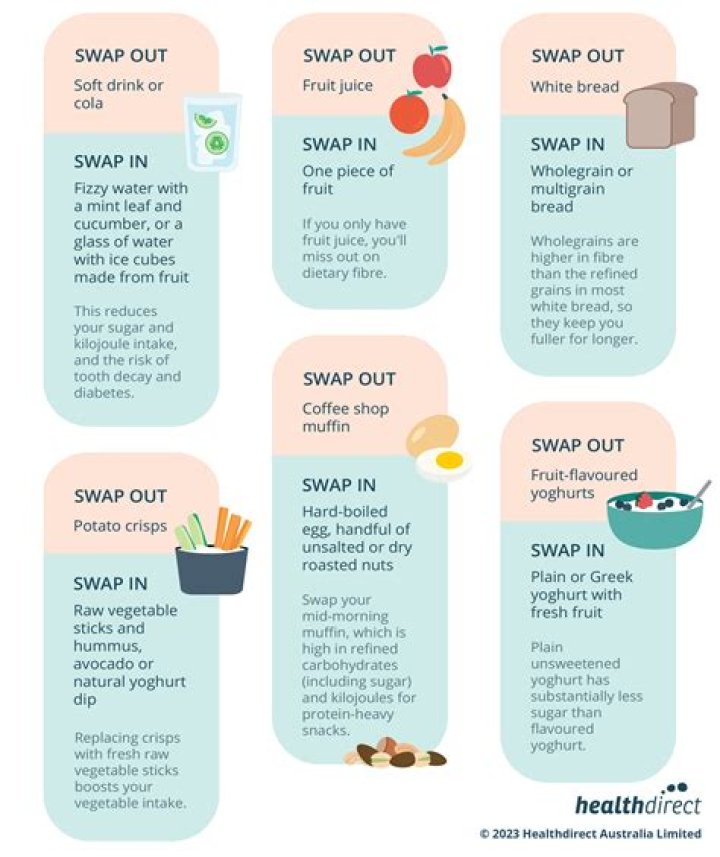
Try these small changes when you have your next meal or drink, or when you open the kitchen cupboard or fridge looking for a snack.
Once you have got started, try thinking of your own healthier swaps, too.
When buying pre-packed food, don’t rely on the attractive promotional print on the wrapping, which can be misleading.
Instead, learn to read the nutritional information when checking for calorie, fat, salt and sugar content.
Breakfast
- swap whole milk for semi-skimmed, 1% fat or even skimmed milk
- swap a sugar-coated breakfast cereal for a wholegrain breakfast cereal such as porridge or shredded wholegrain wheat cereal with no added sugar – read about how to choose a healthy breakfast cereal
- swap a sprinkle of sugar on your breakfast cereal for a topping of fresh or dried fruit, which counts towards one of your 5 A DAY
- swap full-fat greek yoghurt for lower-fat or fat-free greek yoghurt, or natural low-fat yoghurt
Lunch
- swap white breads, bagels and muffins for wholegrain varieties
- swap butter and cheese in your baked potato for reduced-fat spread and reduced salt and sugar baked beans
- swap a tuna melt panini for a tuna salad sandwich on wholemeal bread without mayo
- swap a cheddar cheese filling in your sandwich for reduced-fat hard cheese
Dinner
- swap creamy or cheesy sauces for tomato- or vegetable-based sauces on your pasta, meat or fish dishes
- swap mashed potato made with butter and whole milk for mash with low-fat spread and a lower-fat milk, such as semi-skimmed, 1% fat or skimmed
- choose leaner cuts of meat – for example, swap streaky bacon for back bacon
- swap the frying pan for the grill when cooking meat
Drinks
- swap a coffee made with whole milk to a “skinny” coffee made with semi-skimmed or skimmed milk
- swap a cordial for a cordial with no added sugar
- swap a few of your sugary drinks for a glass of water
- swap a cola or fizzy drink with some 100% fruit juice (with no added sugar) mixed with soda water
- swap hot chocolate made with whole milk and served with whipped cream for a hot chocolate made with skimmed milk and no cream
Snacks
- choose from these 10 surprising 100kcal snacks
- swap a blueberry muffin for a currant bun on its own or with some reduced-fat spread
- swap yoghurt-coated raisins for plain raisins
- swap salted nuts for unsalted nuts
- swap cheese straws for rice cakes with lower-fat cream cheese
More information
Start the NHS weight loss plan, a 12-week guide combining advice on healthier eating and physical activity.
Learn the basics of a healthy diet in Eight tips for healthy eating.
Find healthy recipes for your family in Healthy recipes.
Page last reviewed: 11 July 2018
Next review due: 11 July 2021
These simple ingredient swaps will help boost the nutrition of your lunch without sacrificing the flavors you and your family love.
Lunch can sometimes be left until the last minute, especially when your schedule is packed or different from your usual. Luckily, a quick lunch that can be packed to-go can be easy and healthy with these tips. Small swaps can make a big difference in helping you get a healthy lunch ready that the whole family will love, even when you are on the go.
Pictured Recipe: Picnic Bento Lunch
1. Swap Out: Potato Chips
Swap In: Popcorn
Satisfy the crunch you crave, plus a nutritious boost by switching out traditional potato chips for popcorn. Many people don’t realize that popcorn is actually a whole grain, and is higher in fiber than potato chips. One serving of popcorn, about 3 1/2 cups, contains almost 4 grams of fiber, 4 grams of protein and only 110 calories, compared to a small bag of plain potato chips with 149 calories, 1.7 grams of protein and less than 1 gram of fiber. Popcorn also has less sodium per serving, especially if you make your own popcorn from scratch versus the buttered and salted microwave bags. Making your own popcorn allows you to customize flavors to make exactly the lunch side that you want, from Everything Bagel to Cinnamon-Sugar.
2. Swap Out: Gummies
Swap In: Naturally-Sweet Fruit
If you or your kids are craving a sweet side to go with lunch, swap out gummies that can be packed with added sugars for naturally-sweet fruit—fresh, dehydrated or this healthy take on Fruit Roll-Ups, Mango Fruit Leather. Fruit is higher in fiber and other important nutrients, has fewer calories and contains no added sugar. Fresh fruit also has a high water content to help keep your family hydrated on hot, busy summer days. You can even cut them into cute shapes, like these Rainbow Fruit Kebabs. For kids who are on the go, swapping in our 100% fruit Mango Fruit Leather recipe or store-bought dehydrated fruit, is perfect for an on-the-go snack with no added sugar.
3. Swap Out: Soda
Swap In: Seltzer
Sometimes you crave carbonation to switch it up from plain water. Next time, grab a seltzer instead of a soda. Seltzers leave out the added sugar and come in many unique flavors, and you can even add a splash of fruit juice for some natural sweetness or ice cubes with herbs for an additional flavor boost. Some brands even have cute cans that kids will love. Cutting out sugar-sweetened beverages is a great way to boost your overall health, stay hydrated and even lose weight.
4. Swap Out: Croutons
Swap In: Nuts or Seeds
Any salad is elevated by a crunchy topping. Swap in nuts or seeds for croutons on a salad for a healthy alternative packed with nutrition. Nuts and seeds have more fiber, protein and nutrients than plain croutons. They are also lower in sodium, with one ounce of pumpkin seeds containing 5 milligrams of sodium, compared to 200 milligrams of sodium for one ounce of plain croutons.
5. Swap Out: Sugary Snack Bars
Swap In: Trail Mix
Though these foods are made from similar ingredients, trail mix gives you all of the healthy fats, protein and nutrients you would be getting in a snack bar, without the added sugar used to sweeten and hold together the bar. The combination of healthy ingredients also means that trail mix will help sustain your energy levels through the afternoon, versus crashing an hour later because of excess sugar that spikes, then quickly drops blood sugar. As an added bonus, trail mix won’t melt if left in a backpack on a hot day! Make your own trail mix to make it more affordable and fit your taste preferences.
6. Swap Out: Candy Bars
Swap In: Chocolate-Covered Nuts
Chocolate is an excellent midday pick-me-up, and it even has some health benefits too, like lowering your risk of heart disease and diabetes. Pairing it with nuts, which are made up of healthy fats, will help make this just-sweet-enough snack satisfying and give you more staying power. Chocolate-covered nuts will also be higher in protein, and much lower in sugar than a traditional candy bar, so you won’t crash like you would after eating a whole candy bar.
7. Swap Out: Sour Candy
Swap In: Frozen Grapes
Frozen grapes are a delicious summer snack that kids will crave. Simply throw a bag of grapes in the freezer for a few hours and you have a snack that rivals any popsicle or sour candy. Grapes, regardless of if they’re fresh or frozen, are higher in fiber and nutrients than candy, and have no added sugar. They are hydrating and refreshing to help kids and adults cool down after spending time outside on sunny days. Just note that frozen grapes thaw quickly and are best to be enjoyed right away, instead of packed for later.
8. Swap Out: White Bread
Swap In: Whole-Wheat Bread
This is a swap that you (or your kids) will hardly even notice. Whole grain bread is higher in nutrients and protein than white bread, and even has 3 times more fiber per slice (2.2 grams of fiber in whole-wheat bread compared to 0.7 grams in white bread). Same goes for other grains in salads or bowls. Choose whole-wheat pastas when you can. All of these swaps will help you meet the 2015-2020 Dietary Guidelines for Americans recommendation of making at least half of your grains whole grains.
Bottom Line
When it comes to eating healthier as a family, little swaps can go a long way. These tips prove that choosing a nutritious food doesn’t mean sacrificing the flavors you love. From refreshing midday treats like frozen grapes and chocolate dipped nuts to satisfying snacks like hummus and vegetables, these swaps will help the whole family feel full and nourished all afternoon.
Is eating healthier one of your goals this year? The good news is you don’t have to give up treats like baked goods or snacks, despite what you may think.
The key is to make smart food substitutions for things you’re already eating. By making a simple swap and choosing a more nutritious option for your favorite baking or cooking ingredient or snack, you’ll be well on your way to healthier eating habits. See our list of top swaps to try below.
Healthy Snack Substitutions
Snacks can be a good chance to add a nutritious break to your day. Make a few smart choices that will keep you satisfied between meals.
Instead of regular yogurt, try Greek or Icelandic yogurt
If you like regular yogurt, you can increase the protein and lower the sugar content of your snack by looking to our European friends. Greek-style yogurt has exploded in popularity and offers a lower-sugar, higher-protein option.
Newer still in popularity is Icelandic-style yogurt, or skyr. More tart, and often even higher in protein, it’s a refreshing change from sugary-sweet yogurts.
Instead of chips, try unsalted nuts
Nuts can make for a crunchy, satisfying snack that’s lower in unhealthy fats and higher in protein than a bag of chips. If you’d like additional flavor, try making your own flavored nuts so you can control the sodium and sugar content.
Instead of soda, try sparkling water
Sparkling water isn’t just a cocktail mixer anymore: Sales now reach more than $5 billion annually in the U.S. With no added sugar or artificial sweeteners, sparkling water is a healthier choice than your favorite soda. It helps you stay hydrated, too.
Instead of sweet treats, try dark chocolate
Yes, chocolate can be good for you if you know what to choose. Instead of a prepackaged cookie or cupcake, reach for a few squares of dark chocolate.
Some studies suggest that people who consume about six grams of this treat daily have lower blood pressure and a reduced risk of heart disease. Look for varieties that are at least 70 percent dark for the most benefits.
Instead of fruit canned in syrup, choose fruit in juice or frozen fruit
Eating fruit is good for you, of course, but choosing varieties canned in heavy syrup means you’ll be consuming added sugars and sweeteners like high-fructose corn syrup. Instead, opt for fruit packed in water or juice, or frozen fruit.
Healthy Ingredient Substitutions for Baking
To make your favorite baked good more nutritious, try one of the substitutions below.
Instead of butter, use unsweetened applesauce
In recipes where a crisp texture isn’t the goal, unsweetened applesauce makes a great substitution for some of the butter. It can also create a denser, moister end result – good news for things like dark bread.
Bob’s Red Mill suggests swapping half of the butter in a recipe with unsweetened applesauce for the best results. You’ll shave off fat and calories, too.
Instead of oil, use bananas
While bananas add some natural sugar and carbs to a recipe, they also cut down on the calories and fat content that oil would provide. You can replace half of the oil with pureed bananas in sweet recipes, according to Better Homes and Gardens.
Instead of white flour, use whole wheat or white whole wheat flour
Work some whole grains into your diet with whole-wheat bread. Using whole wheat flour instead of white imparts a nutty taste and hearty texture. Whole grains offer a variety of health benefits, too.
If you find the texture too dry or dense, you can also try white whole wheat flour, a type of whole wheat that’s lighter and softer. Make sure to follow recipes specifically for these types of flours, as they may require additional liquid or increased baking times.
Instead of heavy cream, use evaporated milk
Add a rich, creamy element to recipes with less fat by using evaporated milk. According to the Chicago Tribune, you can swap one cup of heavy (or whipping) cream for one cup of evaporated milk.
Instead of sugar, use maple syrup or honey
Natural sweeteners like honey and maple syrup still contain sugar, just like granulated white sugar. But because they’re usually sweeter, you can often use less of them. See a guide to baking with maple syrup and honey here.
Healthy Food Substitutions For Cooking
You may not even notice a difference in taste when you try one of these healthier food swaps for cooking. But your body will notice a difference in nutrition, and over time, it adds up.
Instead of ground beef, try ground turkey, chicken, or beans
Ground beef was once ubiquitous in recipes, but leaner options like ground poultry are now widely available. Just keep in mind that ground turkey and chicken can have a drier texture than beef.
If you want to try a vegetarian approach, you can also substitute some or all of the ground meat in a recipe for beans. This works best in recipes like soups, stews, and casseroles.
Instead of white rice, try brown rice or other ancient grains
Rice makes a good side dish for stir-fries and roasted meat. Add fiber and protein by switching to brown rice – you’ll barely notice a taste difference. You can also try now-popular “ancient grains” like quinoa, barley, and farro as a tasty and unique side dish option.
Instead of white pasta, try whole-wheat or vegetable-based pasta
While conventional pasta is high in refined cards, whole-wheat pasta or even pasta made with pureed vegetables can be more nutritious choices.
If you’re interested in experimenting, “zoodles” – thin ribbons of zucchini and other vegetables prepared like pasta – can be healthy and fun options, too.
Instead of sour cream, try plain Greek yogurt
Greek yogurt makes another appearance here, and this time as an almost perfect substitute for sour cream. It’s lower in fat and high in protein but still provides the right creamy tang.
Keep in mind that Greek yogurt is available in fat-free, low-fat, and whole-milk varieties. Fat-free and low-fat versions will have a much more tart taste, so choose according to your preferences.
Instead of flour tortillas, try corn tortillas
If you enjoy cooking Tex-Mex dishes, this is one swap that can make your recipes more authentic as well as lower in fat and calories.
Corn tortillas usually hold up better in sauces and as leftovers, too. They tend to be a little stiffer than flour tortillas, so warm them in a dry skillet before filling or rolling them up.
More Healthy Lifestyle Ideas
From exercise that fits your fitness level to ideas for strengthening your relationships, our blog is full of tips for living life your way. Explore all our articles on the blog here.
a young professional’s guide to leading a life they love
5 Simple (And Healthier) Food Swaps You Need To Make Right Now
- Food
- Lifestyle
5 Simple (And Healthier) Food Swaps You Need To Make Right Now
- March 8, 2016
- Jasmin – Macarons & Mascara
- 7 Comments on 5 Simple (And Healthier) Food Swaps You Need To Make Right Now
- ##tastytuesday, #blog post, #college blog, #food, #food blogger, #food swaps, #foods to eat, #healthier foods, #healthy food, #healthy food swaps, #healthy foods to eat
I’ll be the first to admit that I’m not a major health maniac, but I am conscious of what I put in my body. In recent years, anyone looking to change up their diet has stumbled across articles around the idea that foods we thought were as healthy as they come actually aren’t. Yeah, well, who has the time and money to dump their entire pantry in favor of these “new” foods? Certainly not a college student who has never had a paying job!
If you’re like me and don’t want to re-vamp your entire diet, here are some simple food swaps I have made over the last few months that actually have made a difference in the quality of my life and diet.
- Have spinach instead of lettuce in salads. It’s not much of a secret that dark, leafy greens are better for you than their lighter colored, but still pretty and nutritious cousins. One time, I went to see my college nutritionist and she suggested romaine lettuce over iceberg lettuce. This is because iceberg is full of water and therefore not as nutrient-rich as romaine lettuce. This being said, imagine how nutrient-rich spinach is! Spinach doesn’t have any sort of weird taste or flavor, so you probably wouldn’t even notice it. Sure, it’s not as crisp as lettuce, but that’s OK! I even have green smoothies that contain pineapple, mint, water and spinach!
- Instead of frappuccinos from Starbucks, have the refreshers. I love a double chocolate chip frappe as much as the next guy or gal, but I probably don’t have to tell you how much sugar is in those (but for the record, most frappuccinos have around 54g of sugar in them, a.k.a. more than twice the daily allowance). I haven’t had a frappuccino for a few months now. Instead, I buy strawberry refreshers or the peach green tea lemonade, which each contain under 15g of sugar. They’re both very refreshing and extremely satisfying. They’re great post-workout treats and you don’t even have to feel guilty for having them if you’re on a diet! I also love how the strawberry refreshers have pieces of strawberry floating around! #aesthetic. I wrote an entire blog post on how to be healthy at Starbucks , so be sure to check that out if you just can’t get enough of the coffee superstar!
- Trade chocolate bars for bananas and grapes. OK, I’m not shy about admitting that I had a chocolate problem some time ago. OK, like four weeks ago. Anyway, stay away from the chocolate — it’s all unnecessary sugar that can contribute to sugar highs that end in you crashing, and a sick feeling in the bottom of your tummy. Yikes! If you’ve got the munchies and just need to chew on something, try bananas and grapes. They have been my rescue foods as of late and they provide essential and nutritious sugars for your body. Fruit are a healthy take on mindless snacking, so you don’t wake up feeling guilty as hell in the morning after a snackful Grey’s Anatomy binge.
- Insert whole grains anywhere you can. Instead of a regular sandwich wrap, ask for whole wheat. Replace an everything bagel or even a plain bagel with a whole wheat bagel (I promise they taste really good, too!) Whole grains are full of fiber, which makes you poop! Well, you already knew that, but I still wanted to say it for the sake of not giving a shit (pun may or may not be intended) because it’s my blog! Anyway, as we all know, pooping is one of the easiest ways our body gets rid of toxins — toxins that certainly won’t contribute to a better lifestyle! Whole grains are full of fiber, and likewise, there are some snack foods and cereals now that contain a healthy dose of fiber. Beware though: sometimes companies make an unfortunate trade off. They pack all this good fiber into a food, but then there are crazy amounts of sugar, too! If you will get your fiber from sources like cereal and granola bars, be wary of this!
- Go for grilled chicken instead of breaded. Breaded chicken comes with some unnecessary baggage, like extra skin and fat. Grilled chicken tastes great in wraps, sandwiches and salads! Sure, that fried chicken is so crispy and juicy, but unfortunately frequent eating of it won’t positively impact anything — except fried chicken cravings! If you’re a college student and are finding it particularly difficult to make healthy swaps like this one, you can check out my Tips For Healthy Living that I wrote for Her Campus!
Of course, enjoying the not-so-good-for-you foods sparingly is completely fine. What kind of less-than-amateur nutrition expert would I be if I didn’t tell you that, anyway? Will I still have chocolate once in a while? Absolutely — I had a chocolate brownie from Starbucks just yesterday while typing the first half of this post! But, of course, once you make these changes and stick to them, they become second nature. I kid you not, last week I went to buy my usual salad (spinach, turkey pieces, cheddar cheese, croutons, caesar dressing) from the campus dining hall and they didn’t have spinach, but I really wanted a salad so I got lettuce instead and, let me tell you, the lettuce just tasted gross to me. I wasn’t really satisfied with my salad, but that’s what you get for swapping the two! Hope you enjoyed this Tasty Tuesday post!
Learn how to easily turn your favorite comfort foods into healthy, satisfying recipes. All without sacrificing flavor!
Table of Contents
15 Simple Ways to Make Comfort Food Healthy
There’s nothing more comforting than a nice hot, cheesy meal on a winter’s day. The problem is, what many of us consider to be winter comfort foods aren’t always as healthy as we might think. Let’s take a look at Ways to Make Comfort Food Healthy!
FACT: Many comfort foods are high in simple carbohydrates like white flour and sugar, instead of healthier complex carbs like whole wheat flour, legumes, and vegetables. Simple carbohydrates can reduce our serotonin levels and make us tired (and even depressed), which is quite the opposite of what comfort food should do!
According to Health Line, simple carbs equal simplistic nutrition and, therefore, should be limited in your diet in favor of more complex carbs like fruit, nuts, and whole grains.
Also, many traditional comfort food recipes include ingredients high in fat, cholesterol, and sodium, so curbing those is only going to help your waistline and keep your family healthy.
How to Lighten Up Comfort Food
With all this in mind, let’s look at how the comfort foods we love can really be good for us. Trust us, your family won’t know the difference if the flavor is good!
- Macaroni and Cheese, Lasagne, and Other Pasta: Use whole wheat noodles and replace any flour in the recipes with whole wheat flour. Add more vegetables and reduce the cheese and meat content in your casseroles.
- Fried Food: Instead of frying, try baking your chicken, veggies, or fries. And don’t forget to use wheat flour and egg whites instead of a whole egg.
- Soups: Forego the canned varieties that are incredibly high in cholesterol and make your soup fresh where possible. It’s not as complicated as you might think, and it tastes much better. When making your own soup, always skim the fat of your soup stock and use plenty of vegetables. If you don’t have time to make your own stock, choose the low sodium pre-made varieties.
- Chili and stew: Choose leaner cuts of meat. For example, a turkey chili can be just as hearty and delicious as its ground beef counterpart. Of course, don’t forget to load up your chili with vegetables. When making stew, always cut the fat off the meat before cooking and use wheat flour for thickening your delicious meal. If serving bread, use whole wheat, and reduce or forego the butter. A warm whole wheat baguette dipped in homemade chili or stew just doesn’t need the extra added fat and cholesterol.
Practical Swaps for Healthier Comfort Food
It doesn’t matter what your preferred comfort foods are (we’re looking at you Mac & Cheese), you can use this simple guide to prepare many of your favorite meals at little healthier without sacrificing flavor:
- Whole wheat flour replaces white flour.
- Olive oil or coconut oil replaces butter, margarine, and other oils.
- Swap whole eggs for egg whites.
- Use applesauce instead of vegetable oil for baking.
- Skip the butter on bread and vegetables. Use seasoning instead.
- Reduce processed sugar in recipes. Use ingredients like vanilla, cinnamon or other extracts to add a sweet flavor. Or substitute honey or maple syrup.
- Choose leaner cuts of meat and cut off any visible fats before cooking. You can also remove the skin from chicken, or to retain juiciness remove the skin before eating.
- Use skim milk instead of whole milk.
- Swap heavy cream for evaporated skim milk.
- Skip the mayonnaise and opt for non-fat plain yogurt.
- Reduce salt in recipes dramatically. Most recipes don’t actually need salt, excluding ones that include yeast for leavening like bread.
- Cook more meals instead of eating packaged ones.
- Make smart cheese choices. Opt for cheeses that are big on flavor (like tangy goat cheese), so you can use less.
- Try substituting vegetable or chicken stock for cream.
- When in doubt, add more vegetables.
Tip: Screen Shot this guide to keep for reference.
Put Your Slow Cooker to Use for Healthy Recipes
It’s easy to make clean, healthy recipes in your crock pot, so try one of these family favorites:
Eating healthy doesn’t mean avoiding your favorite comfort foods, because life without pizza isn’t doable! But it could mean adjusting things just a little. Keep these tips in mind when preparing your next meal to stay healthy, happy, and trim this winter.
Getting variety in your diet is key to healthy, balanced eating. The Good Food team show you how to make some simple swaps to help you mix things up a bit and make healthier choices.
Swap 1… butter for avocado
Swap your typical spread for mashed avocado. Avocados are a source of healthier unsaturated fat and potassium, a mineral that may help to lower blood pressure.
Try our easy recipe for avocado on toast and read more about the health benefits of avocado.
Swap 2… white sugar for date syrup
Swap 3… coffee for matcha latte
Swap 4… white pasta for spelt pasta
Swap 5… double cream for coconut yogurt
Coconut yogurt offers a dairy-free alternative and works well as an indulgent treat for stirring into vegetable stews and curries or topping desserts. Remember, like double cream, coconut is rich in saturated fat so should be used sparingly. Nutritional values will vary and be dependent on the brand you choose so check labels for nutritional and ingredient details.
Tried any of our healthy swaps? Do you have your own suggestions for nutritious alternatives? Let us know in the comments below…
This page was last reviewed on 4 July 2019 by Kerry Torrens.
A qualified nutritionist (MBANT), Kerry Torrens is a contributing author to a number of nutritional and cookery publications including BBC Good Food magazine. Kerry is a member of the The Royal Society of Medicine, Complementary and Natural Healthcare Council (CNHC), British Association for Applied Nutrition and Nutritional Therapy (BANT).
Indulging doesn’t have to leave you feeling bloated and sluggish
If there was ever a time to fall face first into a plate of mashed potato, it’s winter. With the arctic temperatures and long dark evenings, you can hardly be blamed for consuming 90% carbohydrates and drowning everything in gravy.
However, whilst it might feel great at the time, indulging in too much comfort food can leave you feeling bloated, sluggish, and a million miles from your best damn self – so here are 11 ways to lighten the load without ditching your favourite dishes completely.
Swap creamy soup for broth
Popularised by the eternally glowy Hemsley sisters, bone broth is becoming a mega health food trend. It’s packed with a bunch of powerful nutrients, including phosphorus and calcium for strong bones, gelatine, to help soothe an irritated gut, and collagen, which plumps the skin and keeps your hair and nails looking healthy – so if you’re the type of gal who reaches for a tub of broccoli and stilton on the reg, switching to broth instead can help you cut fat and calories and make you feel better inside and out.
Swap mashed potato for sweet potato mash
Sweet potatoes contain more Vitamins A and C, fibre, potassium and essential minerals than regular potatoes – and when you boil them up and mash them in the way you normally would, you’ll find you don’t need to add as much butter, milk or salt to make them taste indulgent. The secret is their amazing natural sweetness – some people even play on this by adding a sprinkle of cinnamon to their mix. Not convinced? Cauliflower or cannellini beans also make great healthy mash substitutes – try them with your fave sausages and thank us later.
Swap pasta bake for quinoa bake
Pasta? Good. Cheese? Good. Creamy sauce? Good! There’s literally nothing not to love about the humble pasta bake – aside from the fact it’s so rich and stodgy it leaves you lying on the sofa to digest it for several hours afterwards. Quinoa bakes typically give you the same cosy level of oven-cooked joy, but with fewer calories and an added boost of protein from the grain. Toss in extra veggies to boost your 5-a-day, and swap hard cheeses like cheddar for goats cheese, which is easier to digest.
Because when you think about it, what is pie if not stew with a fancy lid? We get that giving up that delicious buttery pastry seems cruel, but once you’re chowing down on the saucy, meaty centre, you’ll (almost) forget all about its usual golden crown – honest! Stew is another one of those meals you can sneak extra good stuff into without even realising – fill up on chunky root veg, and experiment with pulses like beans and chickpeas instead of meat. They’re surprisingly satisfying, and killer protein to boot.
Swap apple crumble for baked apples
Not only are baked apples more nutritious than slices of fruit covered in crumble, they’re also an absolute walk in the palk to make. Pick a sturdy eating apple like Granny Smith or Braeburn, core it, fill the middle with dried fruits, spices, and just a pinch of sugar, then stick it in the oven for 20-30 minutes until cooked through. Whilst you’re at it, ditch the tinned (or powdered!) custard and try a dollop of Greek yoghurt sweetened with honey on top, you virtuous angel, you.
Swap roast vegetables for steamed vegetables
We’re not going to patronise you: you don’t need us to tell you that vegetables are good for you, however you choose to consume them, and having roasted veg is certainly not the end of the world. However, if you’re making a really conscious effort, switching your cooking technique from oil-based to water-based could cut over 100 calories per serving, and takes just 5-7 minutes – wayyy speedier than your average oven cook. Just don’t drench them in butter once you’re done, cos, well, that’s basically the same thing.
Swap shop bought cranberry sauce for homemade
Cranberry sauce in a jar is easy, convenient and relatively cheap to buy. It’s also usually crammed with an absolute shit ton of sugar. Using your own recipe means you have complete control over what goes into it – no preservatives, less of the white stuff, and all the benefits of the fresh berries, including Vitamins C, E and K and minerals like copper. And all you really have to do is boil them down.
Swap mulled wine for champagne
It’s not quite as punchy and warm, but when else is a ‘health’ article going to tell you drink champagne? Mulled wine is delicious because it’s full of fruit and spices (fine) but also usually, added sweeteners, taking its calorie count up to around 225 calories per average cup. Champagne, on the other hand, is relatively low in sugar, has around 90 calories a glass, and is generally savoured and drunk a little slower, although only you can make that happen.
Swap meat stuffing for chestnut stuffing
We know it seems a little like we’re hating on meat, and we’re not – it’s just that most of us could do with eating a little less of it. The sausage meat traditionally used for stuffing is high in fat, whilst chestnuts are one of few ‘low fat’ nuts, as well as packing extra Vitamin C and dietary fibre – it’s kind of BS they’re not in stores all year round, tbh. If you have any left over, roast them on the proverbial ‘open fire’ for a tasty Christmas treat.
Swap gingerbread latte for a skinny latte with cinnamon
An average medium gingerbread latte from a high-street coffee shop which shall remain unnamed contains 330 calories, as well as a pretty staggering 13g fat and 39g sugar (that’s the same as 10 sugar cubes). By making the milk skimmed instead of semi-skimmed, and adding powdered spice like cinnamon or nutmeg to your latte instead of syrup, you can drop around 150 calories and 20g sugar from the same size cup – and still get that festive, wintery taste.
Swap Christmas sandwiches for turkey sandwiches
Okay, so it’s not truly Christmas until you’ve eaten a bap containing a slab of stuffing, half a turkey and a layer of pigs in blankets, but do you really need to do that on a weekly basis? Turkey in itself is actually a really healthy, lean meat, so if you can bear to consume it without sugar-laden cranberry sauce and the empty calories of all the added extras, turkey sandwiches can go on your nice list this year.
It’s that time of year — a new year and a new beginning. As a nutritionist, I often hear from new clients that they make New Year’s resolutions early January and by Valentine’s Day, they are discouraged and back to their same old patterns. Resolutions such as, “I have to lose weight” or, “I want to eat healthier” tend to be too broad, and therefore do not generally work. What I have found in my private practice is that small action-oriented steps and simple substitutions tend to work a lot better.
Here are some smart-and simple food swaps that you can actually implement and incorporate into your everyday routine to help you lead a healthier life.
1. Choose whole fruit instead of juice.
Juice tends to be high in sugar and low in fiber. Fresh fruit, on the other hand, contains more fiber than the juice and has a higher water content, both which are excellent for weight loss. Eating an orange instead of guzzling down a pint of orange juice can save you over 150 calories. Imagine how many calories you can save if you make this switch daily.
2. Start your day with a low fat Greek yogurt instead of a doughnut.
Greek yogurt is an excellent breakfast as it is high in protein, which can keep you full longer. Top your yogurt with fresh fruit and a handful of walnuts to round out your breakfast. A doughnut, on the other hand, is full of calories without much nutrition.
3. Choose whole grains instead of refined grains.
Grains and starches are not taboo and do not need to be avoided to be healthier and lose some weight in the process. The trick is to eat the right kind of grains. Whole grains are the best choice as they are chock full of nutrients and fiber. Include brown rice, quinoa, and oatmeal instead of white bread, white rice, and white pasta.
4. Drink water and seltzer instead of soda.
Soda contains pure sugar, is liquid candy, and a waste of calories. Why not eat your calories instead of drink them? Swapping soda for water or seltzer can save you hundreds of calories. For flavor, add a splash of lemon, orange, or cucumber or throw in a few fruity ice cubes (pour your favorite juice into an ice cube tray and freeze for flavored ice cubes).
5. Eat an English muffin (whole grain, of course) instead of a bagel.
Making this swap can save you over 200 calories. While both a bagel and an English muffin are just one item, a bagel is equivalent to approximately five bread slices whereas an English muffin is more like two bread slices. Save the bagel as an occasional treat.
6. Start your meal with a vegetable salad (dressing on side) instead of a fried appetizer.
Starting your meal with a fresh salad is a great way to include vegetables into your diet. Salad and vegetables are high in vitamins and minerals, full of fiber, and low in calories.
7. Choose a low-fat tomato-based soup instead of a cream-based soup.
I am a soup lover. I enjoy eating soup in the cold winters in NY and also in the summer. Soups make a great snack, a healthy appetizer, and even a great meal. The key is to eat a vegetable based soup and to skip the cream. Great choices include 10 vegetable soup, minestrone soup, and white bean and escarole soup.
8. Eat an apple or a pear as a snack instead of a bag of chips.
When you feel the urge to nibble, go for a healthy piece of fruit instead of a bag of chips.
9. Choose salmon instead of steak.
I advise limiting read meat and choosing fish instead. Grilled salmon, for example, is high in protein, much lower in saturated fat than red meat, and full of heart-healthy omega-3 fatty acids.
10. Finish your meal with a cup of blueberries instead of a slice of blueberry pie.
Berries are rich in antioxidants, fiber, and other nutrients and low in calories. If you want to indulge in an occasional slice of pie, make it a sliver, and surround it with a cup of fresh fruit.
Positive choices that even little ones and partners will enjoy
Eating more healthily as a family needn’t be complicated, according to nutritionist Jenna Hope (@jennahopenutrition) – far from it. All it takes is a few simple choices and, voila, your meals will hit the nutritional jackpot.
‘A few small swaps can make a big difference to you and your family’s energy levels, productivity, concentration and general wellbeing,’ explains Jenna. So, quit thinking you need to overhaul your entire kitchen cupboard – chocolate, bread and so on – and instead focus on the little wins.
‘Adding in more nutrient dense foods, increasing your fibre intake and consuming more slow release carbohydrates can leave everyone feeling energised, well-nourished and ready to take on the day’, Jenna adds.
Ready? Eating well never looked so simple.
White pasta for wholegrain
Big fan of easy pasta for supper but worried it might not be the healthiest choice? Don’t swerve altogether. ‘Pasta can be made all the more nutrient-dense by opting for wholegrain or red lentil varieties,’ explains Jenna.
Why? ‘Both are higher in fibre than white pasta,’ she says. ‘Fibre is essential for supporting a healthy bowel function. What’s more, red-lentil pasta is also higher in protein, meaning that it may keep you fuller for longer.
Try this: ‘Pair mackerel with wholegrain or red lentil pasta for a double protein hit,’ suggests Jenna. Mackerel also contains vitamin B and omega 3 essential fatty acid DHA that helps support heart and brain function. An easy way to elevate simple pasta dishes.
Cooking up a classic dish and fancy something different to the usual meat? Fish may not be the first thing that springs to mind but it’s actually a fantastic choice.
‘Switching beef mince for tuna or salmon in a lasagne is a great way to reduce saturated fat without compromising on protein content or taste. Tuna would be a lower calorie option than beef, too,’ says Jenna.
Try this: ‘Similarly to beef mince, tuna is also rich in vitamin B12 which plays a role in maintaining energy levels within the body,’ she adds. Salmon is rich in omega-3 fatty acids to help support heart and brain function,’ says Jenna.
‘The cooking process isn’t too dissimilar either. ‘Rather than cooking your beef mince simply cook a base of onions, chopped tomatoes, mixed herbs, salt and pepper for around 5-10 minutes before adding the tuna or the salmon. Then continue as you would normally,’ she explains.
Rice cakes for oatcakes
Hungry come 4pm and looking for a snack that’s nutritionally balanced? If you’re a rice cake fan, try snacking on oatcakes, instead – they’re tasty, higher in nutrients and just as versatile.
‘Oatcakes are much more nutrient-dense than rice cakes, as they’re higher in fibre and rich in key nutrients, such as magnesium and iron, both of which are essential for maintaining energy,’ explains Jenna.
Try this: Eat oat cakes topped with smashed avocado or some good quality peanut butter or even a fish pâté. This chunky tuna pâté recipe from John West makes the perfect protein-rich snack the whole family can enjoy.
Ready-made burgers for homemade
Ready to get creative? With a little bit of extra time on your hands, making your own burgers can be a fun and inexpensive way of enjoying a favourite family dish. And it’s something even the kids can join in on.
‘Many shop-bought burgers are packed with artificial additives, salt and processed meat,’ says Jenna. Time to make your own.
Swap mince beef with canned tuna to make healthier high-protein alternatives. ‘Tuna is a source of niacin, B6 and vitamin B12, all of which help to maintain energy within the body,’ says Jenna.
Try this: A simple tuna burger recipe that’s tasty and nutritious – win-win. Tap into the range of No Drain Tuna by John West and you can enjoy the goodness of tuna with far less mess.
Mayonnaise for guacamole
Mayo is undoubtedly a family kitchen staple but sadly, it isn’t the healthiest of condiments.
Jenna suggests opting for its more nutrient-dense friend, guacamole. Why? It’s simple: ‘Avocado is high in monounsaturated fatty acids, essential for heart and skin health, and a great source of vitamin C, which supports your immune system.’
Try this: Why not mix things up a little by combining your smashed avo with a fish of your choice for an easy wrap. ‘It makes for a fun, and still healthy, alternative,’ says Jenna. The kids will love it too if they get involved with adding their favourite fillings.
Cereals can be a good source of nutrients although, many are highly refined, meaning that often a lot of their nutrients and fibre have been stripped.
‘Highly refined cereals are often high in sugar, so why not try switching the family’s cereal choices to a more nutrient dense option such as oats?’ Jenna suggests.
Why? Well, oats have a low glycemic index, which means that the carbohydrates are released at a much slower rate meaning they’ll leave you feeling fuller for longer. ‘Not only that, they’re also high in beta-glucans, a type of fibre which has been associated with a reduction in cholesterol,’ says Jenna.
Try this: Top your porridge with berries and cinnamon for a healthy finish. Cinnamon helps to provide a hint of sweetness without adding sugar. To make it more child-friendly use rolled oats rather than jumbo oats so it’s smoother. Jenna also suggests mashing a banana into it for the kids, instead of adding sugar.
For the month of January, Bioglan Superfoods have teamed up with health and wellness experts with the aim to show you how to superpower your life. As part of my collaboration with Bioglan Superfoods, I want to show you how to superpower your meals. So far, I’ve shared a few recipes using superfoods to boost the nutritional profiles of your meals and today I’m going to show you several healthy food swaps.
I don’t believe in restriction, I believe in making healthier choices. If I was to never have chocolate again I’d go insane. I loveeee chocolate, but I choose to make chocolatey treats with Bioglan Superfoods’ Raw Cacao powder and only have actual, full on calorific, ‘naughty’ chocolate once in a while.
There are plenty of healthy food swaps we can make to make sure we are choosing nutrient-dense foods that will benefit us and improve our health, instead of processed, nutrient-void foods that can be harmful to us. Today I’m sharing these food swaps in a good, better, best format so that you can gradually improve your food choices. Have a think about what else you can swap to limit the bad foods in your diet and share your swaps in the comments below.
Breakfast
It’s so important to get your day off to a good start with a healthy, filling and nutritious breakfast. It will control your blood sugar levels to stop you craving sweet stuff later on, it’ll help you to focus at work or school and it will help you to make healthier choices for the rest of the day. A lot of breakfast options are high in sugar, so swap your boxed breakfast cereal and jam on toast for one of these healthy food swaps instead.
Good: Peanut butter and banana on brown toast. Choose a peanut butter that has no added sugar or palm oil, I personally like Meridian Crunchy Peanut Butter. The peanut butter provides healthy fats and protein and the brown bread is a complex carb to keep you fuller longer.
Better: Porridge made with whole oats (not instant) and dairy-free milk of your choice. Stir in vanilla protein powder and top with berries, chia seeds, milled flaxseed, Bioglan Superfoods Energy Boost and a dash of honey. Oats are also a complex carb, the protein powder provides protein and the chia seeds and milled flaxseed are a source of good fats.
Best: Poached eggs on top of smashed avocado on sourdough toast. This gives you protein, carbs and healthy fats all in one meal to keep you fuller for longer.
Lunch
Grabbing lunch on-the-go can be expensive and unhealthy. Sandwiches are packed with mayonnaise, added sugar(. ) and salt. Making your own lunches is definitely your best option as that way you’ll know exactly what’s in it and save yourself some money too. Put down your store-bought tuna mayonnaise sandwiches and tomato soups and choose one of these healthier lunches instead.
Good: Store-bought tuna mayo sandwich on wholemeal bread, store-bought vegetable soup (check the ingredients label), store-bought wholemeal pasta salad.
Better: Homemade tuna mayo sandwich on wholemeal bread, homemade vegetable soup, homemade wholemeal pasta salad.
Best: Homemade avocado and tuna wrap in a wholemeal pitta, homemade chicken and vegetable soup, homemade salmon and quinoa/cous cous/wild rice salad.
Snacks
Snacks can often be difficult to make healthy as there are sooooo many yummy unhealthy options out there to tempt us. Vending machines are packed with chocolate bars, crisps and cereal bars. Again, packed with sugar, greasy oil and ingredients we can’t pronounce. I hope these healthy food swaps will give you ideas for healthier snacks.
Good: Homemade granola, Nakd bars, dark chocolate, vegetable crisps, yogurt covered nuts and Popchips.
Better: Fresh fruit, dried fruit and nuts, energy bites, air-popped popcorn and a protein shake.
Best: Guacamole devilled eggs, hummus and crudités, a handful of nuts, greek yogurt with berries and chia seeds.
Drinks
A lot of bottled drinks are full of sugars and empty calories. Cutting out fizzy and sugary drinks can have a big impact on our weight and health. Save your teeth, waistline and health by making these drink swaps.
Good: Fresh fruit juices (not from concentrate), ready-made flavoured waters, tea and coffee with sweetener.
Better: Homemade fruit juices, infused water, coconut water, tea and coffee with no sugar or sweetener.
Best: Homemade green smoothies with Bioglan Supergreens, filtered water, herbal teas, matcha teas and black coffee.
- 580 SHARES
What you eat is just as important as the exercises you perform when it comes to maintaining a healthy weight. One way to reduce your daily calorie intake is to reduce your portion size. But the issue with this method is you may not always feel full or satiated and losing weight is not all about cutting calories. Keep the faith yogis! There’s a better way to manage your weight while enjoying the food you eat—and getting enough of it. If you make some simple food swaps, you can reduce your calories, and eat healthier without sacrificing taste or serving size. When you cook at home (or even if you dine out), you can choose these 15 food swaps to maintain a healthy weight without dieting.
Switch This Food For That Food:
1. Sour cream for 0% Greek yogurt
(61 calories vs 17 calories per oz.)
Choose 0% Greek yogurt, a fat-free and protein-packed yogurt that makes a fantastic substitute for a sour cream-like taste. At less than a third of the calories of sour cream, Greek yogurt will keep you full and satisfied without the guilt. You can use Greek yogurt instead of sour cream for dips and toppings for soups, tacos and baked potatoes.
2. Butter for coconut oil
(203 calories vs 244 calories per oz.)
No, coconut oil does not have less calories than butter, but it has a ton of health benefits that far outweigh the additional calories. Additionally, a little coconut oil goes a long way and with the subtle coconut taste, you will use less coconut oil than the butter you would’ve used in the same dish. Replace butter with coconut oil for baking, on pancakes and waffles, or to grease a pan.
3. Flour tortilla for corn tortilla
(190 calories vs 135 calories for medium shell)
While there is only a 55-calorie difference between the flour and corn varieties, do you only eat one tortilla? Probably not! In a plate of enchiladas, you can save 165 calories on the tortilla shells alone by choosing corn instead of flour. If you enjoy tortilla chips, cut up a corn tortilla and baked it in the toaster oven to have a lower calorie snack without the added salt, fat, or grease.
4. Fruit juice for coconut water
(111 calories vs 46 calories per 8 oz. glass)
Fruit juice is high in calories and full of sugar. Choose coconut water instead of fruit juice to slash your calories by more than half. As an added bonus, coconut water keeps you feeling fuller, aids in digestion, and has electrolytes to keep you hydrated during your practice – even hot yoga.
5. Choose cinnamon instead of sugar
(9 calories vs 6 calories per teaspoon)
Reducing your calorie intake by a third, cinnamon adds loads of flavor without the blood sugar spike. Use cinnamon instead of sugar in your beverages and breakfast foods. An added benefit is cinnamon’s positive impact on everything from lowering cholesterol to preventing cancer.
6. Lemon-lime soda for lemon water
(100 calories vs 1 calorie per 8 oz. glass)
While a splash of lemon in your water may not taste exactly like a soda, saving 99 calories per 8 oz. glass is worth the sacrifice. You can add a splash of honey or agave to sweeten your water and satisfy your sugar craving, or go without sugar entirely and know that you can shed 10 pounds by skipping just one glass of soda each day for a year.
7. Sorbet for frozen fruit
(130 calories vs 24 calories per half cup)
Swap out your sugar-filled sorbet for a half-cup of frozen strawberries or berries blended until smooth to save more than 100 calories. Did you know? The Vita-Mix blender can turn your frozen fruit into an ice cream consistency for the perfect delicious and healthy treat.
8. White rice for quinoa
(147 calories vs 136 calories)
While there may not be a large calorie difference between white rice and quinoa, quinoa is full of nutrients, healthy fats and protein instead of the empty calories in white rice. Also, because quinoa is more filling, you will eat less and thus save additional calories.
9. Mayonnaise for hummus
(90 calories vs 23 calories per tablespoon)
Hummus adds nutrients and protein at a fraction of the fat of mayonnaise, all while adding a punch of flavor and spice to a bland sandwich, salad or dish.
10. Alfredo sauce for marinara sauce
(81 calories vs 35 calories per half cup)
Marinara sauce has less than half the calories of Alfredo sauce and offers a quarter of the fat of its heavy cream-based counterpart.
11. Pasta for spaghetti squash
(182 vs 42 calories per cup)
Choose a fresh spaghetti squash and dress it just as you would a traditional pasta to save more than 140 calories per cup. Do this once a week to lose 14 pounds in a year.
12. Potatoes for cauliflower
(105 calories vs 26 calories per 4 oz. serving)
Choose cauliflower instead of a baked potato or mashed potato to save a quarter of the calories, and one-sixth of the carbohydrates. You’ll substitute starch for nutrients—now there’s a good swap!
13. Whole milk for unsweetened coconut milk
(146 calories vs 30 calories per cup)
Unsweetened coconut milk contains nearly one-fifth of the calories of whole milk, without the artery clogging saturated fat. This flavorful alternative also stays fresher longer in the refrigerator and adds a low-calorie creaminess to cereals, beverages and dishes.
14. Ice cream for fresh fruits and greek yogurt
(230 calories vs 35 calories per half cup)
Nix the high-calorie ice cream for some fresh berries with greek yogurt on top to save nearly 200 calories per half-cup serving. Go ahead and make it a double without the guilt!
15. Cream-based salad dressing for vinegar
(73 calories vs 3 calorie per tablespoon)
Salads can be quite boring without flavorful toppings and dressings. Yet by loading up on cream-based, high calorie salad dressings, you defeat the purpose of eating a light, healthy salad. Sprinkle a little balsamic or red wine vinegar on your salad to save hundreds of calories per salad.
If you choose healthier food options, you do not need to feel like you are sacrificing or missing out on anything when it comes to your next meal. These tips will help you shed extra pounds and maintain your figure, without yo-yo dieting or deprivation.
What are your favorite healthy food swaps? Share in the comments below to help your fellow yogis slay slim and trim this summer.
Healthy eating made easy.
Share this:
- More
- Tumblr
By: Rebecca Jacobs
Healthy food swaps are our jam — we believe that eating clean is all about balance and def doesn’t require deprivation. So, we’re breaking down our top eight simple healthy food swaps that anyone can make to start eating healthy right away.
8 Simple Healthy Food Swaps That Make Eating Clean Easy
#1 Go Lower Carb For Breakfast
Breakfast can be tricky — we’re running around trying to get everything ready for the busy day that sometimes we may not even have time to eat. B
ut, if you can get a solid breakfast in to help set the tone for a healthy day, then you’ll be setting yourself up for some serious healthy eating success.
So, instead of carb-heavy, sugar breakfast options, aim for a higher protein meal with some healthy fat mixed in to keep your blood sugar levels in check and your energy levels high.
Here are some great healthy food swaps that will take breakfast to a new healthy and delicious level.
- Egg muffins made with bell peppers, spinach, tomato, and some shredded cheddar cheese (use nutritional yeast for a dairy-free option!)
- Two hard-boiled eggs served with ½ of an avocado drizzled with lemon juice and seasoned with pink Himalayan sea salt and pepper.
- Smoothie made with berries, spinach, unsweetened almond milk, a drizzle of almond butter and raw honey, and a scoop of JS Health X FitOn protein powder.
#2 Sliced Bell Peppers & Hummus vs. Chips & Dip
Skip the salty chips and go for a crunchy and healthy food swap with some sliced bell peppers and hummus.
This is literally the perfect summertime snack since it’s light and is less likely to leave you with post-carb indulgence bloat that comes with those salty and sugary snacks.
Not a fan of bell peppers? Try some sliced cucumbers, carrots, or celery.
#3 Quinoa vs. Rice
Quinoa makes a super easy rice swap that actually comes with some impressive health benefits too. Quinoa is an awesome source of protein and fiber, and it’s gluten-free!
You’ll pack in about 8 grams of protein and 5 grams of fiber per 1 cup of cooked quinoa, so go ahead and use it in place of rice in your fav lunch or dinner recipes for a healthy food swap.
#4 Banana Nice Cream Bowl vs. Ice Cream
It’s during the hotter summer months that we all get a hankering for ice cream, and with this healthy food swap, you can still enjoy it (just a healthier way). Swap out the dairy-heavy ice cream and try making our favorite banana nice cream recipe below.
Chocolate Banana Nice Cream Bowl
Serves: 2
Ingredients:
- 2 frozen bananas
- ¼ cup almond, coconut or cashew milk
- 2 tbsp raw unsweetened cacao powder
- 1 tbsp pure maple syrup
- Shredded coconut and raw cacao nibs for serving
Add the bananas, dairy-free milk, cacao powder, and pure maple syrup to a high-speed blender and blend until smooth.
Split into two serving bowls and top with the shredded coconut and raw cacao nibs,
#5 Pure Maple Syrup vs. Refined Sugar
Swapping out sugar is one of those healthy food swaps we’ve heard about time and time again, but we’re here to acknowledge that it’s not always that easy. This is why we love to use delicious pure maple syrup as a natural sweetener in place of refined sugar.
While it should still be used in moderation, it comes with some additional benefits that plain old table sugar just couldn’t match up to.
Pure maple syrup happens to be a good source of important minerals like:
- Calcium
- Potassium
- Iron
- Zinc
- Manganese
So, use it in moderation in things like coffee, tea, and use in place of sugar in your favorite sweet treats for a healthier alternative.
Note: We’re talking pure maple syrup (like the real deal!) The pure varieties are often found in glass jars and can be found at most grocery stores.
#6 Real Fruit vs. Jam
Here’s another one of those healthy food swaps that’s not only healthier, but tastier too! Try using real fruit vs. jam to avoid any unnecessary added sugars or artificial ingredients.
For a tasty treat, try a slice of gluten-free bread with Kite Hill’s almond-based ricotta or cream cheese and some sliced strawberries (yum!)
#7 Avocado vs. Mayo
We love us some mayo too, but it’s not always the healthiest pick, and avocado makes a really tasty healthy food swap that packs in some added fiber and healthy fat.
Try swapping out mayo for sliced avocado on sandwiches or wraps.
Still missing that mayo? Try avocado oil mayonnaise instead.
#8 Sweet Potatoes vs. Fries
We can’t deny the fact that french fries are delish, but they are often fried in oil, overly salted, and not the healthiest pick.
Good news though — you can easily make sweet potato fries with just a few ingredients, and they taste pretty darn good.
Here’s how to make them.
Easy Sweet Potato Fries
Serves: 3
Ingredients:
- 3 large sweet potatoes, washed and peeled
- 2 tbsp coconut oil, melted
- Sea salt to taste
Start by preheating the oven to 425 degrees F and line a baking sheet with parchment paper.
Cut the washed and peeled sweet potatoes into french fry strips.
Drizzle with the melted coconut oil, coating each fry and season with sea salt.
Bake for 15 minutes and then flip the fries.
Bake for an additional 10-15 minutes or until the edges begin to crisp.
Healthy Eating Doesn’t Have to be Complicated
One of the most common misconceptions about healthy eating is that it’s complicated. But, these eight simple healthy food swaps prove that healthy eating can be simple and totally delicious.
Use these swaps to get your healthy eating on while still packing in tons of flavorful foods that you’ll actually be excited to enjoy.
Healthier and just as yummy!
Published for Kawan Food Berhad , 10 Sep 2020, 03:25 PM
Eating healthier doesn’t have to be so susah. It’s all about making the right swaps.
One easy way to eat healthier is to look out for low GI alternatives of your favourite foods and snacks.
But, what is low GI? GI stands for glycemic index, which is used to rank carbohydrate foods according to their effect on your blood sugar levels.
High GI carbs are digested and absorbed very quickly, which results in a sudden spike in blood sugar levels. To counter this, your body triggers production of a large spike of a specific hormone. Your blood sugar then comes crashing down, causing those oh-so-familiar energy slumps and sugar cravings.
On the other hand, carbs with a low GI value of 55 or less are more slowly digested, absorbed, and metabolised. This causes a slower rise in blood glucose levels, and in turn, the levels of a specific hormone.
This doesn’t mean that you should completely cut carbs out of your diet, after all, they do also contain important nutrients. But what you can do to eat healthier, is to swap your favourite carbs for low GI alternatives.
Here are some simple swaps you can make in your everyday diet:
1. Instead of breakfast cereals, eat rolled oats or natural muesli
Even without that extra sprinkle of sugar on top (dun pretend, we know you do one), breakfast cereals are already pretty high in sugar. Starting your day with a bowl of sugary cereal could lead to a mid-morning slump.
Kickstart your morning with a bowl of low-GI oats or muesli instead. Not only do they contain less sugar, they’re also packed with nutrients and are a good source of slow-release energy.
If you like to have it sweet, try drizzling with honey or maple syrup, or topping with some fresh fruits.
2. Instead of chips, eat nuts
When those snack cravings hit or when you want something to munch on while binge-watching your favourite show, grab some nuts instead. And no, we’re not talking about the flavoured ones that are covered in salt or sugar. Opt for plain or lightly seasoned nuts.
While chips are high in sugar, saturated fats, calories, and salt, nuts are naturally low GI and are a convenient and healthy snack. Eating them will give you a boost of healthy fats, protein, and fibre, helping you feel fuller and more satisfied.
3. Instead of white bread, eat wholemeal, grain, or sourdough bread
From crispy toast for breakfast to sandwiches for lunch, how to give up bread lah? You don’t have to! Just get a different kind instead.
Instead of bread and baked goods made primarily from white flour, choose grainy breads, authentic sourdoughs, or stoneground wholemeal breads. Not only are these options lower in GI, they also contain more fibre, vitamins, and minerals.
4. Instead of potatoes, eat sweet potatoes
Sweet potatoes have a lower GI than regular potatoes, and they’re also loaded with vitamin C, which is great for your immune system and skin. Keep the skin on for extra fibre.
But if you reaaaallly can’t give up potatoes (don’t worry, we can’t either), just look out for lower GI potato brands by checking labels before you buy. Don’t peel them, as the fibre in the skin helps to slow down digestion. Another way to lower their GI even further is to refrigerate potatoes after cooking and eat them cold. This is good for things like potato salad.
- 580 SHARES
What you eat is just as important as the exercises you perform when it comes to maintaining a healthy weight. One way to reduce your daily calorie intake is to reduce your portion size. But the issue with this method is you may not always feel full or satiated and losing weight is not all about cutting calories. Keep the faith yogis! There’s a better way to manage your weight while enjoying the food you eat—and getting enough of it. If you make some simple food swaps, you can reduce your calories, and eat healthier without sacrificing taste or serving size. When you cook at home (or even if you dine out), you can choose these 15 food swaps to maintain a healthy weight without dieting.
Switch This Food For That Food:
1. Sour cream for 0% Greek yogurt
(61 calories vs 17 calories per oz.)
Choose 0% Greek yogurt, a fat-free and protein-packed yogurt that makes a fantastic substitute for a sour cream-like taste. At less than a third of the calories of sour cream, Greek yogurt will keep you full and satisfied without the guilt. You can use Greek yogurt instead of sour cream for dips and toppings for soups, tacos and baked potatoes.
2. Butter for coconut oil
(203 calories vs 244 calories per oz.)
No, coconut oil does not have less calories than butter, but it has a ton of health benefits that far outweigh the additional calories. Additionally, a little coconut oil goes a long way and with the subtle coconut taste, you will use less coconut oil than the butter you would’ve used in the same dish. Replace butter with coconut oil for baking, on pancakes and waffles, or to grease a pan.
3. Flour tortilla for corn tortilla
(190 calories vs 135 calories for medium shell)
While there is only a 55-calorie difference between the flour and corn varieties, do you only eat one tortilla? Probably not! In a plate of enchiladas, you can save 165 calories on the tortilla shells alone by choosing corn instead of flour. If you enjoy tortilla chips, cut up a corn tortilla and baked it in the toaster oven to have a lower calorie snack without the added salt, fat, or grease.
4. Fruit juice for coconut water
(111 calories vs 46 calories per 8 oz. glass)
Fruit juice is high in calories and full of sugar. Choose coconut water instead of fruit juice to slash your calories by more than half. As an added bonus, coconut water keeps you feeling fuller, aids in digestion, and has electrolytes to keep you hydrated during your practice – even hot yoga.
5. Choose cinnamon instead of sugar
(9 calories vs 6 calories per teaspoon)
Reducing your calorie intake by a third, cinnamon adds loads of flavor without the blood sugar spike. Use cinnamon instead of sugar in your beverages and breakfast foods. An added benefit is cinnamon’s positive impact on everything from lowering cholesterol to preventing cancer.
6. Lemon-lime soda for lemon water
(100 calories vs 1 calorie per 8 oz. glass)
While a splash of lemon in your water may not taste exactly like a soda, saving 99 calories per 8 oz. glass is worth the sacrifice. You can add a splash of honey or agave to sweeten your water and satisfy your sugar craving, or go without sugar entirely and know that you can shed 10 pounds by skipping just one glass of soda each day for a year.
7. Sorbet for frozen fruit
(130 calories vs 24 calories per half cup)
Swap out your sugar-filled sorbet for a half-cup of frozen strawberries or berries blended until smooth to save more than 100 calories. Did you know? The Vita-Mix blender can turn your frozen fruit into an ice cream consistency for the perfect delicious and healthy treat.
8. White rice for quinoa
(147 calories vs 136 calories)
While there may not be a large calorie difference between white rice and quinoa, quinoa is full of nutrients, healthy fats and protein instead of the empty calories in white rice. Also, because quinoa is more filling, you will eat less and thus save additional calories.
9. Mayonnaise for hummus
(90 calories vs 23 calories per tablespoon)
Hummus adds nutrients and protein at a fraction of the fat of mayonnaise, all while adding a punch of flavor and spice to a bland sandwich, salad or dish.
10. Alfredo sauce for marinara sauce
(81 calories vs 35 calories per half cup)
Marinara sauce has less than half the calories of Alfredo sauce and offers a quarter of the fat of its heavy cream-based counterpart.
11. Pasta for spaghetti squash
(182 vs 42 calories per cup)
Choose a fresh spaghetti squash and dress it just as you would a traditional pasta to save more than 140 calories per cup. Do this once a week to lose 14 pounds in a year.
12. Potatoes for cauliflower
(105 calories vs 26 calories per 4 oz. serving)
Choose cauliflower instead of a baked potato or mashed potato to save a quarter of the calories, and one-sixth of the carbohydrates. You’ll substitute starch for nutrients—now there’s a good swap!
13. Whole milk for unsweetened coconut milk
(146 calories vs 30 calories per cup)
Unsweetened coconut milk contains nearly one-fifth of the calories of whole milk, without the artery clogging saturated fat. This flavorful alternative also stays fresher longer in the refrigerator and adds a low-calorie creaminess to cereals, beverages and dishes.
14. Ice cream for fresh fruits and greek yogurt
(230 calories vs 35 calories per half cup)
Nix the high-calorie ice cream for some fresh berries with greek yogurt on top to save nearly 200 calories per half-cup serving. Go ahead and make it a double without the guilt!
15. Cream-based salad dressing for vinegar
(73 calories vs 3 calorie per tablespoon)
Salads can be quite boring without flavorful toppings and dressings. Yet by loading up on cream-based, high calorie salad dressings, you defeat the purpose of eating a light, healthy salad. Sprinkle a little balsamic or red wine vinegar on your salad to save hundreds of calories per salad.
If you choose healthier food options, you do not need to feel like you are sacrificing or missing out on anything when it comes to your next meal. These tips will help you shed extra pounds and maintain your figure, without yo-yo dieting or deprivation.
What are your favorite healthy food swaps? Share in the comments below to help your fellow yogis slay slim and trim this summer.
Avoid the mid-afternoon slump with these nutritious swaps.
Snacks can be a delicious and healthy option to keep you fueled and satisfied during the day, but they can also be quite sneaky sources of added sugar and artificial ingredients. These smart swaps help to amp up the fiber, protein and nutritional value of your favorite bites and minimize any unnecessary sweeteners or junk to help avoid that dreaded sugar crash. While you’re at it, check out our favorite recipes for healthy sandwiches, our favorite healthy snacks for work and our guide to 50+ other amazing healthy snacks to enjoy.
This fruit is still nutritious and contains a slew of vitamins and minerals, but a cup of grapes has a mere 1 gram of dietary fiber.
Just one cup of raspberries gives you a whopping 8 grams of fiber to help keep you fueled and satisfied. They’re also high in several antioxidant compounds. Pair them with a handful of nuts for a protein boost.
The size of a bagel has nearly doubled over the past few decades. Bagels can average anywhere from 250 to 400 calories (that’s before the spreads and toppings). Most bagels pack in at least 60 grams of carbs from white refined carbohydrates too.
This option tends to be a more portion-controlled choice and is only about 150 calories. Plus, it still tastes great (bonus points for getting whole wheat if you can find it). A whole wheat mini bagel isn’t a bad choice either.
Essentially a concentrated source of sugar and calories, fruit juice is void of any fiber and takes out much of the nutritional benefits of eating the fruit in its whole form.
A piece of whole fruit is always better than a cup of juice, but sometimes you just want to sip on a refreshing drink. Try slicing a few pieces of fruit and letting it infuse in your water. Not only does it add a great burst of flavor, but it’ll also contribute to your hydration for the day.
This pick tends to be ultra-processed and loaded with excessive amounts of sodium. Typically paired with salty crackers or bread, it’s not the healthiest combo.
This option is one of the lowest-sodium cheeses around and still tastes great on crackers or a sandwich. Add a slice of tomato or vegetable of your choice for extra nutrition.
The high calorie count, sodium content and fat in this crunchy snack can really bog you down, not to mention the fact that they are typically void of fiber and protein.
Air-popped or lightly oil-popped popcorn is a fantastic choice to satisfy that crunchy snack craving. It’s also one of the world’s most popular sources of dietary fiber and is full of healthy polyphenols.
Early childhood services
- Getting started
- National Quality Standard
- Menu planning
- Assess your menu (FoodChecker)
- Training
- Case studies
- Recipes
- Food and drink ideas
- Healthier ingredients
- Allergy and intolerance
- Healthy eating policy
- Promoting healthy eating
- Curriculum activities
- Government guidelines
- Other programs & services
Updated long day care guidelines
New criteria in the Menu planning guidelines for long day care come into effect from 15 June 2020.
FoodChecker
Find out if your long day care menu meets the Menu planning guidelines for free using FoodChecker!
Online training
Learn how to provide healthier foods and drinks in long day care and OSHC in our FREE online training.
Small changes can make a big difference to the foods and drinks in your early childhood service.
Try swapping some ingredients or meals on your menu for these healthier alternatives, to make the foods and drinks available more nutritious for young children.
Canned fish in spring water
Sliced chicken or turkey breast
Lean beef or lamb mince
Baked beans on toast
In this video we talk about a simple strategy for eating healthier. Avoid the fast diets and crashes by simply picking one food you know is unhealthy and swapping it out for something better. Do this for a week or two then move on. Before long, your diet will be much cleaner!
😊 You can find more content at
📹 Logitech BRIO – Affiliate Link: )
🎯 Don’t Forget to SUBSCRIBE to Our Channel!
🔰 SUBSCRIBE here ➽
➥➥➥ CONNECT WITH US ON SOCIAL MEDIA ➥➥➥
➽ Visit our website:
➽ We are on Facebook:
➽ Follow on Twitter:
➽ Join with us on IG:
#Happy #HowToHappy #FoodSwaps
➥➥➥ Check Out Some of Our Previous Happy Talks! ➥➥➥
❤️ HappyTalks: Crucial Conversations
↘️
❤️ HappyTalks: Making Small Talk
↘️
❤️ HappyTalks: How to Deal with Negative People
↘️
❤️ HappyTalks: Healthy Habits
↘️
happy, happiness, how to be happy, how to happy, self-improvement, food swaps, healthy food, healthy food swaps, how to, life hacks, nutrition, 20 healthy food swaps, 10 food swaps, healthy food hacks, hacks, healthy hacks, how to be healthy, easy food swaps, healthy life hacks, food, food hacks for kids, weight loss, hacks to lose weight, healthy dinner ideas, healthy recipes, cooking, easy food hacks, eat this not that, what i eat, best food hacks
➥➥➥➥➥➥ THANKS FOR WATCHING OUR VIDEO ➥➥➥➥➥➥
Whether you want to lose weight or boost your health, there are many small changes you can make to your diet to achieve these results. To help cut out the bad stuff without compromising on taste, check out our top 10 healthy food swaps.
realbuzz team
Whether you want to lose weight or boost your health, there are many small changes you can make to your diet to achieve these results. To help cut out the bad stuff without compromising on taste, check out our top 10 healthy food swaps.
While packaged breakfast cereals may look like a healthy option, in reality most cereals are laden with sugar. Not only does this add to the overall calories consumed, but it can lead to a mid-morning sugar slump which will have you craving more. Instead, try starting your morning with a bowl of low-GI porridge, which is not only packed with nutrients but is a good source of slow-release energy that will fill you up quicker and keep you feeling full for longer.
If you prefer to start your mornings with a few slices of toast, it may be worthwhile substituting jam and marmalades for a healthier spread. While most fruit jams are packed with added sugars or chemical sweeteners, pure fruit spreads are sweetened only with sugars that occur naturally in fruits. Because of this, they deliver the same sweet taste only with fewer calories and no artificial additives.
Although all sugars are high in calories and should be consumed in moderation, if you must use a sweetening product, pure maple syrup is a healthier option than refined sugars. While refined sugars are stripped of nutrients, maple syrup is packed with minerals – including manganese, calcium, magnesium, iron, potassium and zinc – as well as antioxidants. Maple syrup also has a lower GI ranking than table sugar.
In terms of health, most crisps don’t have much going for them. Not only are they high in saturated fats, calories and salt, but they have next to no nutritional value. If you find yourself craving a salty snack between meals, try swapping your crisps for a packet of plain or lightly seasoned popcorn. Not only will you be giving your body a boost of antioxidants, nutrients and fibre, you could be saving yourself around eight grams of fat and 50 calories per 25g serving.
Many people believe that cereal, nut and fruit bars are the perfect in-between meals snack. However, as with so-called healthy cereals, many of these bars are actually packed with cane sugar, corn syrup and saturated fat. In fact, cereal bars can contain as much fat, sugar and calories as a chocolate bar or a couple of biscuits. If you fancy a sweet snack between meals, reach for a piece of fruit instead and save yourself over 100 calories.
Although potatoes contain several nutrients, sweet potatoes may be a better option for those watching their weight. While potatoes are high on the glycemic index, so can lead to energy slumps and cravings, sweet potatoes are a complex carbohydrate with a much lower GI ranking. In addition to this, sweet potatoes are packed with minerals and vitamins including antioxidant beta-carotene. Try swapping your jacket spud for a baked sweet potato, and chips for sweet potato wedges.
Extra virgin olive oil is one of the healthiest oils around due to its high monounsaturated fat content and antioxidant properties. The monounsaturated fats (‘good’ fats) in olive oil can not only help with weight loss, but they can help control cholesterol levels and lower your risk of heart disease. Try to buy olive oil in glass bottles to avoid the PCVs absorbed from plastic containers, and use in place of vegetable oil for salad dressings and low- to medium-heat cooking.
As with potatoes, there is nothing wrong with couscous in itself, however by swapping the processed grain for quinoa you could benefit from a far more nutrient-dense and waist-friendly meal. Quinoa is not only less processed, gluten-free and a good source of slow-release energy, it is a much better source of fibre and one of the best plant sources of protein. In addition to this, quinoa is packed with nutrients including iron, phosphorous, magnesium and zinc.
Most pre-made sauces are heavily processed, packed with unnecessary sugars and salt, and contain chemical preservatives to keep them fresh. Rather than filling your cupboards with jars and bottles, try making your own sauces from chopped tomatoes, herbs, spices and a variety of fresh vegetables. Not only will you be skipping all the nasty additives and extra calories, but you will help boost your intake of essential vitamins, minerals and antioxidants.
Ice cream may be one of the most popular desserts around, but unfortunately the frozen treat is extremely high in sugar and fat. If you are craving dessert but want to save on calories, try swapping ice cream for a bowl of low fat frozen yoghurt. Alternatively, try a sugar-free fruit sorbet or dairy-free ice cream alternative made from oats or cashew nuts. Not only are these easier to digest, they are generally a lot purer and lower in saturated fats and refined sugars.