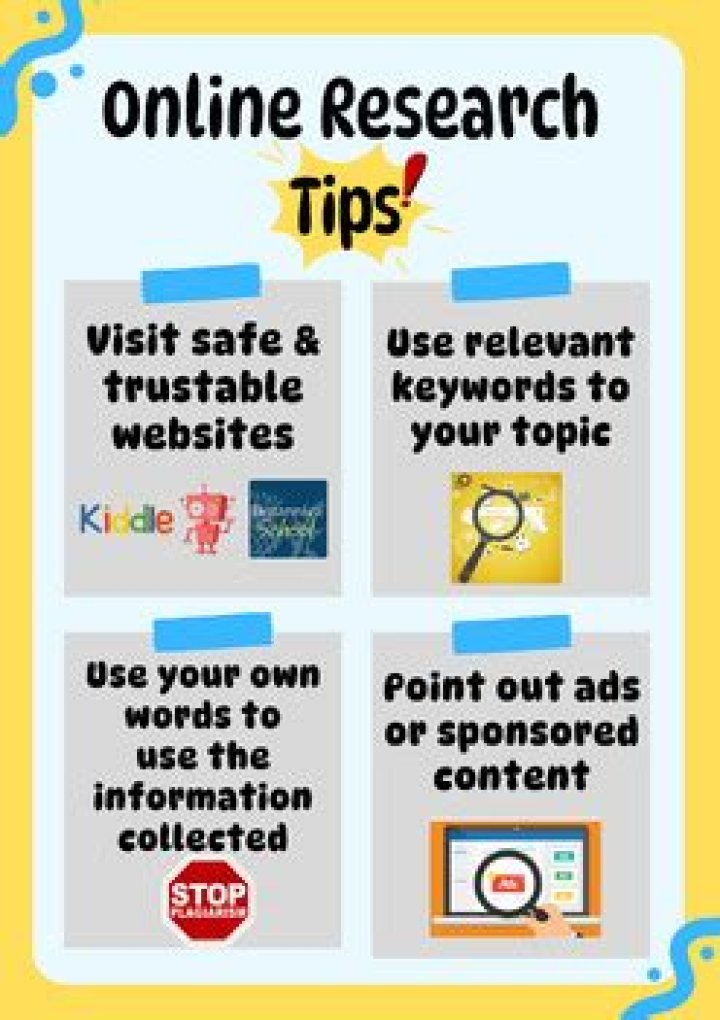
Going online to do research when you’re writing papers and doing projects is a no-brainer. But all of the choices at your fingertips can seem overwhelming sometimes. Knowing how to evaluate and choose online resources can help you avoid headaches and wasted time.
Here are 5 ways to make researching online as easy and effective as possible:
Start at school. Ask your teachers or librarian which resources they’d recommend for your project. That way you can be sure the resources are school approved and the information is accurate. In some cases, your school or teacher may have paid subscriptions to online journals or websites. These can give you information you wouldn’t get through a regular Internet search.
Unless your teacher says otherwise, using the Internet should be an additional tool, not your only tool for researching a topic. Your school library is full of books, magazines, and other resources to help you.
Many schools block access to images or websites that may be valuable to your research. So plan on spending some of your online research time at home or your local library, or anywhere else you have online access.
Sort fact from fiction. Before you begin your research, make a list of the kinds of sites that are best for your topic. Is the website reliable and up to date? Check to see if the author is identified and sources are cited. Government sites ending in .gov and educational sites ending in .edu usually are safe bets. Established news-related sites are OK, too, but be sure that you’re using the original source. If a newspaper article mentions another source, like an organization or website, go directly to that source to find the information.
Sites ending in .org are usually run by nonprofit organizations. They can be good resources, but it’s always best to check with your teacher to make sure he or she considers the site appropriate. Wikipedia.org is popular and ranks high in search results, but it can be edited by anyone, whether a person has accurate knowledge of the topic or not. At most schools, using Wikipedia as a source is not a good way to build credibility.
On commercial websites ending in .com, check to see if the site has advertising. If it does, it may be biased since it’s trying to sell a product. And blogs, personal websites, and social media sites (like YouTube, Digg, Tumblr, Pinterest, or Facebook) are more likely to give personal opinions rather than facts.
Search smart. Start with an established search engine, like Google or Bing. Although search engines often do a good job of guessing what you need, you will get better results when you use more specific terms. Try alternative searches with different words and use search operators, symbols, or advanced search to narrow your results. If you want to learn more ways to improve your searches, ask your teacher or librarian for guidance.
Many search engines are paid to place certain results as advertisements. Sometimes these ads show up at the top of the search result page. The ads will look different from the regular results (appearing on a shaded background, for example) and should be clearly marked as ads. Even when the top results aren’t ads, they still might not be the best possible choices. That’s why it helps to know the best sites for your needs (point #2 above).
Stay focused. When you’re ready to check out websites or go to search engines such as Google, stay focused on your research by logging off of social media and email (and turn off your phone!). If you need to take a break, make a note of where you are before you walk away from your computer. Taking a 5- or 10-minute break from the computer every hour works well for most people. Use the time to move around and stretch a bit.
Cite right. When you research online, it can be easy to copy and paste text, then forget to cite the source or go back and put the thought in your own words later. Just as teachers can recognize your voice in class, most can recognize your voice in your writing. Even accidental plagiarism can have serious consequences for your grades — so don’t take a chance. Identify the text you’ve quoted and add the citation before moving on to the rest of your paper. The format for citing online resources is different from print resources, so be sure to check the particular style your teacher wants you to use for Internet citations.
Course Description
“Basic Research Skills” teaches you how to determine what you need to know when you need to know it. With all of the information readily available today, it’s difficult to decipher good information from bad information. Instead of turning to an Internet search engine for all of your information, there are other sources that can help you learn what you need to learn – quickly and accurately. This course will cover library use, the Dewey Decimal System, dictionary use, thesaurus use, encyclopedias, Internet search engines, Internet news resources, Internet publications, journals, and bibliographies.
With this information, you can research any topic, no matter the purpose or the goal. Instead of simply looking in one place for the answer you need, why not learn how to use all of the tools available? The more you know, the more you can use this information in your everyday life.
“Basic Research Skills” includes real life strategies to help you learn where you need to look for information and how you can be certain the information is accurate.
Each of the 11 lessons include 5 True and False questions and 5 multiple choice questions at the end of each section. These questions are designed to ensure you retain the main concepts before you move onto a new lesson. In each lesson, you will learn what the selected research skill is, how to use it, and other tips as to how to improve your researching abilities.
With “Basic Research Skills,” you will be able to find information in a variety of ways, ensuring no question goes unanswered.
Your institution’s library provides access to plenty of online research databases. They are among the best sources to turn to when you need to find articles from scholarly journals and periodicals. Searching an online academic database is much like searching the internet, but the hits returned will be published scholarly articles. Academic databases are different from generic search engines though, and that’s why we have compiled a series of tips to get you started.
1. Use the campus network to access research databases
Most of the academic databases cannot be accessed for free! Your institution needs to buy access for staff and students, and that’s why you can only use them when you are on campus network. Nonetheless, there are services like EZProxy that allow you to also access your library’s resources from your home network. Check out our list of EZProxy connections to see if your institution provides such as service.
2. Find databases that are specifically related to your topic
It’s 2.5 million articles that are published EACH year. Make sure to search the right database, which is pertaining specifically to your topic, otherwise you will have to screen too many unrelated papers. Ask a librarian or check your library’s brief overview to which databases you have access to. If you do not know where to start, check out the three biggest academic database providers:
Or take a look at our compilation of research database for computer science or healthcare. Remember: Searching the right databases is key to finding the right articles!
3. Set up the search parameters within the database to be as narrow as possible
Start with one database. Narrow your search to get the most pertinent information. Determine which options are available to do that, for example narrowing the search by only including articles within a specific date range, or uncheck certain types of journals or magazines that are included in the database but have nothing to do with your topic. Make sure to also use very specific keywords when searching.
4. Find the tricks that help you get results
Unlike in a Google search, typing in full sentences will not bring you satisfactory results. There are different methods to search different databases. Ask your librarian or do an internet search on how to best search your particular database. Check out Northeastern’s Libguide on this.
5. Slowly expand your search to get additional results
The specific search might not return many results. This can be good because these results will most likely be current and applicable. If you do not get enough results, slowly start expanding date range, type of journal or keywords to get more results.
6. Use the pro features of the database
Databases are getting smart! In the age of big data and text mining many databases crunch millions of scientific papers to extract connections between them. Watch out for things like:
- related articles
- similar articles
- list of “cited by” or “citations”
- list of references
They all will lead you to other highly relevant scholarly articles!
7. If needed, you can move to another or more general database
When you have thoroughly finished searching a database, you can move on to another to find more results. Some databases that cover the same topics might give you the same search results, but they might also cover different journals or you might prefer the search system of one database over the other. You can also move to a more general database like
8. Notice the big players in your field
There are experts in every field, people who have published a lot on your topic, people who get quoted or interviewed a lot, and seem to be present almost everywhere when researching your particular topic. Pay attention to those names when searching a database and once you found someone interesting, you can search for more from that person.
Frequently Asked Questions about searching online databases
Where do I access academic databases?
Your institution’s library provides access to plenty of online research databases. They are among the best sources to turn to when you need to find articles from scholarly journals and periodicals.
What type of database should I access?
Searching the right databases is key to finding the right articles Ask a librarian or check your library’s brief overview to which databases you have access to. If you do not know where to start, check out the three biggest academic database providers:
Or take a look at our compilation of research database for computer science or healthcare. Remember:
How do I narrow down my online search?
Start with one database. Narrow your search to get the most pertinent information. Determine which options are available to do that, for example narrowing the search by only including articles within a specific date range, or uncheck certain types of journals or magazines that are included in the database but have nothing to do with your topic. Make sure to also use very specific keywords when searching.
What are the best tricks to an efficient online research?
Unlike in a Google search, typing in full sentences will not bring you satisfactory results. There are different methods to search different databases. Ask your librarian or do an internet search on how to best search your particular database. Check out Northeastern’s Libguide on this.
What if my online research has been unsuccessful?
Narrowing down a search might not return many results. If you do not get enough results, slowly start expanding date range, type of journal or keywords to get more results.
Everyone uses social media for various purposes. Some people look for information, some users try to find new friends, some individuals learn the news, and others try to develop their business on social media platforms. Speaking about academic writing, one should mention that it’s very important to find catching topics for research paper writing on social media. Topics like “what is social media” won’t surprise anyone. By the way, such a topic doesn’t lead to discussions and cannot raise provocative arguments.
20 Topics to Consider when Choosing a Social Media Research Theme
If you have to write a research paper on social media, you may choose one of the following topics.
- Social Media: a Perfect Platform to Develop Private Business
- Social Media or It Cuts Both Ways
- How Social Networks Make People to Commit a Suicide: Manipulating Games, Cyberbullying, and Virtual Games Leading to Cruelty
- How Schools Benefit and Lose when Letting Their Schoolchildren Use Social Media
- How do Social Networks Make a Person Addicted to Social Media and Can a Person Treat That Addiction?
- Should Parents Control Their Children’s Activity on Social Networks? Pros and Cons of Parents’ Hyperprotection
- Facebook and Twitter Save Lives: How Social Media Helps When Natural Disasters Occur
- The Danger behind the Profile: How Social Media “Assists” in Kidnapping and Assaults
- Social Media: Connecting and Disconnecting People
- Celebrities on Social Media or We Need Good PR
- Is Personal Data Protected on Social Media Platforms? Is It Possible to Avoid Government’s Monitoring?
- Looking for the Job on Facebook: Is It Safe or Not?
- Social Media Helps People Who Suffer from Various Diseases: How to Save a Person and Not to Become a Victim of Cheaters
- Human Values Before and After Social Media Creation
- I’m on Facebook Since My Birthday: Should the Government Impose Age Limitation Concerning Social Media Activity
- “Momo” and “Blue Whale Challenge”: What Games Should People Avoid When Browsing Social Media
- Does Social Media Spread or Kill Stereotyping?
- Can Social Media Help to Stop Racism and Nationalism?
- Social Media Fashion: Programs Which Help to Educate and Make Us Look and Feel Better
- Advertising and Spams: How to Recognize the Lie and Reality
A researcher should select a topic that deals with the up-to-date problem and offers new ways of its solution. Moreover, the topic has to be supported with strong facts so the paper is considered reliable and valid.
Try a quicker way
Sample Paper on Social Media: Generation Gap or What Parents Should Know about Social Media
It’s not a secret that there are people who prefer staying aside from social media. They either want to keep in secret their private life or just have no time to live active life online. As a result, parents often are not aware of what their children do on social networks and what danger is hidden behind the person’s profile. They also don’t know how a person can benefit from using social media platforms.
Children, especially, teenagers hate when their parents control their social accounts. Kids like to behave like adults and social networks help them feel independent. They post their photos, videos, comment things, get their likes, and choose people they want to communicate with. Parents’ mission is to protect their children. That’s why they often try to impose their points of view concerning the choice of friends. Consequently, parents quarrel with children and children apply various passwords trying to protect their virtual life.
There are things which parents should know about social networking. First, it’s necessary to learn its positive nature. Social media lets children find new people, learn languages, improve knowledge, solve their problems, enrich their outlook, and keep in touch with time requirements. Children can exchange personal experience. Students can warn their mates and tutors in case they feel unwell or need to miss classes. There are many social communities letting their users study, progress, and even earn money.
On the other hand, there are negative aspects of social networking. A great number of people use Facebook to kidnap and commit crimes. The problem of the Internet is that it lacks lucidity. One can upload pictures and videos which don’t belong to the owner and give false information about a person. For example, a senior man can pretend to be a teenager and try to date young girls. First, he “interviews” a girl. Then, he cozies up to the victim and, finally, asks her to spend some time with him tête-a-tête.
Burglars also like studying profiles on Facebook, LinkedIn, YouTube, and other social platforms on the Internet. They try to learn the information about possible victims. They learn their address, personal data, and follow their accounts to see when they plan traveling. Due to that, they can penetrate into the apartments and steal valuable things. Some criminals try to find prosperous families who have kids. They either kidnap kids and hold to ransom or leave them holding the bag making parents redeem them.
That’s why parents have to explain to their kids that it’s very dangerous to share personal information on social networks. Children should avoid publishing their intimate photos and meeting unknown people in private. By the way, they must not inform the Internet audience about plans for holidays. It’s better to post data afterward unless the apartments are not empty (for example, children went somewhere with their mother or teacher and their father stayed at home).
Where to look when you need information
- Tweet
- Share
Research websites come in handy in all kinds of situations, whether you’re looking for the average rainfall in the Amazon rainforest, researching Roman history, or just having fun learning to find information.
This list of the best research websites will help greatly, and most of them are updated daily with new information.
Learn how to organize your research to keep track of everything you gather online.
Best Research Websites
Depending on the type of research you’re doing or how you need to reference the information, you may need quick access to books. There are lots of places to download free books online, plus sites with free textbooks and free educational movies.
Other Ways to Do Research
Search engines like Google are a great way to perform online research. You can locate books, articles, interviews, and lots more. Learn how to search better to get the most out of your research.
Another top source of expert information is your local librarian. Librarians are trained to find answers to obscure questions, they’re friendly, and best of all, you can talk with them face to face. Librarians often ask you questions that you might not have considered, leading to even better results. You can get help from librarians online, too, through some of the sources above.
October 18, 2017
Journalists frequently contact us looking for research on a specific topic. While we have published a number of resources on how to understand an academic study and how to pick a good one — and why using social science research enriches journalism and public debate — we have little on the mechanics of how to search. This tip sheet will briefly discuss the resources we use.
Google Scholar
Let’s say we’re looking for papers on the opioid crisis. We often start with Google Scholar, a free service from Google that searches scholarly articles, books and documents rather than the entire web: scholar.google.com.
But a search for the keyword “opioids” returns almost half a million results, some from the 1980s. Let’s narrow down our search. On the left, you see options “anytime” (the default), “since 2013,” “since 2016,” etc. Try “since 2017” and the results are now about 17,000. You can also insert a custom range to search for specific years. And you can include patents or citations, if you like (unchecking these will slightly decrease the number of results).
Still too many results. To narrow the search further, try any trick you’d use with Google. (Here are some tips from MIT on how to supercharge your Google searches.) Let’s look for papers on opioids published in 2015 that look at race and exclude fentanyl (Google: “opioids +race -fentanyl”). Now we’re down to 2,750 results. Better.
Unless you tell Google to “sort by date,” the search engine will generally weight the papers that have been cited most often so you will see them first.
Try different keywords. If you’re looking for a paper that studies existing research, include the term “meta-analysis.” Try searching by the author’s name, if you know it, or title of the paper. Look at the endnotes in papers you like for other papers. And look at the papers that cited the paper you like; they’ll probably be useful for your project.
Paywalls
If you locate a study and it’s behind a paywall, try these steps:
- Click on “all versions.” Some may be available for free. (Though check the date, as this may include earlier drafts of a paper.)
- Reach out to the journal and the scholar. (The scholar’s email is often on the abstract page. Also, scholars generally have an easy-to-find webpage.) One is likely to give you a free copy of the paper, especially if you are a member of the press.
- In regular Google, search for the study by title and you might find a free version.
More tips on using Google Scholar from MIT and Google.
Other databases
- PubMed Central at the National Library of Medicine: If you are working on a topic that has a relationship to health, try this database run by the National Institutes of Health. This free site hosts articles or abstracts and links to free versions of a paper if they are available. Often Google Scholar will point you here.
- If you have online access to a university library or a local library, try that.
- Directory of Open Access Journals.
- Digital Public Library of America.
- Subscription services include org and Web of Science.
For more on efforts to make scholarly research open and accessible for all, check out SPARC, a coalition of university libraries.
Citations as a measure of impact
How do you know if a paper is impactful? Some scholars use the number of times the paper has been cited by other scholars. But that can be problematic: Some papers cite papers that are flawed simply to debunk them. Some topics will be cited more often than others. And new research, even if it’s high-quality, may not be cited yet.
The impact factor measures how frequently a journal, not a paper, is cited.
This guide from the University of Illinois, Chicago, has more on metrics.
What else?
Here’s a useful source of new papers curated by Boston Globe columnist Kevin Lewis for National Affairs.
Another way to monitor journals for new research is to set up an RSS reader like Feedly. Most journals have a media page where you can sign up for press releases or newsletters featuring the latest research.
Relevant tip sheets from Journalist’s Resource:
We welcome feedback. Please contact us here.
It can be frustrating to conduct online research because internet sources can be quite unreliable. If you find an online article that provides relevant information for your research topic, you should take care to investigate the source to make sure it is valid and reliable. This is an essential step in maintaining sound research ethics.
It is your responsibility as a researcher to find and use trustworthy sources.
Methods to Investigate Your Source
Investigate the Author
In most cases, you should stay away from internet information that doesn’t provide the name of an author. While the information contained in the article may be true, it is more difficult to validate information if you don’t know the credentials of the author.
If the author is named, find their website to:
- Verify educational credits
- Discover if the writer is published in a scholarly journal
- See if the writer has published a book from a university press
- Verify that the writer is employed by a research institution or university
Observe the URL
If the information is linked to an organization, try to determine the reliability of the sponsoring organization. One tip is the URL ending. If the site name ends with .edu, it is most likely an educational institution. Even so, you should be aware of political bias.
If a site ends in .gov, it is most likely a reliable government website. Government sites are usually good sources for statistics and objective reports.
Sites that end in .org are usually non-profit organizations. They can be very good sources or very poor sources, so you’ll have to take care to research their possible agendas or political biases if they exist.
For instance, collegeboard.org is the organization that provides the SAT and other tests. You can find valuable information, statistics, and advice on that site. PBS.org is a non-profit organization that provides educational public broadcasts. It provides a wealth of quality articles on its site.
Other sites with the .org ending are advocacy groups that are highly political. While it is entirely possible to find reliable information from a site like this, be mindful of the political slant and acknowledge this in your work.
Online Journals and Magazines
A reputable journal or magazine should contain a bibliography for every article. The list of sources within that bibliography should be pretty extensive, and it should include scholarly non-Internet sources. Check for statistics and data within the article to back up the claims made by the author. Does the writer provide evidence to support his statements? Look for citations of recent studies, perhaps with footnotes and see if there are primary quotes from other relevant experts in the field.
News Sources
Every television and print news source has a website. To some extent, you can rely on the most trusted news sources such as CNN and the BBC, but you should not rely on them exclusively. After all, network and cable news stations are involved in entertainment. Think of them as a stepping stone to more reliable sources.
Research-Based Writing
What is a research question?
A research question is the question around which you center your research. It should be:
- clear: it provides enough specifics that one’s audience can easily understand its purpose without needing additional explanation.
- focused: it is narrow enough that it can be answered thoroughly in the space the writing task allows.
- concise: it is expressed in the fewest possible words.
- complex: it is not answerable with a simple “yes” or “no,” but rather requires synthesis and analysis of ideas and sources prior to composition of an answer.
- arguable: its potential answers are open to debate rather than accepted facts.
You should ask a question about an issue that you are genuinely curious and/or passionate about.
The question you ask should be developed for the discipline you are studying. A question appropriate for Biology, for instance, is different from an appropriate one in Political Science or Sociology. If you are developing your question for a course other than first-year composition, you may want to discuss your ideas for a research question with your professor.
Why is a research question essential to the research process?
Research questions help writers focus their research by providing a path through the research and writing process. The specificity of a well-developed research question helps writers avoid the “all-about” paper and work toward supporting a specific, arguable thesis.
Steps to developing a research question:
- Choose an interesting general topic. Most professional researchers focus on topics they are genuinely interested in studying. Writers should choose a broad topic about which they genuinely would like to know more. An example of a general topic might be “Slavery in the American South” or “Films of the 1930s.”
- Do some preliminary research on your general topic. Do a few quick searches in current periodicals and journals on your topic to see what’s already been done and to help you narrow your focus. What issues are scholars and researchers discussing, when it comes to your topic? What questions occur to you as you read these articles?
- Consider your audience. For most college papers, your audience will be academic, but always keep your audience in mind when narrowing your topic and developing your question. Would that particular audience be interested in the question you are developing?
- Start asking questions. Taking into consideration all of the above, start asking yourself open-ended “how” and “why” questions about your general topic. For example, “Why were slave narratives effective tools in working toward the abolishment of slavery?” or “How did the films of the 1930s reflect or respond to the conditions of the Great Depression?”
- Evaluate your question. After you’ve put a question or even a couple of questions down on paper, evaluate these questions to determine whether they would be effective research questions or whether they need more revising and refining.
- Is your research question clear? With so much research available on any given topic, research questions must be as clear as possible in order to be effective in helping the writer direct his or her research.
- Is your research question focused? Research questions must be specific enough to be well covered in the space available.
- Is your research question complex? Research questions should not be answerable with a simple “yes” or “no” or by easily-found facts. They should, instead, require both research and analysis on the part of the writer. They often begin with “How” or “Why.”
- Begin your research. After you’ve come up with a question, think about the possible paths your research could take. What sources should you consult as you seek answers to your question? What research process will ensure that you find a variety of perspectives and responses to your question?
Sample Research Questions
Unclear: How should social networking sites address the harm they cause?
Clear: What action should social networking sites like MySpace and Facebook take to protect users’ personal information and privacy?
The unclear version of this question doesn’t specify which social networking sites or suggest what kind of harm the sites might be causing. It also assumes that this “harm” is proven and/or accepted. The clearer version specifies sites (MySpace and Facebook), the type of potential harm (privacy issues), and who may be experiencing that harm (users). A strong research question should never leave room for ambiguity or interpretation.
Unfocused: What is the effect on the environment from global warming?
Focused: What is the most significant effect of glacial melting on the lives of penguins in Antarctica?
The unfocused research question is so broad that it couldn’t be adequately answered in a book-length piece, let alone a standard college-level paper. The focused version narrows down to a specific effect of global warming (glacial melting), a specific place (Antarctica), and a specific animal that is affected (penguins). It also requires the writer to take a stance on which effect has the greatest impact on the affected animal. When in doubt, make a research question as narrow and focused as possible.
Too simple: How are doctors addressing diabetes in the U.S.?
Appropriately Complex: What main environmental, behavioral, and genetic factors predict whether Americans will develop diabetes, and how can these commonalities be used to aid the medical community in prevention of the disease?
The simple version of this question can be looked up online and answered in a few factual sentences; it leaves no room for analysis. The more complex version is written in two parts; it is thought provoking and requires both significant investigation and evaluation from the writer. As a general rule of thumb, if a quick Google search can answer a research question, it’s likely not very effective.
Published on April 15, 2019 by Shona McCombes. Revised on January 8, 2020.
A research problem is a specific issue, difficulty, contradiction, or gap in knowledge that you will aim to address in your research. You might look for practical problems aimed at contributing to change, or theoretical problems aimed at expanding knowledge.
Bear in mind that some research will do both of these things, but usually the research problem focuses on one or the other. The type of research problem you choose depends on your broad topic of interest and the type of research you want to do.
This article helps you identify and refine a research problem. When writing your research proposal or introduction, you will have to formulate it as a problem statement and/or research questions.
Table of contents
- Why is the research problem important?
- Identify a broad problem area
- Learn more about the problem
Why is the research problem important?
Your topic is interesting and you have lots to say about it, but this isn’t a strong enough basis for academic research. Without a well-defined research problem, you are likely to end up with an unfocused and unmanageable project.
You might end up repeating what other people have already said, trying to say too much, or doing research without a clear purpose and justification. You need a problem in order to do research that contributes new and relevant insights.
Whether you’re planning your thesis, starting a research paper or writing a research proposal, the research problem is the first step towards knowing exactly what you’ll do and why.
Step 1: Identify a broad problem area
As you discuss and read about your topic, look for under-explored aspects and areas of concern, conflict or controversy. Your goal is to find a gap that your research project can fill.
Practical research problems
If you are doing practical research, you can identify a problem by reading reports, following up on previous research, and talking to people who work in the relevant field or organization. You might look for:
- Issues with performance or efficiency in an organization
- Processes that could be improved in an institution
- Areas of concern among practitioners in a field
- Difficulties faced by specific groups of people in society
If your research is connected to a job or internship, you will need to find a research problem that has practical relevance for the organization.
Examples of practical research problems
Voter turnout in region X has been decreasing, in contrast to the rest of the country.
Department A of Company B has a high staff turnover rate, affecting productivity and team cohesion.
Non-profit organization Y faces a funding gap that means some of its programs will have to be cut.
Theoretical research problems
Theoretical research focuses on expanding knowledge and understanding rather than directly contributing to change. You can identify a research problem by reading recent research, theory and debates on your topic to find a gap in what is currently known about it. You might look for:
- A phenomenon or context that has not been closely studied
- A contradiction between two or more perspectives
- A situation or relationship that is not well understood
- A troubling question that has yet to be resolved
Theoretical problems often have practical consequences, but they are not focused on solving an immediate issue in a specific place (though you might take a case study approach to the research).
Examples of theoretical research problems
The effects of long-term Vitamin D deficiency on cardiovascular health are not well understood.
The relationship between gender, race and income inequality has yet to be closely studied in the context of the millennial gig economy.
Historians of Scottish nationalism disagree about the role of the British Empire in the development of Scotland’s national identity.
What is your plagiarism score?
Compare your paper with over 60 billion web pages and 30 million publications.
- Best plagiarism checker of 2020
- Plagiarism report & percentage
- Largest plagiarism database
Step 2: Learn more about the problem
Next, you have to find out what is already known about the problem, and pinpoint the exact aspect that your research will address.
Context and background
- Who does the problem affect?
- Has it been an issue for a long time, or is it a newly discovered problem?
- What research has already been done?
- Have any solutions been proposed?
- What are the current debates about the problem, and what do you think is missing from them?
Specificity and relevance
- What particular place, time and/or people will you focus on?
- What aspects will you not be able to tackle?
- What will be the consequences if the problem is not resolved?
- Whose will benefit from resolving the problem (e.g. the management of an organization or future researchers)?
Example of a specific research problem
Non-profit organization X has been focused on retaining its existing support base, but lacks understanding of how best to target potential new donors. To be able to continue its work, the organization requires research into more effective fundraising strategies.
When you have narrowed down your problem, the next step is to formulate a problem statement and research questions or hypotheses.