To change the formatting of the bullets or numbers in a list, click any bullet or number to select all the bullets or numbers in the list. If you select the text, the formatting of both the text and the bullets or numbering changes.
Choose a new bullet or numbering format
Click a bullet or number in the list that you want to change.
In a multiple-level list, you can change the formatting one level at a time by clicking one bullet or number at that level in the list.
On the Home tab, under Paragraph, click the arrow next to Bullets or Numbering.
Click the bullet or numbering list format that you want in the Bullet Library or the Numbering Library.
Define a new bullet character, font, or picture
Bullets shown in the bullet library are a subset of the Word font libraries. This means you can choose a different character for your bullets. For example, you can change your dot bullets to arrows or even something like a Euro or Dollar character. You can also use an image either found through the internet, or on your computer.
Click a bullet in a list to select all the bullets.
Click the down arrow next to the bullet icon. .
At the bottom of the pop up panel, click Define New Bullet.
In the Define New Bullet panel, do one of the following:
To change or add a character, click Symbol. From the symbol library, choose a character and click OK.
To change the font attributes after picking a new character, click Font. Change the style, size, and font, and then click OK.
To add a picture, click Picture. In the Insert Pictures window, click either From a file for images on your computer, or Bing Image Search to find a picture online.
Choose the image you want to use from your computer, or a Bing search, and then click Open or Insert.
If your new bullets look good in the Preview, then click OK.
Change the font format, color, or size for bullets or numbers in a list
Bullet and number fonts, colors, and size are all controlled by the Font attributes. You can change the text formatting of bullets or numbers in a list without making changes to the text in the list. For example, you can format numbers or bullets with a different font color than the text in the list.
Click a bullet or number in a list.
All the bullets or numbers in the list are selected.
On the Home tab, in the Font group, make the changes that you want.
For example, click the arrow next to Font Color, and then click the color that you want.
You can easily change the level of a list item.
Click the bullet or number that has moved out of position.
On the Home tab, under Paragraph, click the arrow next to Bullets or Numbering.
Point to Change List Level, and then click the level that you want.
Click a bullet or number in the list that you want to change.
By clicking a bullet or number in an automatically recognized bulleted or numbered list, you select the entire list.
On the Home tab, in the Paragraph group, click Bullets or Numbering.
To change the list back, click either Bullets or Numbering .
A multilevel list shows the list items at several levels rather than at one level.
Click a bullet or number in the list at the level that you want to change.
By clicking a bullet or number in an automatically recognized bulleted or numbered list, you select all of the list items that are at that particular level.
To convert the entire multilevel list to bullets or numbers, select the entire list.
On the Home tab, in the Paragraph group, click Bullets or Numbering.
To change the list back, click Bullets or Numbering .
Related topics
We’re listening!
Updated May 11, 2017 thanks to customer feedback.
Was this article helpful? If so, please let us know at the bottom of this page. If it wasn’t helpful, let us know what was confusing or missing. Please include your Word and Operating System versions you’re using. We’ll use your feedback to double-check the facts, add info, and update this article.
Microsoft Word by default automatically changes some special symbols with the followed space, if you type them in the first position of the line, to the bulleted lists. Some examples:
| Symbol with the followed space | Bulleted list |
|---|---|
| – | |
| * | |
| > | |
| -> | |
| => |
Microsoft Word by default automatically changes some symbols with the followed point or closing parenthesis and space, if you type them in the first position of the line, to the numbered lists. Some examples:
| Symbols with the followed point or closing parenthesis and space | Numbered list |
|---|---|
| 1. or 1) – any digit | or |
| I. or I) as Roman numeric | or |
| i. or i) as Roman numeric | or |
| A. or A) – any capital letter | or |
| a. or a) – any letter | or |
To turn off automatic creation of the bulleted or numbered lists in Word, do the following:
1. On the File tab click Options to open Word Options dialog box:
2. In the Word Options dialog box, choose the Proofing tab, and then click the AutoCorrect Options. button:
3. In the AutoCorrect dialog box, on the AutoFormat As You Type tab:
- To turn off automatic creation of bulleted or numbered lists, uncheck the appropriate checkboxes,
- To turn on automatic creation of bulleted or numbered lists, check the appropriate checkboxes.
If you have any questions or suggestions, please feel free to ask OfficeToolTips team.
Creating numbered lists
Creating bulleted lists
Create lists with AutoFormat or turn it off
We use cookies to personalise content and ads, to provide social media features and to analyse our traffic. We also share information about your use of our site with our social media, advertising and analytics partners who may combine it with other information you’ve provided to them or they’ve collected from your use of their services.
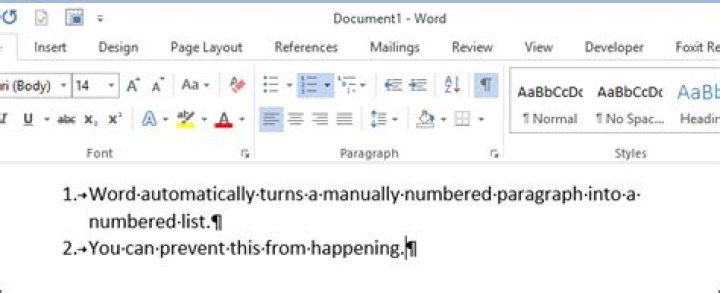
- At the beginning of a paragraph, type a number, a separator, and then a space or tab. For example, type 1. and then a space or press Tab. Word automatically changes the paragraph into part of a numbered list:
You can turn off AutoFormat creation of numbered and bulleted lists. Follow these steps:
1. On the File tab, click the Options button:
2. Choose the Proofing tab, and then click the AutoCorrect Options. button:
3. In the AutoCorrect dialog box, choose the AutoFormat As You Type tab, clear the Automatic bulleted lists check box and the Automatic numbered lists check box:
If you have any questions or suggestions, please feel free to ask OfficeToolTips team.
How to turn off automatic creation of bulleted and numbered lists
Creating numbered lists
Tabulation or next level in the numbered list
We use cookies to personalise content and ads, to provide social media features and to analyse our traffic. We also share information about your use of our site with our social media, advertising and analytics partners who may combine it with other information you’ve provided to them or they’ve collected from your use of their services.
Microsoft Word by default automatically changes some special symbols with the followed space, if you type them in the first position of the line, to the bulleted lists. Some examples:
| Symbol with the followed space | Bulleted list |
|---|---|
| – | |
| * | |
| > | |
| -> | |
| => |
Microsoft Word by default automatically changes some symbols with the followed point or closing parenthesis and space, if you type them in the first position of the line, to the numbered lists. Some examples:
| Symbols with the followed point or closing parenthesis and space | Numbered list |
|---|---|
| 1. or 1) – any digit | or |
| I. or I) as Roman numeric | or |
| i. or i) as Roman numeric | or |
| A. or A) – any capital letter | or |
| a. or a) – any letter | or |
To turn off automatic creation of the bulleted or numbered lists in Word, do the following:
1. On the File tab click Options to open Word Options dialog box:
2. In the Word Options dialog box, choose the Proofing tab, and then click the AutoCorrect Options. button:
3. In the AutoCorrect dialog box, on the AutoFormat As You Type tab:
- To turn off automatic creation of bulleted or numbered lists, uncheck the appropriate checkboxes,
- To turn on automatic creation of bulleted or numbered lists, check the appropriate checkboxes.
If you have any questions or suggestions, please feel free to ask OfficeToolTips team.
Create lists with AutoFormat or turn it off
Creating numbered lists
Customizing numbered lists
We use cookies to personalise content and ads, to provide social media features and to analyse our traffic. We also share information about your use of our site with our social media, advertising and analytics partners who may combine it with other information you’ve provided to them or they’ve collected from your use of their services.
One of the automatic formatting features included with Word is automatic bulleted lists. When you enter some text that Word thinks should be a bulleted list, and then press Enter, Word formats the paragraph with a hanging indent and places a bullet at the beginning of it. In addition, Word assumes the next paragraph will be part of the same bulleted list.
For instance, if you type an asterisk, press the Space Bar or the Tab key, and then type your text, when you press Enter, Word formats the paragraph as a bulleted list. If you didn’t want the paragraph to be a bulleted list, you can cancel the formatting done by Word by immediately pressing Ctrl+Z. If the automatic formatting bothers you a lot, you can follow these steps to turn it off:
- Choose AutoCorrect from the Tools menu. (In Word 2003 you choose AutoCorrect Options from the Tools menu.) Word displays the AutoCorrect dialog box.
- Make sure the AutoFormat As You Type tab is selected. (See Figure 1.)
Figure 1. The AutoFormat As You Type tab of the AutoCorrect dialog box
WordTips is your source for cost-effective Microsoft Word training. (Microsoft Word is the most popular word processing software in the world.) This tip (602) applies to Microsoft Word 97, 2000, 2002, and 2003. You can find a version of this tip for the ribbon interface of Word (Word 2007 and later) here: Turning Off Automatic Bulleted Lists.
Author Bio
With more than 50 non-fiction books and numerous magazine articles to his credit, Allen Wyatt is an internationally recognized author. He is president of Sharon Parq Associates, a computer and publishing services company. Learn more about Allen.
Lori KaufmanLori Kaufman
Writer
Lori Kaufman is a technology expert with 25 years of experience. She’s been a senior technical writer, worked as a programmer, and has even run her own multi-location business. Read more.
Changing the type of numbers used in a numbered list is easy, but what if you want to change the formatting on just the numbers–say, make the numbers bold, but not the text? It’s not obvious how to do that, but it can be done.
This trick works on both numbered and bulleted lists.
The formatting for a number in a numbered list is contained in the paragraph mark at the end of that item. So, before you change the formatting of the numbers on a numbered list, you need to show the paragraph marks in your document. Click the “Home” tab and then click the “Show/Hide ¶” button in the Paragraph section.
To change the formatting for one number in the list, select only the paragraph mark at the end of that item.
Then, you can apply formatting to that paragraph mark, and the number.
For example, we made the number on the first item red and bold in our example.
If you want to change the formatting for more than one number, but not all of them, hold down the Ctrl key while you select the paragraph marks for the numbers you want to change. Then, apply the desired formatting.
If you want to change the formatting for all the numbers in the list, put the cursor directly over one of the numbers in the list and click. All the numbers in the list are selected. Apply the formatting as usual.
When you apply formatting to the items in the list, that formatting is also applied to the numbers. But, the formatting you applied only to the numbers is also kept. For example, if we select the items in the list in the our example and apply italics, the text of the items will be italic, but the numbers will now be red, bold, and italic. If you remove formatting applied to the items in the list, the formatting you applied to just the numbers remains.
To remove the formatting specific to the numbers, follow these steps again to select one of the numbers or multiple numbers and turn off the formatting.
- › How to Add Images to Questions in Google Forms
- › How to Delete Your Photos on Facebook
- › Razer Thinks You Want a PC Gaming Headset That Vibrates
- › How to Get a Link to a Photo or Video on Instagram
- › The Fix for Slow AMD Processors on Windows 11 Is Here
Lori Kaufman
Lori Kaufman is a technology expert with 25 years of experience. She’s been a senior technical writer, worked as a programmer, and has even run her own multi-location business.
Read Full Bio »
One of the ways in which Word tries to help you create documents faster is by automatically applying formatting to your document, based on what you type. One incarnation of this feature is seen when Word creates automatic numbered lists for you. When you enter some text that Word thinks should be a numbered list, and then press Enter, Word formats the paragraph with a hanging indent and places an appropriate number at the beginning of it. In addition, Word assumes the next paragraph will be part of the same numbered list.
For instance, if you type a number or letter, a period, and then the Space Bar or the Tab key, and then type your text, when you press Enter, Word formats the paragraph as a numbered list. If you didn’t want the paragraph to be a numbered list item, you can cancel the formatting done by Word by immediately pressing Ctrl+Z after the automatic formatting is applied. If the automatic formatting bothers you a lot, you can follow these steps:
- Choose AutoCorrect from the Tools menu. (In Word 2002 or Word 2003 choose AutoCorrect Options from the Tools menu.) Word displays the AutoCorrect dialog box.
- Make sure the AutoFormat As You Type tab is selected. (See Figure 1.)
Figure 1. The AutoFormat As You Type tab of the AutoCorrect dialog box.
WordTips is your source for cost-effective Microsoft Word training. (Microsoft Word is the most popular word processing software in the world.) This tip (67) applies to Microsoft Word 97, 2000, 2002, and 2003. You can find a version of this tip for the ribbon interface of Word (Word 2007 and later) here: Turning Off Automatic Numbered Lists.
Author Bio
With more than 50 non-fiction books and numerous magazine articles to his credit, Allen Wyatt is an internationally recognized author. He is president of Sharon Parq Associates, a computer and publishing services company. Learn more about Allen.
One of the automatic formatting features included with Word is automatic bulleted lists. When you enter some text that Word thinks should be a bulleted list, and then press Enter, Word formats the paragraph with a hanging indent and places a bullet at the beginning of it. In addition, Word assumes the next paragraph will be part of the same bulleted list.
For instance, if you type an asterisk, press the Space Bar or the Tab key, and then type your text, when you press Enter, Word formats the paragraph as a bulleted list. If you didn’t want the paragraph to be a bulleted list, you can cancel the formatting done by Word by immediately pressing Ctrl+Z. If the automatic formatting bothers you a lot, you can follow these steps to turn it off:
- Display the Word Options dialog box. (In Word 2007 click the Office button and then click Word Options. In Word 2010 or a later version, display the File tab of the ribbon and then click Options.)
- Click Proofing at the left side of the dialog box, and then click AutoCorrect Options. Word displays the AutoCorrect dialog box.
- Make sure the AutoFormat As You Type tab is displayed. (See Figure 1.)
Figure 1. The AutoFormat As You Type tab of the AutoCorrect dialog box.
WordTips is your source for cost-effective Microsoft Word training. (Microsoft Word is the most popular word processing software in the world.) This tip (11813) applies to Microsoft Word 2007, 2010, 2013, 2016, 2019, and Word in Office 365. You can find a version of this tip for the older menu interface of Word here: Turning Off Automatic Bulleted Lists.
Author Bio
With more than 50 non-fiction books and numerous magazine articles to his credit, Allen Wyatt is an internationally recognized author. He is president of Sharon Parq Associates, a computer and publishing services company. Learn more about Allen.
Not only the Bullet symbol can be used for the bulleted lists. As bullets can also be used several regular symbols, such as * (asterisk), – (hyphen), and . – (period). Historically, the Checkmark or Tick symbol and the Index symbol (representing a hand with a pointing index finger) were famous for similar uses.
Create a bulleted list using the keyboard (using AutoCorrect)
Microsoft Word, by default, automatically changes some special symbols with the followed space if you type them in the first position of the line to the bulleted lists. Some examples:
| Symbol with the followed space | Bulleted list |
|---|---|
| – | |
| * | |
| > | |
| -> | |
| => |
To create a bulleted list, just type the appropriate symbols with the followed space:
Note: If Word doesn’t automatically change these symbols, check the AutoCorrect setting for lists (see How to turn off the automatic creation of bulleted and numbered lists).
Create a bulleted list using the mouse
To create a bulleted list, follow the next steps:
1. Type your list, and then select it.
2. Do one of the following:
- On the Home tab, in the Paragraph group, click the Bullets button:
Word creates the bulleted list with the last used bullet symbol or with the bullet symbol , used by default. You can find different bullet symbols by clicking the arrow next to Bullets:
Choose any of the pre-defined symbols, or define the custom bullet. See customizing bulleted lists for more details.
3. To add additional bulleted items to your list, move the insertion point to the end of a line formatted with a bullet symbol and press Enter:
4. Move the insertion point to the end of the last bulleted item on your list. Press Enter and then Del, or press Enter and click the Bullets button again on the Home tab, in the Paragraph group, to turn off the formatting:
Note: More details are available in the Bulleted lists section in the Work with bulleted, numbered and multi-level lists lesson of the Create basic documents free course.
If you have any questions or suggestions, please feel free to ask OfficeToolTips team.
Creating numbered lists
How to turn off automatic creation of bulleted and numbered lists
Customizing bulleted lists
We use cookies to personalise content and ads, to provide social media features and to analyse our traffic. We also share information about your use of our site with our social media, advertising and analytics partners who may combine it with other information you’ve provided to them or they’ve collected from your use of their services.